
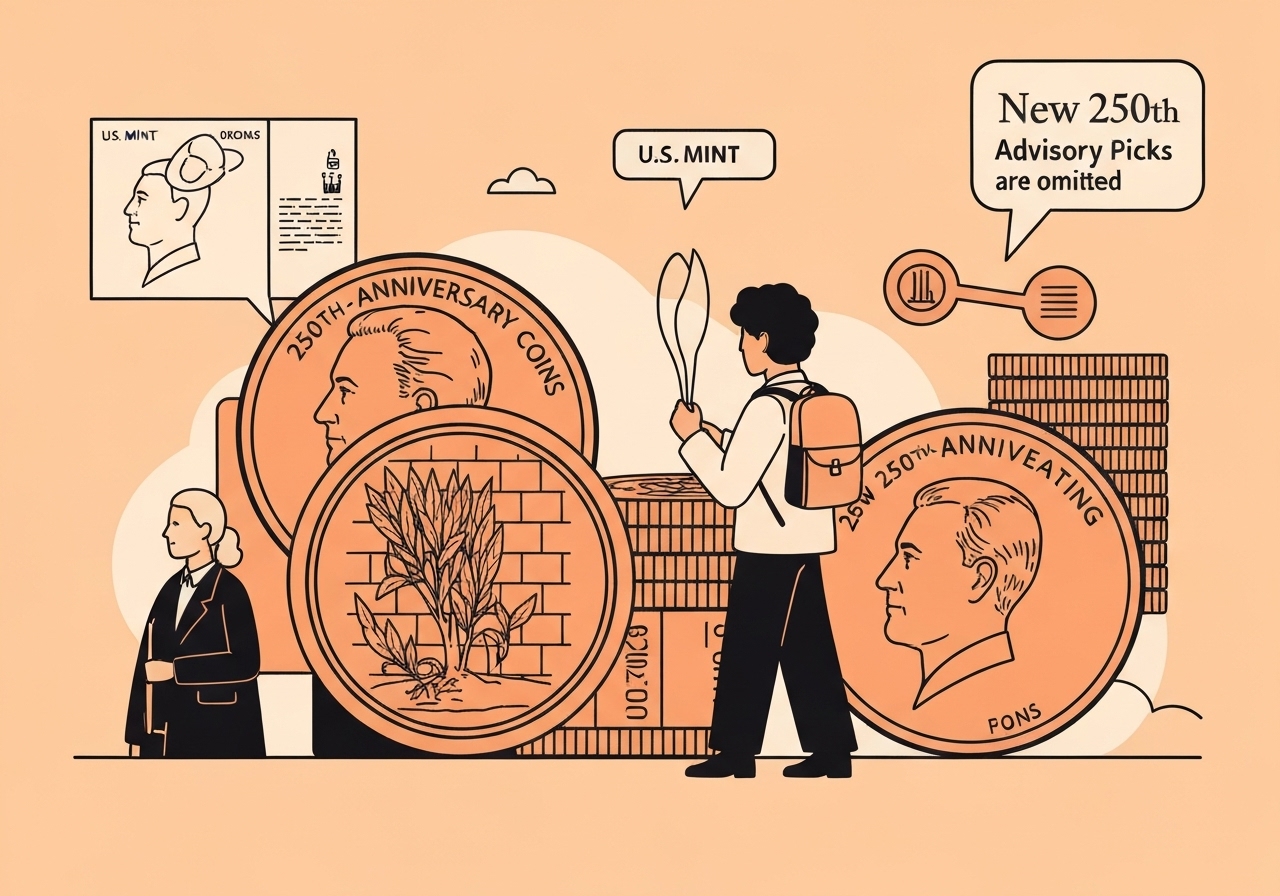
On Jan. 5, 2026, the U.S. Mint began circulating redesigned coins commemorating the nation’s 250th anniversary, after Treasury Secretary Scott Bessent approved a set of motifs that depart from the recommendations of a citizen advisory panel. The released designs feature pilgrims and early presidents — including George Washington, Thomas Jefferson and James Madison — while committee proposals honoring figures such as Frederick Douglass, Ruby Bridges and the 19th Amendment were not selected. The Mint has also proposed, for the first time in modern practice, a $1 coin bearing the image of the sitting president, Donald Trump, a move that has prompted criticism from lawmakers and some committee members. The choices and the process have sparked debate about tradition, symbolism and who is represented in the public commemoration of the semiquincentennial.
Key Takeaways
- The commemorative program was authorized by Congress in 2021 and launched in advance of the 2026 semiquincentennial; coins began circulating on Jan. 5, 2026.
- The Treasury-approved designs feature the Mayflower Compact, Revolutionary War themes and the Gettysburg Address, and depict early presidents including Washington, Jefferson and Madison.
- The Citizens Coinage Advisory Committee (CCAC) recommended five quarter designs, including Frederick Douglass, a 19th Amendment design for women’s suffrage and a Ruby Bridges motif, all of which were set aside by the Treasury Secretary.
- Treasury Secretary Scott Bessent made the final selections after review by the CCAC or the Commission of Fine Arts, according to the Mint; one CCAC member, Donald Scarinci, publicly boycotted the unveiling.
- The Mint has floated producing a $1 circulating coin with President Donald Trump’s likeness, which would be an unprecedented modern break from the U.S. tradition of not putting sitting presidents on circulating coinage.
- Nine Democratic senators have urged the Treasury to reject a Trump $1 coin, warning it could create an appearance of a “cult of personality.”
Background
Congress authorized a special coin program in 2021 to mark the United States’ 250th anniversary, setting in motion a multi-year design effort ahead of the 2026 semiquincentennial. That process included public outreach, focus groups and formal reviews by advisory bodies intended to surface a range of designs that reflect both the founding moment and subsequent struggles to expand American ideals. The Citizens Coinage Advisory Committee, a long-standing citizen panel, compiled and voted on design recommendations; Donald Scarinci, a CCAC member for about 20 years, has described the committee’s deliberations as regionally and politically diverse by design.
U.S. coinage has long informal norms about imagery: historically the United States avoided placing living leaders on circulating coins, a practice rooted partly in the republican rejection of monarchical symbolism. George Washington’s portrait did not appear on a circulating coin until 1932, more than a century after his death, and contemporary curators and historians note that placing a sitting head of state on widely used money would be a notable precedent. That history frames current objections to a proposed $1 coin with a living president’s visage.
Main Event
The Mint’s new quarter series was unveiled in early January 2026 after months of internal review and external consultation. Treasury Secretary Scott Bessent selected the final set of designs; a Mint spokeswoman said each choice had been reviewed at some point by either the CCAC or the Commission of Fine Arts. Still, multiple CCAC recommendations — including designs featuring Frederick Douglass, a 19th Amendment theme and a depiction of 6‑year‑old Ruby Bridges — were omitted from the final rollout.
At the public unveiling, Scarinci said the CCAC had seen many of the final designs only recently and that he would boycott the ceremony in protest of decisions that, he argued, sidelined civil‑rights and suffrage themes the committee had prioritized. The Treasury maintained that the statutory process had been followed and that the chosen motifs reflect certain historical threads the department wished to highlight during the anniversary year.
Separately, the Mint has proposed issuing a circulating $1 coin bearing the portrait of President Donald Trump, a proposal described by the Mint as part of the anniversary options under consideration. That proposal departs from modern practice and has drawn criticism from some lawmakers and numismatic experts, who say it would be a sharp break from longstanding norms against depicting living presidents on circulating coinage.
Analysis & Implications
The Treasury’s design choices shift the narrative of the semiquincentennial toward early colonial and Revolutionary symbolism rather than centering more contemporary struggles to realize the founding promises. This has immediate symbolic implications: coinage is durable, widely seen and taught as part of civic life, so which stories are minted becomes part of the public record for generations. Omitting Frederick Douglass and Ruby Bridges from the initial circulation lineup narrows those visible narratives at a moment when many institutions are reexamining how national history is commemorated.
Putting a living, sitting president on a circulating coin would set a modern precedent that policymakers and historians warn could blur lines between civic commemoration and political messaging. Legal barriers are limited — Congress authorizes coin programs and the Treasury implements them — but norms and political reactions matter: the letter from nine Democratic senators shows concrete legislative pushback that could influence Treasury decisions or prompt congressional oversight.
Practically, the controversy could affect public trust in the Mint’s advisory processes. The CCAC and the Commission of Fine Arts exist to provide expertise and public input; when their recommendations are overruled without extensive public explanation, the perception of a closed decision‑making process increases. That may lead to calls for clearer rules about how advisory input is used and for greater transparency in future commemorative programs.
Comparison & Data
| CCAC Recommendation | Intended Theme | Final Treasury Selection |
|---|---|---|
| Frederick Douglass | Abolition and the fight to end slavery | Mayflower Compact (pilgrim theme) |
| 19th Amendment | Women’s suffrage | Revolutionary War motif |
| Ruby Bridges (age 6) | School desegregation / civil rights | Gettysburg Address theme |
The table above contrasts three prominent CCAC proposals with the Treasury’s published selections. The differences underscore a shift in emphasis from more recent social‑justice milestones to earlier founding and wartime symbols. Those choices will shape which historical moments are most visible in everyday transactions during 2026, and they provide a concrete way to compare advisory intent with final outcomes.
Reactions & Quotes
Several participants in the design process and outside experts have voiced concerns about both the selections and the proposed Trump $1 coin. The following quotes are brief excerpts placed in context.
“We struggled as a nation with civil rights and with women’s suffrage, but we persevered in many ways; those stories were part of our recommendations.”
Donald Scarinci, Citizens Coinage Advisory Committee member
Scarinci has served on the CCAC for about two decades and said he and other members worked to nominate designs that acknowledged the long arc of American struggles for equality. He declined to attend the Mint’s unveiling in protest of the final selections.
“It’s an absolute break from tradition to feature a sitting president on a circulating coin.”
Douglas Mudd, Director, Money Museum (American Numismatic Association)
Douglas Mudd, curator and director of the Money Museum run by the American Numismatic Association, emphasized the rarity and symbolic weight of depicting a living head of state on everyday currency, calling the proposal a significant departure from historical practice.
Unconfirmed
- It is not yet confirmed whether the proposed $1 coin featuring President Trump will be produced for wide circulation; the proposal has been discussed but no final minting order has been published.
- The full rationale and internal memos explaining why specific CCAC recommendations were set aside have not been publicly released, leaving some motivations unclear.
- It is unconfirmed whether omitted designs (Douglass, Bridges, suffrage) might be used in later, separate releases during the anniversary year.
Bottom Line
The Mint’s Jan. 5, 2026 circulation of semiquincentennial coins marks a visible, long‑lasting commemoration of 250 years of U.S. history, but the selection process has produced a sharp debate about whose stories are foregrounded. By choosing earlier colonial and wartime imagery while excluding several advisory committee suggestions that honored civil‑rights and suffrage milestones, the Treasury has steered the public narrative in a particular direction during a major national anniversary.
Beyond symbolism, the proposal to place a living president on a circulating $1 coin — if approved — would break a modern norm and could reshape expectations for future commemorations. Watch for potential congressional responses, further statements from the Mint and Treasury, and any subsequent decisions to issue or withhold the proposed Trump coin or to release additional designs that might address the committee’s omitted recommendations.
Sources
- NPR (news coverage summarizing the Mint rollout and reactions)
- U.S. Mint (official agency information on coin programs and press releases)
- Citizens Coinage Advisory Committee (CCAC) (official advisory body information)
- American Numismatic Association / Money Museum (industry/curatorial perspective)