
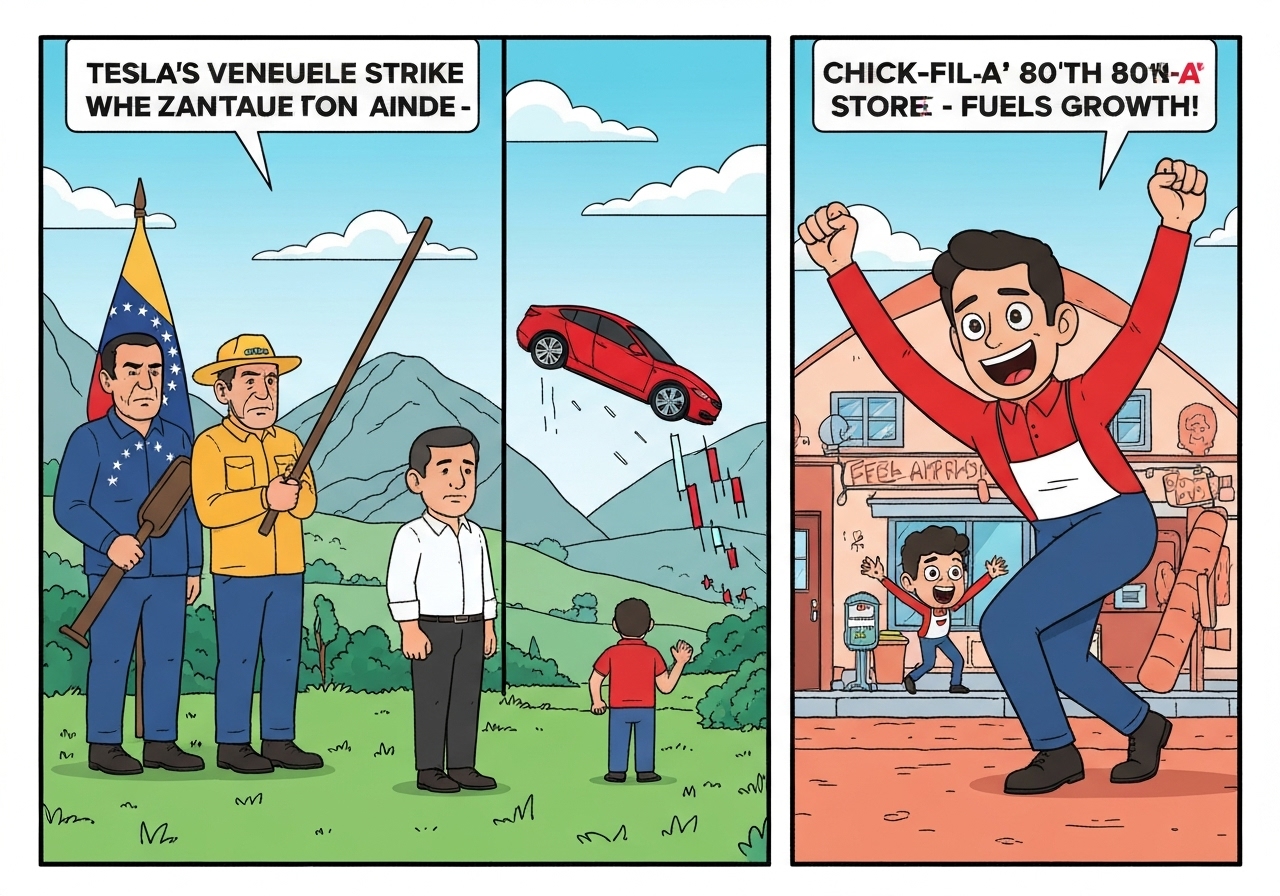
Lead: A weekend of major developments opened markets on Monday. U.S. forces conducted a large-scale operation in Venezuela that Washington says resulted in the capture of President Nicolás Maduro and his wife and prompted regional airspace restrictions. Markets responded cautiously — S&P 500 futures ticked higher after a losing week — while energy, technology and consumer sectors digested fresh risks and opportunities. Corporate headlines ranged from Tesla losing the global EV crown to Chick‑fil‑A launching its largest-ever marketing campaign for its 80th anniversary.
Key Takeaways
- S&P 500 futures rose modestly Monday after a week of losses, reflecting mixed investor reactions to geopolitical news and macro data.
- The U.S. said it led a major strike in Venezuela; U.S. officials reported President Nicolás Maduro and his wife were captured and moved to New York on narco-terrorism charges.
- Tesla reported 418,227 deliveries in Q4 and 1.64 million vehicles for the 2025 calendar year, placing it behind BYD, which sold 2.26 million units in 2025.
- Following the Venezuela operation, Eastern Caribbean airspace was briefly closed for U.S. carriers; airlines added flights once restrictions lifted to move thousands of stranded travelers.
- Elon Musk’s broader businesses faced pressure: criticism over xAI/Grok content and a Starlink pledge to provide free broadband to Venezuelans until early February.
- Anthropic’s president Daniela Amodei highlighted a disciplined spending model — “do more with less” — as the startup balances performance with constrained compute and capital.
- Chick‑fil‑A unveiled a major anniversary push with retro packaging, collectible merchandise and promotions as system sales growth slowed to 5.4% in 2024.
Background
Venezuela has been mired in economic collapse and political confrontation for years, driven by falling oil revenues, international sanctions and contested elections. Nicolás Maduro’s government has faced repeated U.S. pressure and criminal allegations tied to narcotics trafficking; past administrations and regional leaders have alternately sought negotiations or harsher measures. The country’s oil sector remains a strategic asset — large reserves attract repeated foreign interest despite damaged infrastructure and heavy sovereign debt.
U.S.–Venezuelan ties have oscillated between sanctions, diplomatic isolation and intermittent engagement. The Trump administration’s recent statements followed other regional and legal moves, including scrutiny of past pardons and the prosecution of officials accused of facilitating cocaine shipments. Any U.S. plan that leverages an oil blockade or regional military presence will interact with fragile local institutions and long-standing geopolitical dynamics in Latin America.
Main Event
Late Friday and into Saturday, U.S. officials announced a multi-pronged operation in Venezuela. The White House described the action as a strike that killed members of Maduro’s security detail and led to the capture of Maduro and his wife; U.S. officials said both were transferred to New York to face indictments on narco-terrorism charges. President Donald Trump addressed the operation from his Mar‑a‑Lago residence, saying the U.S. could sustain pressure until a political transition is arranged.
Secretary of State Marco Rubio and other administration figures framed the effort as a combination of military pressure and economic levers, notably an oil blockade intended to limit Maduro’s revenue streams. The U.S. also signaled that other Venezuelan officials — named in statements and threats — could face heightened consequences if they resist U.S. demands. Regional governments and some congressional Democrats expressed immediate concern about legal authority and escalation risks.
Logistics and civilian impacts were tangible: regulators temporarily closed Eastern Caribbean airspace to U.S. carriers, stranding tens of thousands of travelers until flights resumed. Separately, SpaceX’s Starlink announced free broadband service for Venezuelan users through early February as part of emergency connectivity efforts tied to the unfolding events.
On the corporate front, Tesla’s delivery miss for Q4 — 418,227 vehicles — and a 2025 total of 1.64 million vehicles handed the global sales lead to China’s BYD at 2.26 million. The miss and rising competition have renewed questions about Tesla’s growth trajectory. Concurrently, xAI’s Grok chatbot drew criticism after AI-generated sexualized images of minors were shared on X, amplifying reputational pressure on Elon Musk’s ecosystem.
Analysis & Implications
Geopolitically, the U.S. action represents a significant escalation in direct intervention versus prolonged sanctions or diplomatic isolation. If Washington follows through on proposals to use oil leverage and regional military posture, markets for crude and refined products could see volatility driven by both supply shock fears and legal/sovereign risk premia. Energy companies evaluating Venezuelan assets will weigh potential access against legal, security and debt-restructuring hurdles.
Domestically, the operation raises constitutional and congressional oversight questions. Lawmakers from both parties signaled a need for briefings and review, underscoring possible friction between the executive branch’s operational claims and legislators’ demand for accountability. Internationally, allied and regional responses will shape the operation’s legitimacy and the feasibility of any U.S.-led transition framework.
For markets and investors, the immediate effect was measured: futures were modestly higher as traders priced both risk and opportunity. Oil prices and related equities will be especially sensitive to any sustained disruption or formal blockade. In technology, Tesla’s ranking loss to BYD highlights how fast-evolving global competition — particularly in China — is reshaping EV leadership and investor expectations.
In consumer sectors, Chick‑fil‑A’s aggressive anniversary program reflects a broader industry tactic: drive traffic and brand engagement when unit-sales growth decelerates. For fast-food operators facing single-digit comparable sales growth, loyalty campaigns and limited-time merchandise aim to sustain same-store metrics and customer frequency amid a tougher foot-traffic environment.
Comparison & Data
| Company | Q4 Deliveries (units) | 2025 Calendar Year (units) |
|---|---|---|
| Tesla | 418,227 | 1,640,000 |
| BYD | — | 2,260,000 |
Context: Tesla’s Q4 shortfall and the year-over-year dynamics reflect both production adjustments and demand-side shifts. BYD’s higher 2025 total underscores China’s domestic and export strength in electrified vehicle segments. Investors will watch margins, pricing, and regional demand trends to assess whether Tesla can regain growth momentum.
Reactions & Quotes
The White House framed the operation as targeted and necessary; lawmakers and foreign leaders called for clarity. Below are representative, brief quotes with context.
“We can run Venezuela until a political transition can be achieved,”
President Donald Trump (statement from Mar‑a‑Lago)
Context: The President’s language signaled a willingness to sustain pressure and use multiple levers — including an oil blockade — to force political change. That framing has prompted debate over the scope of U.S. authority and the durability of any governance arrangement.
“Anthropic has historically delivered strong model performance with far less compute and capital than competitors,”
Daniela Amodei, Anthropic president (Bloomberg interview)
Context: Amodei’s remark illustrates a cost-discipline approach at some AI start-ups, contrasting with rivals’ heavy spending on compute and licensing. Investors and clients will watch whether that model scales as workloads and expectations rise.
“We’re marking our 80th with retro packaging, collectibles and giveaways to reconnect with customers,”
Chick‑fil‑A communications (campaign announcement)
Context: The company’s campaign — labeled “newstalgia” — aims to boost traffic and brand engagement as the restaurant industry navigates slower guest counts and tighter comps.
Unconfirmed
- The precise status and location of Nicolás Maduro and his wife beyond initial U.S. statements remain contested in some regional reports and have not been independently verified by multiple international sources.
- The scale and timeline of proposed U.S. investments by American oil companies in a post‑Maduro Venezuela are projections cited by officials and have not been finalized.
- Details about the chain of command and full casualty counts among Maduro’s security forces are still being corroborated by independent journalists and regional authorities.
Bottom Line
The U.S. operation in Venezuela, as framed by the administration, marks a turning point with far-reaching geopolitical, legal and market consequences. Energy markets and investors must weigh potential supply disruptions against the uncertain timeline for any political transition and legal processes tied to narcotics indictments.
Separately, corporate developments underscore how policy shocks and competitive dynamics move markets: Tesla’s slide behind BYD highlights shifting EV leadership, Anthropic’s cost discipline signals alternative tech strategies, and Chick‑fil‑A’s anniversary push shows how brands seek to buoy traffic amid slower industry growth. In the near term, markets will track follow-up confirmations, congressional responses, and any shifts in oil flows or sanctions policy.
Sources
- CNBC Morning Squawk newsletter — news/primary report
- Reuters — international news agency (for regional coverage and imagery)
- Tesla Investor Relations — corporate filings and delivery figures
- Bloomberg Technology — interview coverage and AI industry reporting
- Chick‑fil‑A — corporate announcement and campaign materials
- BYD — corporate sales disclosures