
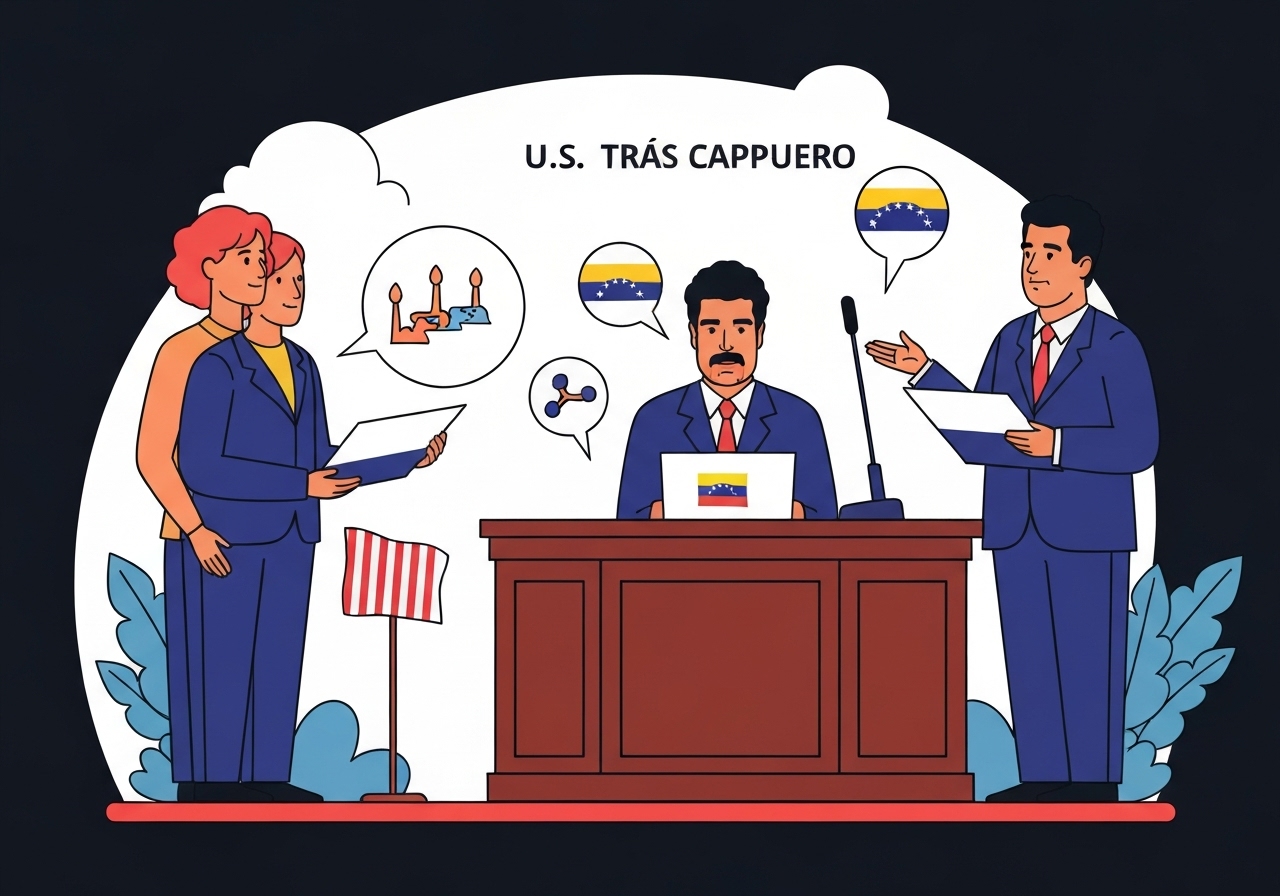
Lead: Venezuelan authorities on Monday installed Delcy Rodríguez as interim president after U.S. forces captured long-serving leader Nicolás Maduro during a weekend operation. Lawmakers aligned with the ruling party convened in Caracas to swear in a National Assembly whose term runs to 2031, while Maduro pleaded not guilty in a U.S. federal court to narco‑terrorism charges. The move seeks to project continuity and independence amid international controversy and U.S. statements about temporary involvement in Venezuela.
Key takeaways
- Delcy Rodríguez was sworn in as interim president on Monday, following a Supreme Court appointment after Maduro’s seizure on Saturday, Jan. 3, 2026.
- The reconstituted National Assembly was sworn for a term through 2031, with Jorge Rodríguez reelected as speaker.
- Nicolás Maduro and first lady Cilia Flores were taken to the United States in a military operation and made their first U.S. court appearances; Maduro pleaded not guilty to federal drug‑trafficking and narco‑terrorism charges.
- Maduro’s son, Nicolás Maduro Guerra, demanded their return and framed the seizure as a global threat to sovereign leaders.
- U.S. President Donald Trump said the U.S. would “run” Venezuela temporarily; Secretary of State Marco Rubio said Washington would not govern day‑to‑day but would enforce an oil quarantine and pressure the oil sector.
- Venezuela’s Supreme Court characterized Maduro’s absence as “temporary,” citing vice‑presidential succession rules rather than the 30‑day election trigger for permanent vacancies.
- The Venezuelan military publicly backs Rodríguez, a long‑time regime insider, raising questions about internal cohesion and the succession’s durability.
- U.S. officials have begun preliminary planning on options including reopening an embassy in Caracas, according to an official briefed on internal deliberations.
Background
Venezuela has been ruled by Nicolás Maduro for nearly 13 years, a period marked by economic collapse, mass migration and international isolation. The Maduro administration consolidated power through aligned institutions: a loyal Supreme Court, a pliant prosecutor’s office and the support of military leaders who control key state assets. Opposition movements and Western governments have alternately sanctioned and sought negotiations with Caracas, but Maduro retained control of core levers of power until this week’s operation.
Constitutionally, a permanent vacancy of the presidency triggers a 30‑day timetable for a new election; a temporary absence places the vice president in charge for up to 90 days, extendable to six months with an assembly vote. Venezuela’s Supreme Court ruled Maduro’s absence temporary, enabling the vice president to assume duties without an immediate nationwide vote. That interpretation—and the court’s role in the succession—has long been a focal point for critics who say democratic norms have been hollowed out.
Main event
On Saturday, Jan. 3, 2026, U.S. forces carried out an operation that resulted in the capture of Nicolás Maduro and Cilia Flores at a residence on a Venezuelan military base; both were transported to the United States and presented to federal authorities. Venezuelan legislators aligned with Maduro convened in Caracas on Monday to swear in a National Assembly for the 2025–2031 term and to install Delcy Rodríguez as interim president, a maneuver framed as constitutional by the country’s Supreme Court.
At the legislative session, Maduro’s son, Nicolás Maduro Guerra, made a high‑profile appearance, denouncing his father’s seizure and calling on international allies to press for their return. Lawmakers used the session to cast the U.S. operation as a violation of sovereignty and to rally public sentiment around the new interim administration. Rodríguez — who served as vice president under Maduro and has longstanding ties to the regime — pledged to defend the nation and pursue international respect.
In New York, Maduro appeared in federal court and pleaded not guilty to narco‑terrorism and drug‑trafficking counts brought by the U.S. Department of Justice. The U.S. government has tied the operation to those charges; U.S. officials including the president framed their actions as part of law enforcement and pressure on illicit networks, while also signaling limited governance intentions in Caracas.
Analysis & implications
The swift appointment of an interim president and the assembly’s swearing‑in are designed to show domestic continuity and to blunt narratives that Venezuela is under foreign control. By placing a trusted insider in the interim presidency, the regime seeks to preserve command over state institutions—especially the military and energy apparatus—while delegitimizing the U.S. operation in diplomatic terms.
Internationally, the seizure and the U.S. rhetoric complicate diplomatic space. Washington’s statements about enforcing an “oil quarantine” and applying pressure to the petroleum sector signal a strategy linking justice actions to economic leverage. That could heighten geopolitical tensions with states that view the operation as an extraterritorial use of force and invite countermeasures or condemnations in multilateral forums.
Domestically, Rodríguez’s authority will depend on two pivot points: the loyalty of senior military commanders and the coherence of the ruling coalition. If the military remains united behind Rodríguez, she can sustain governance; if fractures emerge, Venezuela could face competing claims to authority, localized unrest or attempts by other actors to negotiate leverage with foreign governments.
Comparison & data
| Item | Constitutional/Official Rule | Current action |
|---|---|---|
| Presidential vacancy | Permanent vacancy → election within 30 days | Court labeled Maduro’s absence “temporary” |
| Acting successor | Vice president serves up to 90 days; can extend to 6 months by Assembly vote | Delcy Rodríguez sworn in; Assembly term renewed through 2031 |
| Maduro’s tenure | N/A | Nearly 13 years in power until capture |
| Date of capture | N/A | Saturday, Jan. 3, 2026 (U.S. operation) |
The table above shows how Venezuela’s constitutional mechanisms for succession intersect with the Supreme Court’s ruling and the current political response. The court’s temporary classification avoids the 30‑day election mandate, providing a legal pathway for the vice president to govern while the Assembly and judiciary set the timeline.
Reactions & quotes
Venezuelan officials used the legislative session to present the succession as lawful and to condemn the U.S. operation. Lawmakers and family members framed the seizure as an attack on national sovereignty and a danger to global norms on head‑of‑state immunity.
If we normalize the kidnapping of a head of state, no country is safe. Today, it’s Venezuela. Tomorrow, it could be any nation that refuses to submit.
Nicolás Maduro Guerra, son of Nicolás Maduro
U.S. officials characterized their actions as law‑enforcement and policy pressure rather than long‑term governance. A senior administration official briefed reporters that options—including embassy reopening—were under consideration, but emphasized limited operational aims in Caracas.
We expect to use pressure on the oil sector to drive changes in policy and to stop drug trafficking, not to run daily governance of Venezuela.
Secretary of State Marco Rubio (statement on CBS’ Face the Nation)
Some international observers called for calm and adherence to legal processes, noting the potential for escalation if domestic or foreign actors misread each other’s intentions.
Actions taken in the name of law enforcement must still respect international norms and clear legal procedures to avoid broader instability.
Independent regional analyst
Unconfirmed
- Whether Delcy Rodríguez will seek to extend her interim term beyond constitutionally specified limits remains unclear and is the subject of political speculation.
- The exact operational details of the U.S. military seizure—beyond publicly released summaries—have not been fully corroborated in open documentation.
- Preliminary U.S. planning to reopen an embassy in Caracas has been reported internally but no formal policy decision or timeline has been announced.
Bottom line
The swift swearing in of an interim president is intended to signal that Venezuela’s state institutions remain functional and autonomous despite the extraordinary U.S. operation that removed Nicolás Maduro. The legal framing by the Supreme Court and the military’s visible backing of Delcy Rodríguez are central to whether that signal holds and whether the interim government can operate without contest.
Watch points in the coming weeks include whether the National Assembly extends the interim period, how key military commanders align themselves, the course of Maduro’s U.S. legal proceedings, and how international actors respond to both the seizure and Venezuela’s institutional moves. Those dynamics will determine whether the transition remains managed and constitutional in appearance or evolves into a broader confrontation with regional and global implications.
Sources
- NPR (U.S. news reporting) — original reporting and timeline of events.
- Associated Press (news/photo agency) — photo credit and on‑the‑ground reporting referenced in coverage.
- U.S. Department of State (official) — framework for U.S. diplomatic posture and statements on policy tools.
- U.S. Department of Justice (official) — federal charges and court proceedings referenced in reporting.