
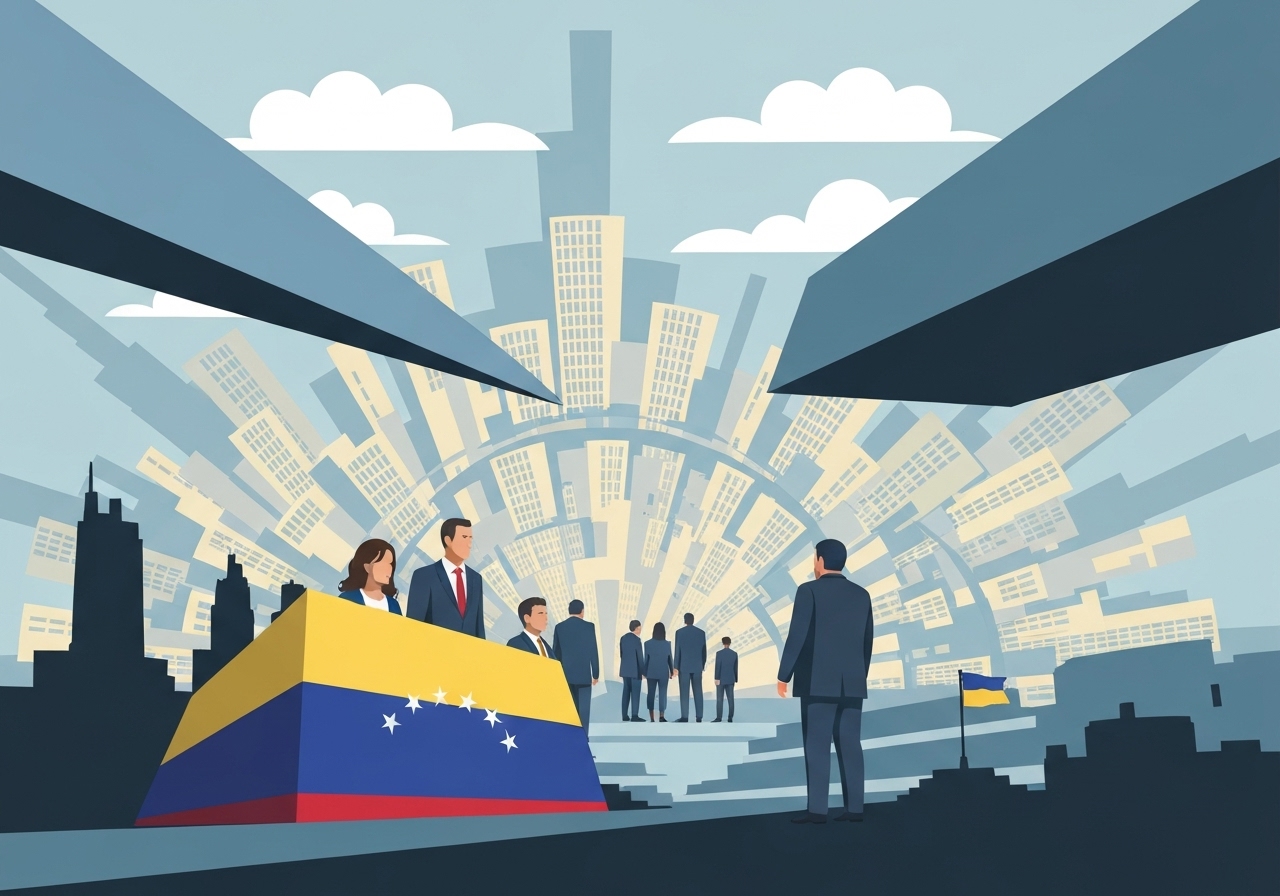
Allies gathered in Paris on Tuesday to shape security guarantees for Ukraine if a ceasefire with Russia is reached, but momentum looked fragile as U.S. attention shifted to events in Venezuela and a diplomatic rift over Greenland intensified. French President Emmanuel Macron had expressed hope the meeting of the so-called “coalition of the willing” would yield concrete commitments; organizers said 35 officials, including 27 heads of state or government, were expected in person. The U.S. sent envoys Steve Witkoff and Jared Kushner after plans for Secretary of State Marco Rubio to lead the delegation changed amid a U.S. military operation in Venezuela. The competing priorities and European unease about recent U.S. remarks on Greenland left delegates facing a complex diplomatic balancing act in Paris.
Key Takeaways
- Paris hosted 35 participants, including 27 heads of state or government, for talks intended to secure Ukraine’s post-ceasefire safety.
- The U.S. delegation consisted of envoys Steve Witkoff and Jared Kushner after Secretary of State Marco Rubio altered plans related to the Venezuela operation.
- Five priority areas framed the summit: ceasefire monitoring, support for Ukraine’s armed forces, multinational deployments, guarantees against renewed Russian aggression, and long-term defense cooperation.
- French and British coordinators emphasized strengthening Ukraine’s military through training, weapons, and support as the first line of defense.
- Comments by U.S. leaders about taking Greenland provoked rebukes from Danish and Greenlandic officials and raised wider European concerns about alliance cohesion.
- Ukrainian President Volodymyr Zelenskyy warned that not all partners were ready to commit troops and that parliamentary approvals could constrain decisions.
- Some allies signaled readiness to contribute support in non-deployable forms—sanctions, finance, humanitarian aid, and intelligence—if troop commitments were unavailable.
Background
For months, a coalition led in large part by France and the United Kingdom has pursued contingency plans to deter any return of Russian hostilities should fighting in Ukraine pause. The effort grew from diplomatic and security concerns raised by the conflict’s trajectory and the need to avoid a ceasefire that could enable Russian reconstitution. Macron publicly framed the Paris gathering as a moment to “make concrete commitments” toward a just and lasting peace, signaling French interest in turning months of planning into tangible pledges.
European capitals have wrestled with the trade-off between political unity and military credibility: many view U.S. backing as essential to credible deterrence but also expect Washington to remain a reliable diplomatic partner. At the same time, national constraints—parliamentary approvals, public opinion, and defense budgets—limit how quickly some states can commit forces abroad. Those domestic realities complicate formation of a multinational force that Ukraine and France say may be needed to deter renewed aggression.
Main Event
Delegates arrived in Paris with a short, focused agenda: agree mechanisms to monitor any ceasefire, detail support to strengthen Ukraine’s armed forces, plan a multinational presence on land, sea and air, outline rapid-response commitments in the event of renewed aggression, and sketch long-term defense cooperation. Organizers presented a framework but had not finalized key operational details, especially on the size, command arrangements, and legal basis for any multinational deployment.
The U.S. presence in Paris was notably calibrated. After a U.S. operation affecting Venezuelan leadership, Washington dispatched envoys rather than a Cabinet-level official. That shift introduced uncertainty for partners who sought firm U.S. operational guarantees as an anchor for broader coalition commitments. Kyiv made clear it wanted concrete assurances from Washington before endorsing or publicizing prospective multinational deployments.
Diplomatic friction over Greenland complicated the atmosphere. After President Trump renewed comments about the strategic value of Greenland and floated the idea of U.S. control of the island, Danish Prime Minister Mette Frederiksen and Greenland’s leader Jens Frederik Nielsen publicly rebuked the suggestion and warned of severe consequences for NATO ties. Several European leaders voiced similar dismay, even as they acknowledged the practical need for American military capacity to back up deterrence plans for Ukraine.
French officials emphasized that the coalition’s approach centers on reinforcing Ukraine’s own military as the primary deterrent, supplemented by allied training, materiel, and, where politically feasible, multinational deployments positioned away from frontline trenches. They said such measures would be designed to reduce the risk that a ceasefire simply becomes a pause that enables a renewed offensive.
Analysis & Implications
The Paris talks were intended to convert diplomatic momentum into commitments that would make a ceasefire sustainable. Success would require coordinated pledges across logistics, intelligence-sharing, command-and-control, and legal cover for multinational forces—areas where European states vary widely in capacity and political willingness. Without clear U.S. operational commitment, some partners may be reluctant to risk troop deployments that could escalate tensions with Russia.
The U.S. focus on Venezuela and the attendant personnel changes in Paris risk signaling a lower threshold for Washington’s engagement in European crises, at least in the near term. Even if the envoys convey strong political backing, allies typically prefer formal, high-level commitments—especially where parliamentary approvals are needed to send forces abroad. That gap between political signaling and formal authorization could slow or water down operational plans developed in Paris.
Greenland-related tensions underscore a deeper diplomatic hazard: allied trust. Public disputes over core strategic questions can make collaboration on a separate theater—Ukraine—harder, especially when coalition cohesion depends on credible deterrence backed by the full range of alliance members. If NATO unity weakens publicly, adversaries could perceive opportunities to test allied resolve.
Economically and militarily, a bundled approach that combines defensive capability building for Ukraine with sanctions and financial support from non-deploying partners can still yield meaningful deterrence. However, such a strategy rests on sustained coordination and transparency about who will provide what—logistics, air defense, training cadres, or rapid-reaction forces—and on mechanisms to enforce commitments if Russia breaches a ceasefire.
Comparison & Data
| Item | Detail |
|---|---|
| Participants | 35 officials, incl. 27 heads of state/government |
| Priority areas | 5 — monitoring, force support, multinational presence, guarantees, long-term cooperation |
| U.S. representation | Envoys Steve Witkoff and Jared Kushner (post-Venezuela operation) |
The table summarizes core, agreed facts presented at the Paris meeting. While numbers of participants and priority areas were clear, operational specifics—such as troop numbers, rules of engagement, financing, and timelines—remained largely unfinalized and are the subject of ongoing negotiation.
Reactions & Quotes
Officials and observers responded swiftly to both the Paris agenda and the broader diplomatic friction.
“Productive discussions” had been under way before the Venezuelan operation, according to one U.S. envoy, who pointed to work on security guarantees and deconfliction mechanisms.
Steve Witkoff (U.S. envoy)
The comment reflected private optimism among some negotiators that core technical issues could be advanced; however, it did not substitute for formal commitments.
“Not everyone is ready,” Ukraine’s president warned, urging clearer commitments and noting some partners cannot provide troops but can offer weapons, intelligence and other support.
Volodymyr Zelenskyy (President of Ukraine)
Zelenskyy’s statement highlighted the coalition’s dependence on differentiated contributions and parliamentary constraints in many countries that could limit immediate troop deployments.
Unconfirmed
- Precise troop numbers for any potential multinational deployment remain unfinalized and were not confirmed at the Paris meeting.
- Reports that specific nations had already committed to ground forces were not independently verified and may depend on parliamentary approvals.
- The long-term command arrangements and legal frameworks for a multinational force had not been agreed and were still under negotiation.
Bottom Line
The Paris meeting aimed to convert planning into enforceable guarantees that would make a ceasefire durable, but key operational details and high-level U.S. commitment were unresolved. European partners face a choice between accepting a patchwork of non-deployable support measures or pressing for clearer, risk-bearing commitments that some governments may find politically difficult.
Greenland-related tensions and Washington’s distraction with Venezuela complicated the diplomatic environment and may slow consensus on an operational multinational presence. For Ukraine, the immediate priority is guarantees that reduce the risk of a renewed offensive; whether Paris produces those guarantees will depend on follow-through in the weeks after the summit and on the ability of allies to convert political language into legally and logistically binding commitments.
Sources
- Associated Press — Paris meeting report (News: Associated Press)
- Associated Press — Russia-Ukraine coverage hub (News: Associated Press)