
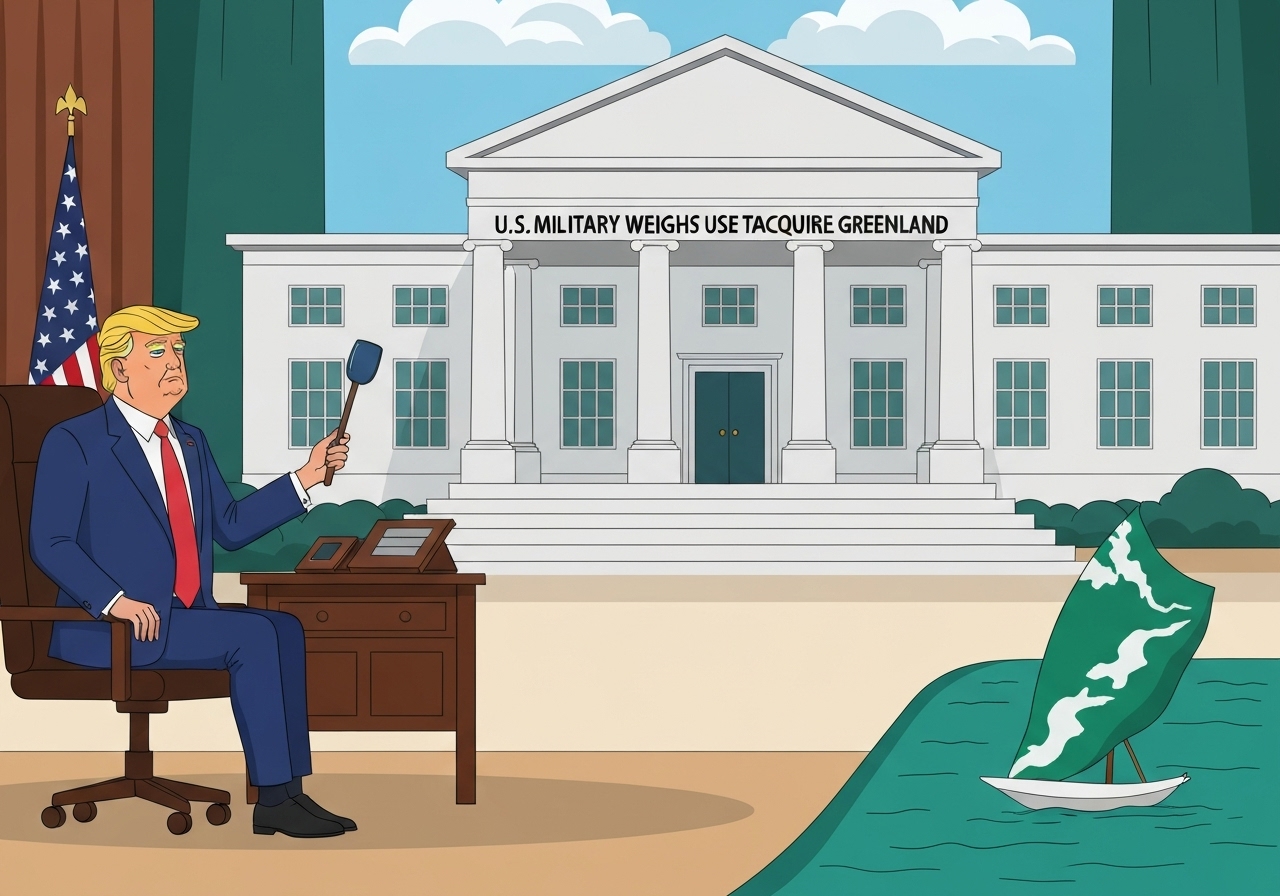
Lead: The White House said on Tuesday that President Donald Trump and his team are considering a “range of options,” including the possible use of U.S. military forces, to pursue the acquisition of Greenland. The comment from press secretary Karoline Leavitt came after a joint statement by Denmark and other European NATO allies pushing back on U.S. designs. The escalation follows renewed public remarks by Mr. Trump that he views Greenland as a strategic priority for national security, amid heightened activity by Russia and China near the Arctic. The announcement has triggered immediate diplomatic concern and legislative pushback in Washington.
Key Takeaways
- The White House confirmed on Jan. 6, 2026 that options under discussion to acquire Greenland include potential use of U.S. military assets, according to press secretary Karoline Leavitt’s remarks to CNBC.
- Greenland is an autonomous territory of the Kingdom of Denmark and a NATO partner; Denmark and multiple European NATO states issued a joint statement opposing any U.S. move to seize the island.
- President Trump has repeatedly framed Greenland as a U.S. national security priority, citing Russian and Chinese activity in the Arctic region.
- Sen. Ruben Gallego (D-Ariz.) announced he would introduce a congressional resolution to block any U.S. invasion of Greenland.
- The developments come days after U.S. forces were reported to have entered Venezuela and captured President Nicolás Maduro and Cilia Flores, a move the administration said would remain in place until a transition occurs.
- Legal, logistical and diplomatic obstacles make a forcible acquisition of Greenland both complex and unprecedented among allies, raising questions about NATO cohesion and international law.
- Markets and prediction platforms have recently priced higher probabilities for unconventional territorial moves by the administration, according to media reporting and trading indicators cited in coverage.
Background
Greenland is an Arctic island with roughly 2,166,086 square kilometers of land and a population of about 56,000. It is an autonomous constituent country within the Kingdom of Denmark, which retains responsibility for foreign affairs and defense. Historically, the United States has had strategic interests in Greenland: during the Cold War it maintained bases there, and in 1946 the U.S. proposed purchasing the territory.
Interest in Greenland resurged publicly in 2019 when President Trump discussed buying the island. The Arctic’s strategic value has grown in recent years as melting ice opens new maritime routes and resource access, drawing greater attention from Russia and China. NATO members, including Denmark and the U.S., share defense responsibilities in the North Atlantic, making any dispute over Greenland a matter with alliance-wide implications.
Main Event
On Jan. 6, 2026, White House press secretary Karoline Leavitt told CNBC that “the President and his team are discussing a range of options to pursue this important foreign policy goal, and of course, utilizing the U.S. Military is always an option at the Commander in Chief’s disposal.” Her remarks marked a rhetorical escalation from previous comments about purchasing or absorbing Greenland.
The statement followed a joint message from Danish and other European leaders issued earlier that morning, which pushed back against the idea that Greenland could be transferred to U.S. control. European officials framed Greenland as belonging to its people and underscored Denmark’s constitutional role and sovereignty over the territory.
In Washington, Senator Ruben Gallego announced plans for a congressional resolution intended to bar the President from ordering a military invasion of Greenland. Gallego framed the move as a pre-emptive check on executive action, saying lawmakers must act to prevent unilateral territorial seizures.
Administration officials linked the renewed focus on Greenland to perceived strategic needs in the Arctic, citing increased Russian and Chinese activity in the region. The broader context for the White House’s assertiveness also includes recent U.S. military operations in Venezuela that the administration said would stay in place until a transition of power is arranged, a factor the President said bears on broader regional strategy.
Analysis & Implications
Legally and diplomatically, forcibly acquiring territory from a fellow NATO member would be without modern precedent and would likely violate international law, including the UN Charter, which prohibits conquest and acquisition by force. Any attempt to transfer Greenland from Denmark to the United States would create a diplomatic rupture with a treaty ally whose sovereignty and territorial integrity are widely recognized.
Operationally, Greenland’s geography presents significant logistical challenges. Its sparse population, vast ice-covered interior and limited infrastructure complicate occupation or rapid administrative takeover. Establishing durable governance and providing civil services would require long-term commitments of personnel and funding, with substantial local resistance expected.
Politically within the United States, the President’s public assertions have provoked both bipartisan alarm and calls for congressional oversight. A resolution like the one proposed by Sen. Gallego would aim to constrain executive action, but conflicts between branches over war powers and emergency authorities could generate protracted legal battles if the administration attempted unilateral military measures.
Internationally, such a move would likely fracture NATO cohesion and push European partners toward stronger countermeasures, including sanctions or military re-posturing. It could also accelerate Arctic competition: Russia and China would likely respond diplomatically and militarily to perceived U.S. expansionism in the high north, increasing the risk of escalation in an already sensitive region.
Comparison & Data
| Metric | Greenland | Denmark |
|---|---|---|
| Land area (km²) | 2,166,086 | 42,933 |
| Population (approx.) | 56,000 | 5.9 million |
These contrasts underscore Greenland’s strategic value (large landmass, Arctic position) but also its limited human infrastructure compared with Denmark. Any change in sovereignty would raise immediate governance and security questions given Greenland’s small population and reliance on Danish institutions for defense and foreign policy.
Reactions & Quotes
Officials in Copenhagen and other European capitals issued quick rebuttals emphasizing sovereignty and the rights of Greenlanders.
“Greenland belongs to its people and their democratically governed institutions. Any suggestion otherwise is unacceptable.”
Joint statement — Denmark and European NATO leaders
White House remarks framed the matter as a strategic priority.
“The President has made it well known that acquiring Greenland is a national security priority of the United States… utilizing the U.S. Military is always an option at the Commander in Chief’s disposal.”
Karoline Leavitt, White House press secretary (to CNBC)
In the U.S. Congress, some lawmakers warned of constitutional and legal limits.
“WAKE UP. Trump is telling us exactly what he wants to do. We must stop him before he invades another country on a whim.”
Sen. Ruben Gallego (D-Ariz.) — social post
Unconfirmed
- The existence of a finalized plan by the U.S. government to invade or seize Greenland has not been independently verified; the administration has said it is considering options.
- Reports that U.S. forces have definitively captured Venezuelan President Nicolás Maduro and his wife remain reported by some outlets and administration sources but lack corroboration from independent international monitors in this article.
- The scale and timeline of any proposed military action related to Greenland — including which forces, rules of engagement, or post-action governance plans — have not been disclosed publicly and remain unconfirmed.
Bottom Line
The White House’s statement that using the U.S. military is “always an option” marks a notable rhetorical escalation regarding Greenland, turning a long-running political anecdote into a live policy controversy. Given Greenland’s status as an autonomous territory of Denmark and NATO obligations, any attempt to transfer control would trigger major legal, diplomatic and logistical challenges.
Watch for immediate next steps: formal White House policy papers or briefings, a Danish government response beyond the joint statement, and congressional action such as the resolution announced by Sen. Gallego. Those developments will determine whether the dispute remains rhetorical or moves toward concrete—but contested—policy decisions.