
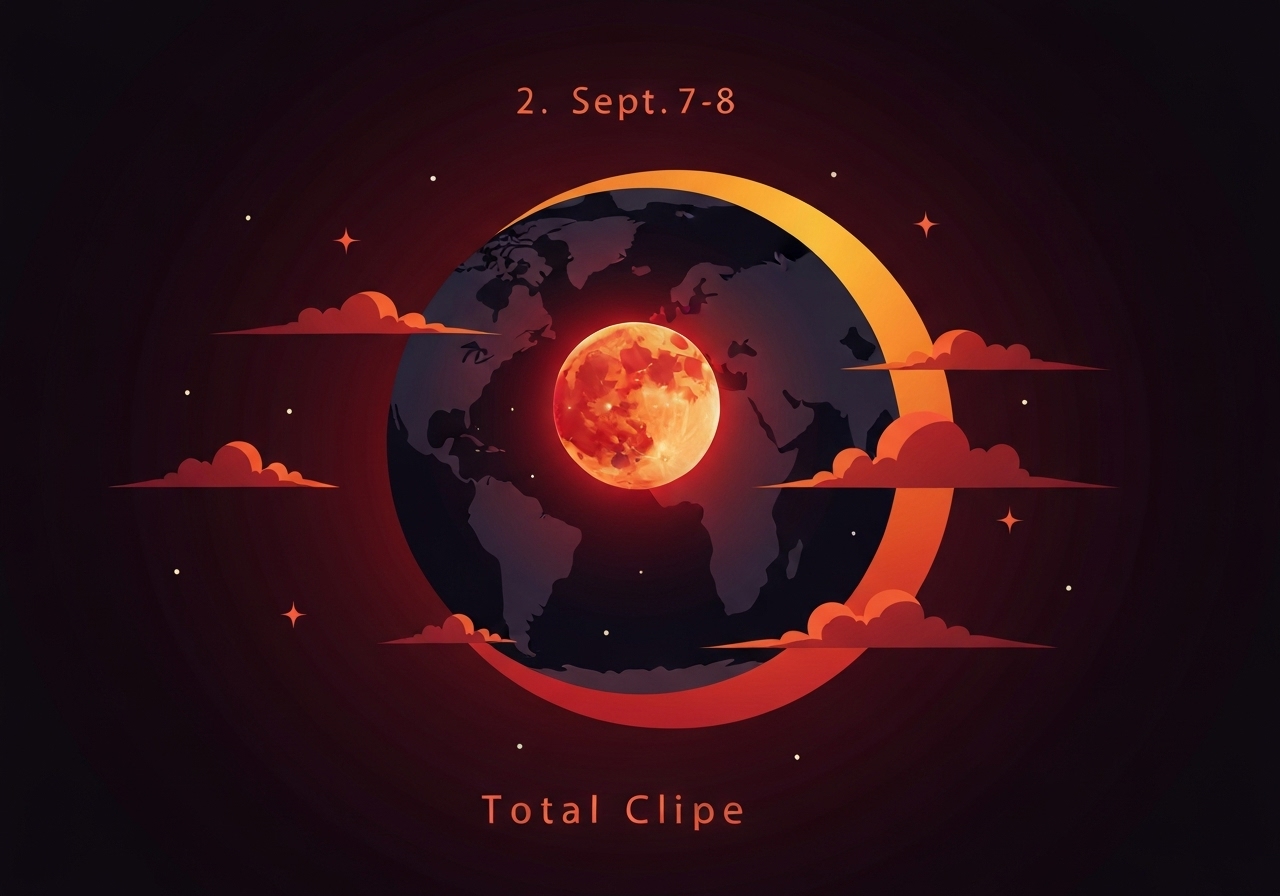
Skywatchers across Asia, Western Australia and much of Europe will see a total lunar eclipse—a “blood moon”—overnight on Sept. 7–8, peaking at 21:11 GMT (5:11 p.m. EDT) with roughly 82 minutes of totality.
Key takeaways
- Maximum eclipse (mid-totality): 21:11 GMT on Sept. 7 (5:11 p.m. EDT).
- Totality duration: about 82 minutes while the Moon sits deep in Earth’s umbra.
- Best visibility: most of Asia, Western Australia and Europe; the Americas will not see the event.
- Example city viewing windows (local dates/times): London (BST) 7:30–7:52 p.m. Sept. 7; Paris (CEST) 7:30–8:52 p.m. Sept. 7; Mumbai (IST) 11:00 p.m. Sept. 7–12:22 a.m. Sept. 8; Beijing/Hong Kong/Perth 1:30–2:52 a.m. Sept. 8; Tokyo 2:30–3:52 a.m. Sept. 8; Sydney 3:30–4:52 a.m. Sept. 8.
- About 77% of the global population can witness the full total phase, according to Time and Date.
- Space.com will livestream the eclipse for those who cannot view it in person.
- The Moon will be 2.7 days before perigee, appearing slightly larger than typical.
Verified facts
The eclipse begins when the Moon first enters Earth’s faint penumbral shadow and progresses as the satellite moves into the darker umbra; during totality the lunar surface takes on reddish tones because sunlight filtering through Earth’s atmosphere is refracted onto the Moon. The event is set to reach its deepest phase at 21:11 GMT on Sept. 7 (5:11 p.m. EDT), with totality lasting roughly 82 minutes.
Visibility is region-dependent. Observers across Asia and Australia will see the Moon high in the sky during totality, which is ideal for imaging. In Europe and parts of Africa the eclipse will be visible as the Moon rises at dusk; in those locations the eclipse will already be underway at moonrise. The Americas are outside the visibility window for this event.
Published local windows for a selection of cities are: London (BST) 7:30–7:52 p.m. Sept. 7 (moon already rising in eclipse); Paris (CEST) 7:30–8:52 p.m. Sept. 7 (low on horizon); Cape Town (SAST) 7:30–8:52 p.m. Sept. 7; Istanbul/Cairo/Nairobi (EEST/EAT) 8:30–9:52 p.m. Sept. 7; Tehran (IRST) 9:00–10:22 p.m. Sept. 7; Mumbai (IST) 11:00 p.m. Sept. 7–12:22 a.m. Sept. 8; Bangkok (ICT) 12:30–1:52 a.m. Sept. 8; Beijing/Hong Kong/Perth (CST/HKT/AWST) 1:30–2:52 a.m. Sept. 8; Tokyo (JST) 2:30–3:52 a.m. Sept. 8; Sydney (AEST) 3:30–4:52 a.m. Sept. 8.
Context & impact
This total lunar eclipse is notable for how deeply the Moon will travel through Earth’s umbra, which tends to produce a darker, richer red hue compared with shallow eclipses. The proximity to perigee (2.7 days before closest approach) means the lunar disk will appear a little larger, improving photographic detail for observers with telephoto lenses or small telescopes.
For the general public the eclipse is primarily a cultural and recreational event: it’s an accessible astronomical spectacle that requires no special equipment to enjoy. For amateur and professional astronomers the eclipse offers a chance to study the atmosphere’s effect on lunar color and to practice timed imaging sequences during a lengthy totality.
Viewing and photography notes
- Use a tripod and a shutter release or remote to reduce camera shake during long exposures.
- For stills try exposures between 1/100 and several seconds as the eclipse progresses; bracket exposures to capture both bright and dark phases.
- Cloud cover and local weather are the primary risk to observing; check regional forecasts in advance.
We will livestream the eclipse so those who cannot view it in person can follow along.
Space.com
Unconfirmed
- The precise shade and brightness of the eclipsed Moon cannot be forecasted in detail because it depends on global atmospheric conditions at the time.
- Local cloud cover will determine whether any given observing site actually sees the event; weather forecasts should be consulted on the night.
Bottom line
This total lunar eclipse on Sept. 7–8 offers a long, deep totality visible across Asia, Western Australia and Europe, with a clear peak at 21:11 GMT and about 82 minutes of totality. Observers should plan for local weather, arrive early to set up equipment, and consider the Space.com livestream if conditions prevent direct viewing.