
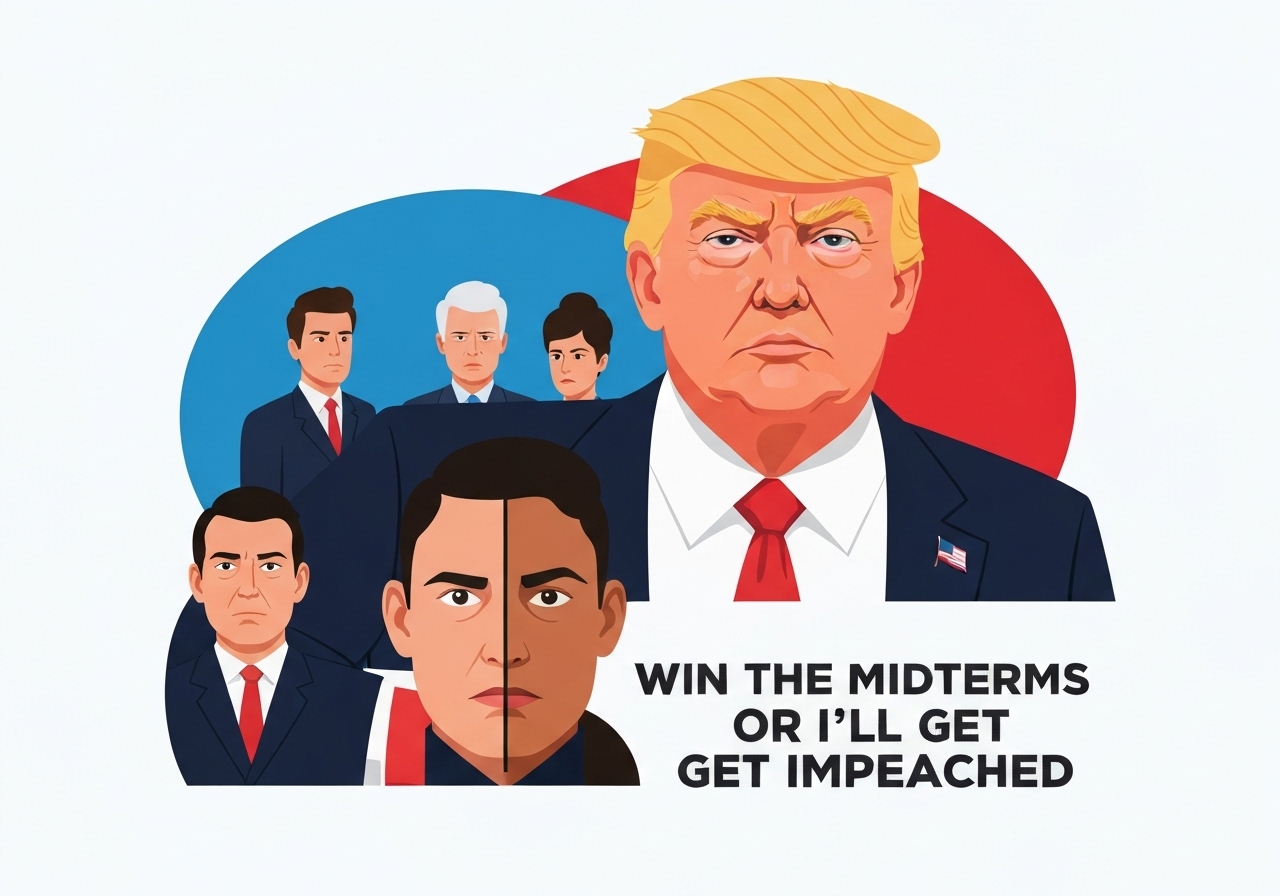
At a House Republican retreat held at the Kennedy Center on Jan. 6, 2026, President Donald Trump warned GOP lawmakers that failing to secure wins in this year’s midterm elections would leave him vulnerable to another impeachment effort. He said opponents would “find a reason” to move against him, noting he had been impeached twice during his first term and acquitted by the Senate both times. Trump used the gathering to press his view that Republican policies outperform Democratic ones, while urging tactical flexibility on issues such as health care and the Hyde Amendment. The remarks came as the House GOP’s slim majority narrowed following the reported death of Rep. Doug LaMalfa and the early retirement of Rep. Majorie Taylor Greene.
Key Takeaways
- On Jan. 6, 2026, at a House GOP retreat, President Trump warned that Republicans must win the midterms or he will face impeachment efforts.
- Trump has been impeached twice: in 2019 (abuse of power and obstruction) and in 2021 (incitement of insurrection); he was acquitted by the Senate both times.
- The speech took place at the Kennedy Center, recently renamed by a board that includes Trump appointees.
- With enhanced Affordable Care Act subsidies having expired at the end of 2025, Trump pressed a policy of direct payments to individuals to buy health coverage.
- He urged GOP lawmakers to be “flexible” on the Hyde Amendment, without detailing specific legislative fixes.
- Trump publicly endorsed House Speaker Mike Johnson at the retreat while noting the party’s shrinking House majority, now a two-vote margin after recent developments.
Background
Impeachment has been a recurring feature of Trump’s political dossier: the first House impeachment in 2019 accused him of abusing presidential power and obstructing Congress over interactions with Ukraine; the second, in January 2021, charged him with incitement following the Jan. 6 attack on the U.S. Capitol. In both cases the Senate voted to acquit. Those episodes remain salient to GOP and Democratic strategists as they shape messaging ahead of the 2026 cycle.
Midterm elections historically present headwinds for the party holding the presidency, a dynamic Trump acknowledged in his remarks. Republicans control a narrow House majority that analysts say constrains both messaging and legislative maneuvering. The Kennedy Center setting — and its recent renaming move by a board filled with Trump appointees — provided a symbolic backdrop for the president’s appeal to loyal lawmakers.
Main Event
Speaking at the retreat, Trump framed the midterms as existential for his political future, telling attendees they must “win the midterms” or risk renewed impeachment efforts. He repeatedly criticized Democratic leadership and past Democratic presidents, arguing Republican policy is superior and urging campaigns to emphasize those contrasts. He also defended his own record, saying the impeachments were unfounded and noting the Jan. 6 anniversary as he spoke.
On health care, Trump recommended sending funds directly to Americans so they could purchase coverage on their own — a proposal he described as putting money into a health account or giving direct payments. He criticized the Affordable Care Act (Obamacare) and highlighted the policy debate now that enhanced ACA subsidies expired at the end of 2025, framing health care as a central battleground for campaigns.
On abortion funding, Trump urged Republicans to be pragmatic about the Hyde Amendment, instructing lawmakers to show “flexibility” and ingenuity while not spelling out precise changes. His comments left the specifics unclear but signaled a willingness to explore compromise language to broaden GOP appeal in competitive districts.
Trump also addressed internal House dynamics, praising Speaker Mike Johnson in a show of party unity but acknowledging the difficulties of governing with a narrow margin. He noted the majority had slimmed to approximately two votes after the unexpected death of Rep. Doug LaMalfa and Rep. Majorie Taylor Greene’s early retirement, underscoring the fragility of the GOP’s control in the House.
Analysis & Implications
Politically, Trump’s warning merges personal legal vulnerability with campaign strategy: by framing impeachment as contingent on midterm outcomes, he converts a legal threat into an electoral rallying cry. That message can mobilize the base, but it also risks further polarizing independent and swing voters who may view such rhetoric as self-protective rather than policy-focused.
Substantively, his push for direct payments to individuals to buy health insurance represents a shift from federal entitlement-style solutions to a consumer-focused subsidy model. If adopted by Republican campaigns, the approach would force detailed legislative design: payment size, eligibility, and interaction with existing ACA marketplaces would all determine voter impact and feasibility.
On abortion funding, asking Republicans to be “flexible” on Hyde signals acknowledgment of electoral realities in swing districts where strict federal funding bans may be unpopular. However, without concrete policy proposals, the comment functions more as a message test than a commitment, leaving activists and members uncertain about the party’s next steps.
Legislative arithmetic matters: with a two-vote House margin described at the retreat, priorities expressed by the White House can be difficult to translate into law. Narrow majorities increase the relevance of individual members and make intra-party negotiation crucial, especially on contentious issues like health care and abortion funding.
Comparison & Data
| Year | Charge(s) | Senate Outcome |
|---|---|---|
| 2019 | Abuse of power; obstruction of Congress | Acquittal |
| 2021 | Incitement of insurrection (Jan. 6) | Acquittal |
The table above summarizes the two House impeachments of President Trump and their Senate outcomes. Both impeachments resulted in acquittal, a fact Trump highlighted to argue the efforts were baseless. For elections context, political scientists note incumbents’ parties typically lose ground in the first midterm after a presidential win, a dynamic Republicans must counter in 2026.
Reactions & Quotes
Republican leadership in the room received Trump’s endorsement of Speaker Johnson, which aimed to present unity amid a narrow majority and recent member departures. Observers say a public endorsement can shore up internal support even if legislative leverage remains limited.
“You got to win the midterms because if we don’t win the midterms, it’s just going to be — they’ll find a reason to impeach me.”
President Donald Trump, Jan. 6, 2026
Legal analysts and Democratic strategists responded that framing impeachment as a partisan threat may energize both sides: it can consolidate Trump’s base while motivating opponents who see the claim as an attempt to influence the political environment around legal accountability.
“You have to be a little flexible on Hyde…you’ve got to use ingenuity.”
President Donald Trump, Jan. 6, 2026
Advocacy groups on both sides are likely to scrutinize any shifts on Hyde. Pro-choice organizations cautioned that vague calls for flexibility are insufficient, while pro-life groups stressed protection of restrictions on federal funding for abortion.
Unconfirmed
- Specific legislative language or mechanisms Trump envisions to be “flexible” on the Hyde Amendment were not provided and remain unclear.
- Details about how direct payments for health care would interact with existing ACA marketplaces and eligibility rules were not spelled out in the remarks.
- Reports cited a narrowed House majority after the death of Rep. Doug LaMalfa and the retirement of Rep. Majorie Taylor Greene; some personnel or timing details were not fully confirmed at the time of the speech.
Bottom Line
President Trump used the Jan. 6, 2026 House GOP retreat to fuse electoral strategy with personal legal framing, warning that failure in the midterms would invite renewed impeachment efforts. By doing so he sought to turn a legal vulnerability into a campaign imperative that could mobilize Republican voters and shape GOP messaging through 2026.
Substantive proposals mentioned at the retreat — direct payments for health coverage and “flexibility” on Hyde — signal areas where Republicans may seek policy footing, but both ideas lack detailed plans that would be required to legislate effectively. With a slim House majority, internal consensus and tactical choices in battleground districts will determine whether those messages translate into electoral success or legislative shifts.
Sources
- ABC News (news report) — original coverage of Trump’s remarks at the House GOP retreat, Jan. 6, 2026.