
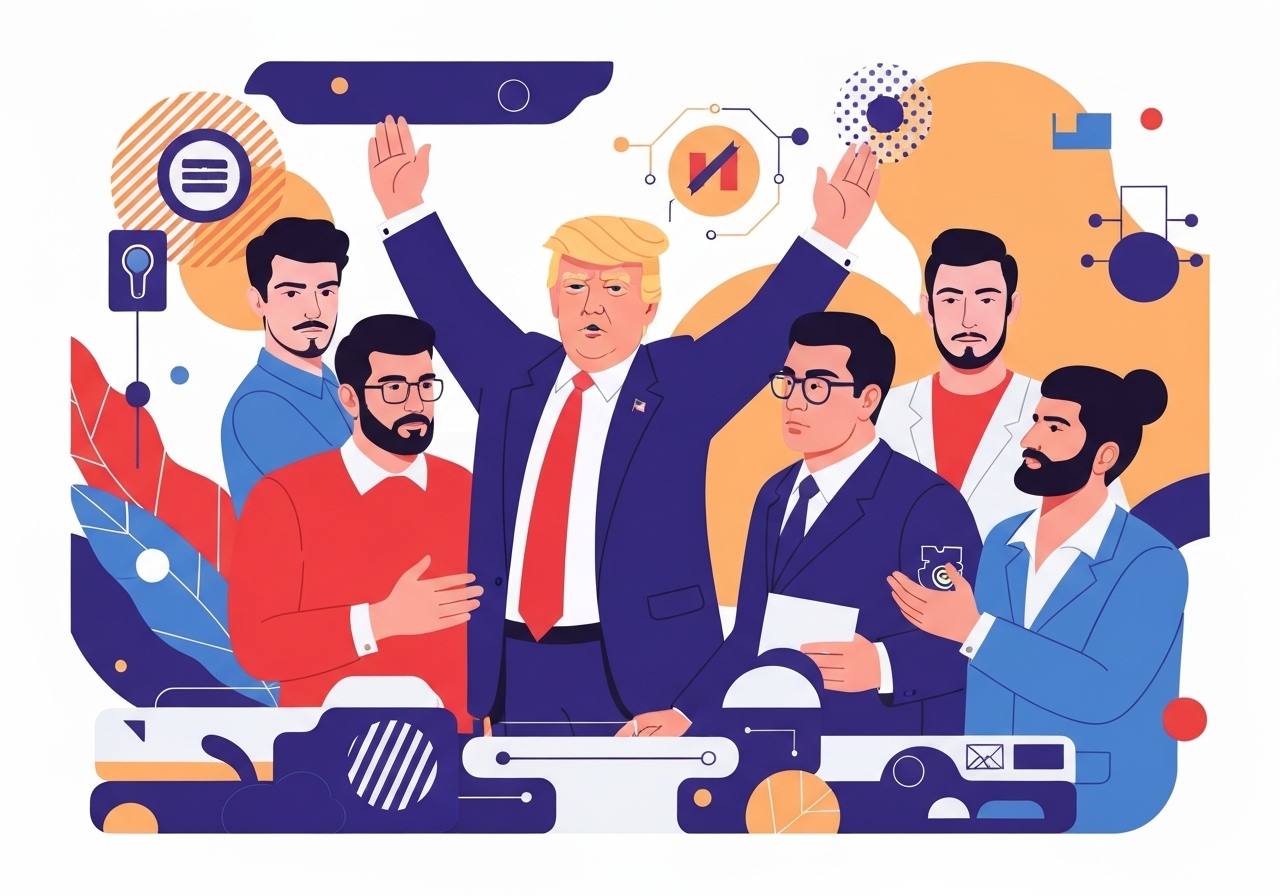
On September 5, 2025, at the White House, President Donald J. Trump and the First Lady hosted senior executives from major technology companies to announce a coordinated public-private push to expand U.S. artificial intelligence capacity, including commitments on infrastructure, workforce development and large corporate investments to keep the United States competitive in AI.
Key Takeaways
- A White House convening on Sept 5 brought top tech CEOs and administration officials together to focus on AI leadership.
- The meeting highlighted an “AI Action Plan” and the First Lady’s initiative on AI education.
- Executives pledged large-scale investments and infrastructure buildouts in the U.S., with companies citing multibillion- and multitrillion-dollar commitments.
- Participants emphasized market access, trust and a pro-innovation regulatory stance as priorities.
- Company comments framed the collaboration as a turning point for domestic AI capabilities and supply chain expansion.
- Cited figures and program claims come from company statements and the White House release; some specifics remain company-reported and pending independent confirmation.
Verified Facts
The event took place at the White House on September 5, 2025, and was described by the administration as a public-private partnership focused on advancing U.S. leadership in artificial intelligence. The White House framed the gathering around an “AI Action Plan” and noted efforts to expand infrastructure and workforce training.
Leaders attending or quoted by the White House included executives from OpenAI, Google/Alphabet, Microsoft, Apple, Meta, Oracle and AMD. Company leaders publicly expressed support for the administration’s approach and outlined plans to invest in U.S. facilities, data centers and advanced manufacturing.
Executives reiterated commitments to increase domestic capacity: Apple and Meta executives referenced large-scale U.S. investments (figures cited by those executives include $600 billion or more in aggregate or multi-year commitments). Microsoft and Google leaders emphasized policies that promote market access and global trust in American technology.
Context & Impact
The meeting follows increased global competition in AI capabilities, intensifying attention on semiconductors, data-center capacity and AI talent. The administration signaled that federal policy will prioritize infrastructure permitting, workforce programs and incentives to attract private investment.
Industry leaders said clearer, supportive policy and government coordination reduce friction for large capital projects such as data centers and chip fabs. If executed, expanded infrastructure and corporate investment could accelerate model training capacity, lower latency for services and retain more AI development onshore.
- Short-term: faster approvals and public funding can speed planned builds and hiring.
- Medium-term: larger domestic compute and chip capacity may shift some supply chains back to the U.S.
- Long-term: combined public-private efforts aim to maintain U.S. competitiveness in AI research and commercialization.
Official Statements
“This investment will set us up for a long period of success,”
Sam Altman, OpenAI (as quoted by the White House)
“The AI moment is one of the most transformative moments…we look forward to working together,”
Sundar Pichai, Alphabet/Google (as quoted by the White House)
Unconfirmed
- Aggregate investment totals referenced by CEOs (for example, specific $600 billion figures cited by Apple and Meta) are company statements and have not been independently verified here.
- Descriptions such as “the most massive infrastructure building in history,” attributed to some participants, are characterization rather than independently measured claims.
Bottom Line
The White House meeting on September 5, 2025, signals closer alignment between the U.S. government and major technology firms on expanding domestic AI capacity. Company commitments and policy steps, if realized, could accelerate infrastructure and workforce initiatives that support long-term U.S. competitiveness in AI. Observers should watch for detailed funding plans, timelines and independent verification of the investment figures announced by companies.