
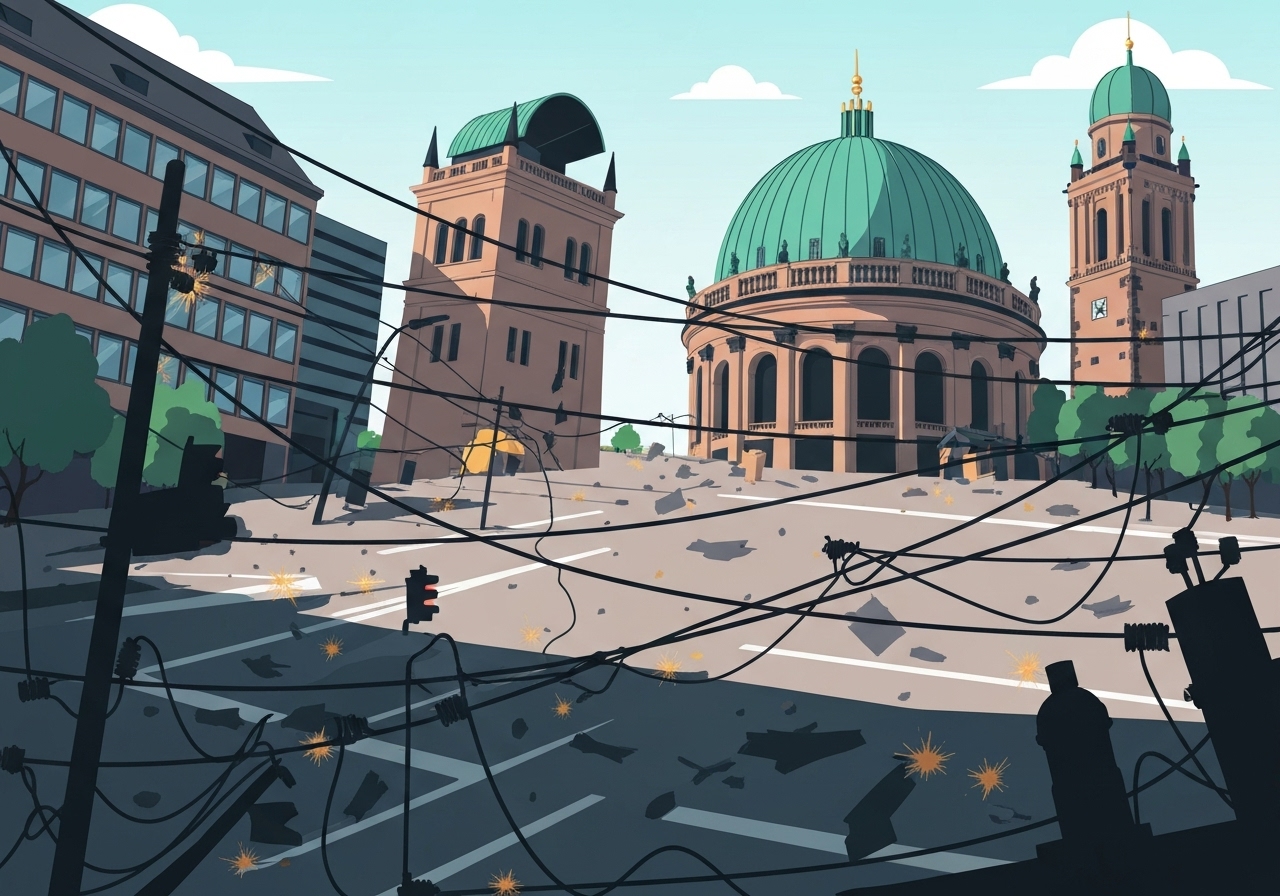
Lead
On 3 January 2026 a deliberate arson attack in south‑west Berlin cut power to roughly 45,000 households and nearly 2,000 businesses, forcing evacuations and disrupting hospitals, care homes and schools. The group calling itself Vulkangruppe (Volcano Group) claimed responsibility, saying the act aimed to spotlight Germany’s dependence on fossil fuels. Federal state prosecutors have taken over the criminal probe, but investigators say physical evidence is limited. By Wednesday morning officials had restored service to most users, yet residents and experts are demanding clearer answers about how critical infrastructure was left so exposed.
Key takeaways
- Scope: About 45,000 households, almost 2,000 businesses, four hospitals, 74 care homes and 20 schools were affected by the outage caused by an arson attack on high‑voltage infrastructure.
- Responsibility: A leftwing anarchist cell calling itself Vulkangruppe claimed the sabotage and said it sought to “turn off the juice of those in power.”
- Investigation: Federal state prosecutors have assumed control of the criminal inquiry; investigators report only limited physical clues, including footprints in snow.
- Restoration: By Wednesday morning roughly 20,000 households and 850 businesses that remained without heating or hot water had been reconnected.
- Response: The Red Cross and the Bundeswehr (army) assisted with relief and logistics, distributing supplies and diesel to clinics running generators.
- Vulnerabilities: Experts point to gaps in redundancy and legal requirements for utilities, arguing that resilience investments lag behind visible security projects.
- Political fallout: The disruption has been seized on by political opponents and sparked public anger, especially among those on fixed incomes and dependent on continuous care.
Background
Germany has long debated the balance between an open, transparent energy transition and hardened security measures for critical networks. In recent years policymakers have prioritised decarbonisation and digital transparency, but experts say investments in physical resilience — duplicated lines, protected conduits and upgraded civil‑defence systems — have not kept pace. Independent groups such as AG Kritis have repeatedly warned of single‑point failures that could cascade across electricity, water and communications networks if a key element is disabled.
Public concern has grown since Russia’s full invasion of Ukraine prompted households to keep emergency kits and small generators; anecdotal accounts of prepping are now common. Berlin’s Zehlendorf district, an area with many diplomatic and affluent residences alongside ordinary households, became a focal point when the arson on a bridge carrying high‑voltage cables left residents without heat amid winter conditions. The episode revived long‑running debates about whether utilities and local authorities have sufficient legal incentives and funding to harden infrastructure against sabotage and severe weather alike.
Main event
On the night of Saturday 3 January 2026, attackers set fire to a bridge structure used to carry high‑voltage transmission lines in south‑west Berlin. The blaze damaged cables and interrupted supply to large swathes of the city, prompting immediate cutovers and emergency responses. City services, emergency crews and utility teams worked through the night to isolate and repair damaged sections while hospitals and care homes relied on backup generators.
Those relying on medical equipment or lifts in residential blocks were among the most vulnerable. Emergency shelters were set up in sports halls, where residents, including elderly people moved from care homes, were given army camp beds. Hotels, libraries, cinemas and municipal facilities opened as warm spaces; volunteers and the Red Cross distributed hot drinks, thermal flasks and food parcels.
Investigators say the arsonists left only sparse traces — footprints in the snow near the scene — and that forensic leads are limited. Vulkangruppe published a claim taking political responsibility and framing the action as a protest against fossil‑fuel dependency. Officials have emphasised the criminality of the act and launched a federal‑level probe to coordinate evidence collection and track possible networks behind the perpetrators.
Analysis & implications
The attack exposed the tension between public access to information and the need to protect critical assets. Officials acknowledged that maps and publicly available data can be used by malicious actors to identify vulnerabilities; at the same time, transparency is central to public oversight and technical cooperation. Policymakers will face pressure to reassess what information is published and how to secure physical infrastructure without eroding democratic accountability.
Regulatory frameworks also matter. Experts from AG Kritis and other resilience groups say existing rules often require only a baseline level of protection, leaving operators to follow minimum compliance rather than proactive hardening. That dynamic means that, unless legal requirements are tightened or subsidies provided for redundancy upgrades, commercial incentives alone are unlikely to close the gap.
There are wider political and social consequences. Populist parties have already used the outage to argue that authorities failed to protect citizens, while civil‑society voices stress the human cost to elderly and low‑income residents. Internationally, the incident may prompt other European capitals to review their networks for similar single‑point vulnerabilities, particularly as energy systems become more interconnected during the transition away from fossil fuels.
Comparison & data
| Metric | Count |
|---|---|
| Households affected | ~45,000 |
| Businesses affected | ~1,900 |
| Hospitals | 4 |
| Care homes | 74 |
| Schools | 20 |
Officials described this as Germany’s longest blackout since the second world war in terms of the scale and the number of institutions affected. The table above summarises the on‑the‑ground counts reported in the days following the attack. Restoring redundant infrastructure typically requires coordinated action across network operators, municipal engineers and state prosecutors when criminal damage is involved, which lengthens repair timelines compared with straightforward technical faults.
Reactions & quotes
Local officials, emergency groups and residents voiced frustration and concern about both the immediate harms and longer‑term policy implications.
“What is wrong with this city?”
Anguished resident, Zehlendorf
The short, anguished question was directed at visiting city leaders and captured the mix of bewilderment and anger felt by many residents who lost heat and access to daily services. Officials acknowledged the emotional toll as they coordinated shelter and supplies.
“This is a serious blow to critical infrastructure.”
Franziska Giffey, Berlin senator for energy and economy
The senator described visible damage to a bridge carrying high‑voltage cables and said publicly available information likely informed the attackers’ site selection, prompting calls to reassess the balance between transparency and security.
“Resilience costs money.”
Manuel Atug, AG Kritis founder
Atug used the incident to reiterate that legal and financial incentives are required to ensure utilities invest in redundancy and protective measures beyond minimum compliance.
Unconfirmed
- The precise chain of command, recruitment or broader network behind Vulkangruppe’s cells remains unverified and under investigation.
- Claims that attackers used specific public maps or data to pick the site are plausible but not independently confirmed by prosecutors.
- Any foreign involvement or material support for the saboteurs has not been substantiated publicly as of the latest official statements.
Bottom line
The arson attack that knocked out power to tens of thousands of Berliners was both a criminal act and a stress test for Germany’s critical infrastructure. It has exposed gaps in physical redundancy and raised difficult questions about the trade‑offs between transparency and security for public utilities. Residents who suffered immediate harms — especially the elderly, care‑dependent and low‑income households — have driven a visceral public demand for clearer answers and faster policy fixes.
Going forward, policymakers will need to decide whether to raise regulatory standards for resilience, fund targeted upgrades to ageing structures, and reassess how much operational detail about networks is published online. The federal probe and expert reviews that follow should clarify how the sabotage succeeded and what legal, technical and budgetary steps are required to reduce the chance of a repeat.