
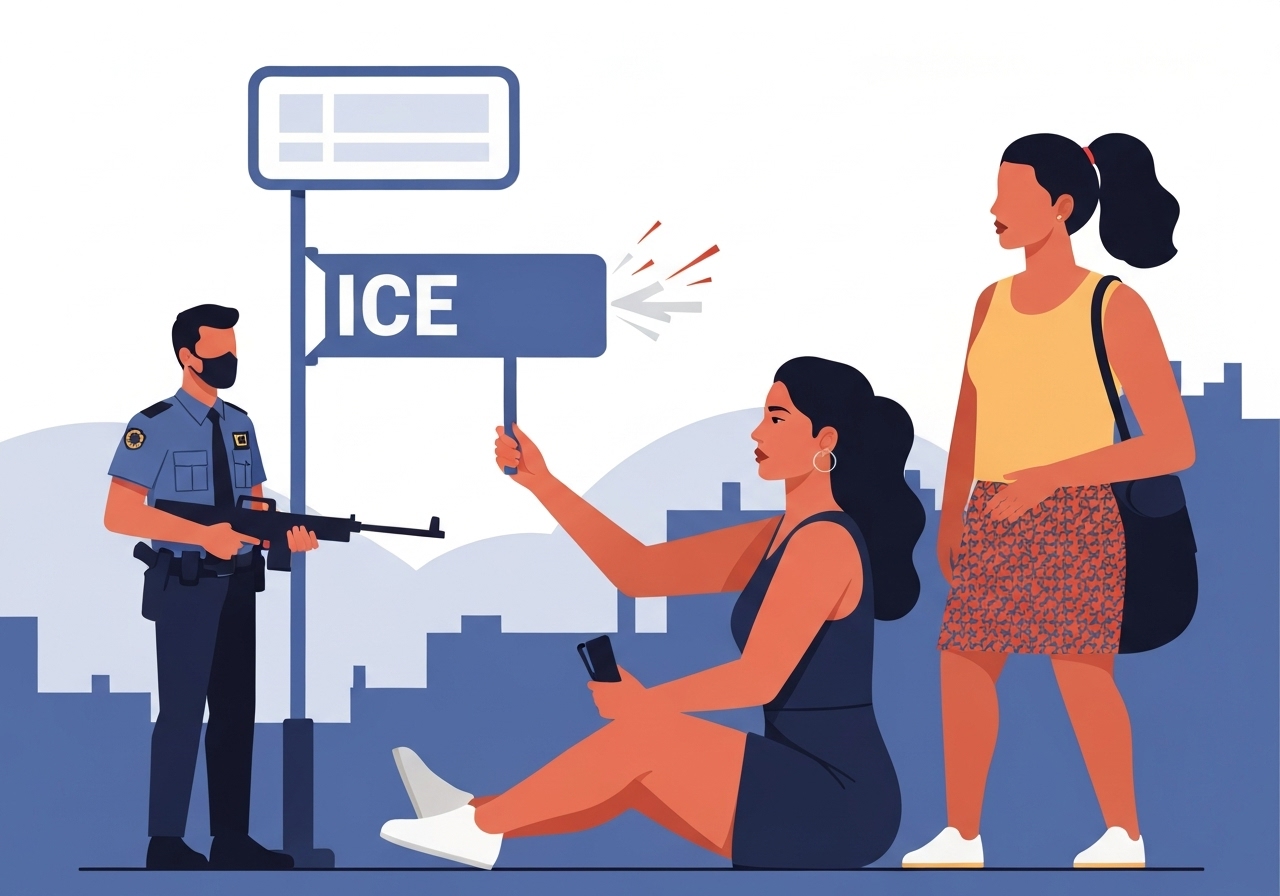
Federal officials say U.S. Immigration and Customs Enforcement (ICE) agents shot and killed a woman in her car in Minneapolis on Jan. 7, 2026, after agency officials say the vehicle was used to attack officers. The Department of Homeland Security (DHS) described the episode as an instance in which a driver weaponized a car; video circulating on social media shows a rapid confrontation on a residential street and at least three shots fired. Local elected leaders immediately condemned the shooting and demanded ICE withdraw from the city while investigations are opened at multiple levels. Authorities have not released the victim’s name pending family notification and a fuller inquiry.
Key Takeaways
- On Jan. 7, 2026, ICE agents confronted a vehicle blocking a suburban Minneapolis street; video shows agents ordering the driver to exit before shots were fired.
- Video on social platforms indicates at least three shots were fired; reporters noted under three seconds elapsed between a reported reverse movement and the start of gunfire.
- DHS Assistant Secretary Tricia McLaughlin characterized the incident as an attempt to kill officers and labeled the action “an act of domestic terrorism” in an agency post.
- Minneapolis Mayor Jacob Frey and Rep. Ilhan Omar publicly denounced ICE, with city leaders calling for the agency to leave Minneapolis and for accountability.
- State officials said they will gather information; federal and local investigative bodies that typically review such incidents are likely to be involved.
Background
ICE has periodically conducted targeted operations in Minneapolis and other U.S. cities as part of immigration enforcement efforts. Those operations have long been contentious in Minneapolis, where local leaders and some community groups have argued that federal immigration enforcement disrupts families and undermines trust with law enforcement. The presence of ICE in the city has prompted protests and policy disputes in recent years, reflecting broader national tensions over immigration policy and enforcement tactics.
Use-of-force encounters involving federal immigration agents are reviewed by internal ICE channels and by oversight bodies including the Department of Homeland Security’s Office of Inspector General (OIG) in many instances. Local prosecutors or law enforcement agencies can also open parallel inquiries when civilian deaths occur during federal actions. Public scrutiny tends to increase when third-party video of an incident is posted online, shortening the timeline for public reaction and political response.
Main Event
According to DHS and video posted on social media, ICE agents arrived at a residential street in Minneapolis as part of a targeted operation on Jan. 7, 2026. The footage shows a line of cars stopped on the road; an exchange between people on camera and the arriving agents is audible. Agents approach a vehicle that was reportedly blocking the roadway and instruct the driver to exit.
Video reviewed by reporters shows the subject vehicle backing up slightly and then beginning to move forward; less than three seconds separate that motion from the start of gunfire. At least three shots are visible on the recording, after which the struck vehicle collides with another car further down the street. The person who was shot died at the scene, officials said; authorities have not publicly released the person’s identity.
DHS Assistant Secretary Tricia McLaughlin posted that officers were met by people blocking their path and that one person used a vehicle in an attempt to run over officers. She described the act as an attempt to kill federal personnel. Local officials, by contrast, called for answers and criticized ICE’s tactics, saying the agency’s actions have sowed fear in immigrant communities.
Analysis & Implications
The incident escalates a long-running dispute between Minneapolis city leaders and federal immigration authorities. If a federal review finds the agents followed policy, it may still leave open legal and political questions about the wisdom of conducting such operations in residential neighborhoods. Conversely, if investigators conclude agents used excessive force, the case could prompt administrative discipline, civil litigation and renewed calls for policy changes.
Investigations will determine whether the officers’ use of deadly force met legal standards for self-defense and whether less-lethal options were feasible in the seconds available. These inquiries typically examine body-worn camera footage, other video, agent statements and forensic evidence. The outcome could influence how ICE plans and executes similar operations nationwide and may affect local–federal cooperation on immigration enforcement.
Politically, the shooting will intensify debates at local and federal levels about the role of ICE in cities that have resisted aggressive enforcement. Elected officials in Minnesota have already demanded that ICE leave Minneapolis, a response that may pressure state and federal policymakers to clarify enforcement guidelines or to limit operations in municipal jurisdictions that object.
Comparison & Data
| Item | Detail |
|---|---|
| Date | Jan. 7, 2026 |
| Location | South Minneapolis, residential street |
| Shots recorded | At least three (video) |
| Time gap noted | Under three seconds between reverse and start of gunfire (video) |
| Victim | One woman, died at scene (name not released) |
The table summarizes the verifiable facts reported publicly and visible in circulating video. Investigative records, ballistics analysis and official timelines will be necessary to determine exact movements and causal relationships beyond the video’s frame.
Reactions & Quotes
Federal and local officials issued sharply different accounts in the hours after the shooting, reflecting the political stakes surrounding ICE operations.
“Today, ICE officers in Minneapolis were conducting targeted operations when rioters began blocking ICE officers and one of these violent rioters weaponized her vehicle,”
Tricia McLaughlin, DHS Assistant Secretary (agency post)
McLaughlin’s statement framed the action as a life-threatening attack on officers, a characterization DHS used to defend the agents’ response. The agency emphasized officer safety and the alleged use of a vehicle as a weapon.
“Get the f— out of Minneapolis,”
Jacob Frey, Mayor of Minneapolis (press conference)
Mayor Frey condemned the shooting at a press conference, calling the agents’ actions reckless and demanding ICE leave the city. His remarks reflect longstanding municipal objections to federal immigration enforcement activities.
“ICE must stop terrorizing our communities and leave our city,”
Rep. Ilhan Omar (social post)
Representative Ilhan Omar echoed calls for ICE to withdraw and for a thorough inquiry. State officials said they would gather information and urged calm while investigations proceed.
Unconfirmed
- Whether the driver intentionally attempted to run over ICE officers as claimed by DHS has not been independently established beyond the video footage.
- The identity, immigration status and precise role of the person shot have not been publicly released or confirmed.
- The specific investigative agencies that will lead the criminal and administrative reviews (federal OIG, U.S. Attorney, state or local prosecutors) have not all been formally announced.
Bottom Line
The Jan. 7, 2026, shooting of a woman in Minneapolis by ICE agents has intensified a fraught local debate over federal immigration enforcement. Video of the incident and competing official statements have produced sharply divergent narratives about whether the agents acted in self-defense or used excessive force.
Expect multiple, overlapping investigations to follow: agency internal reviews, likely DHS OIG scrutiny and possible local or federal criminal inquiries. The findings will shape not only accountability in this case but also policy debates over where and how ICE conducts operations in communities that oppose its presence.