
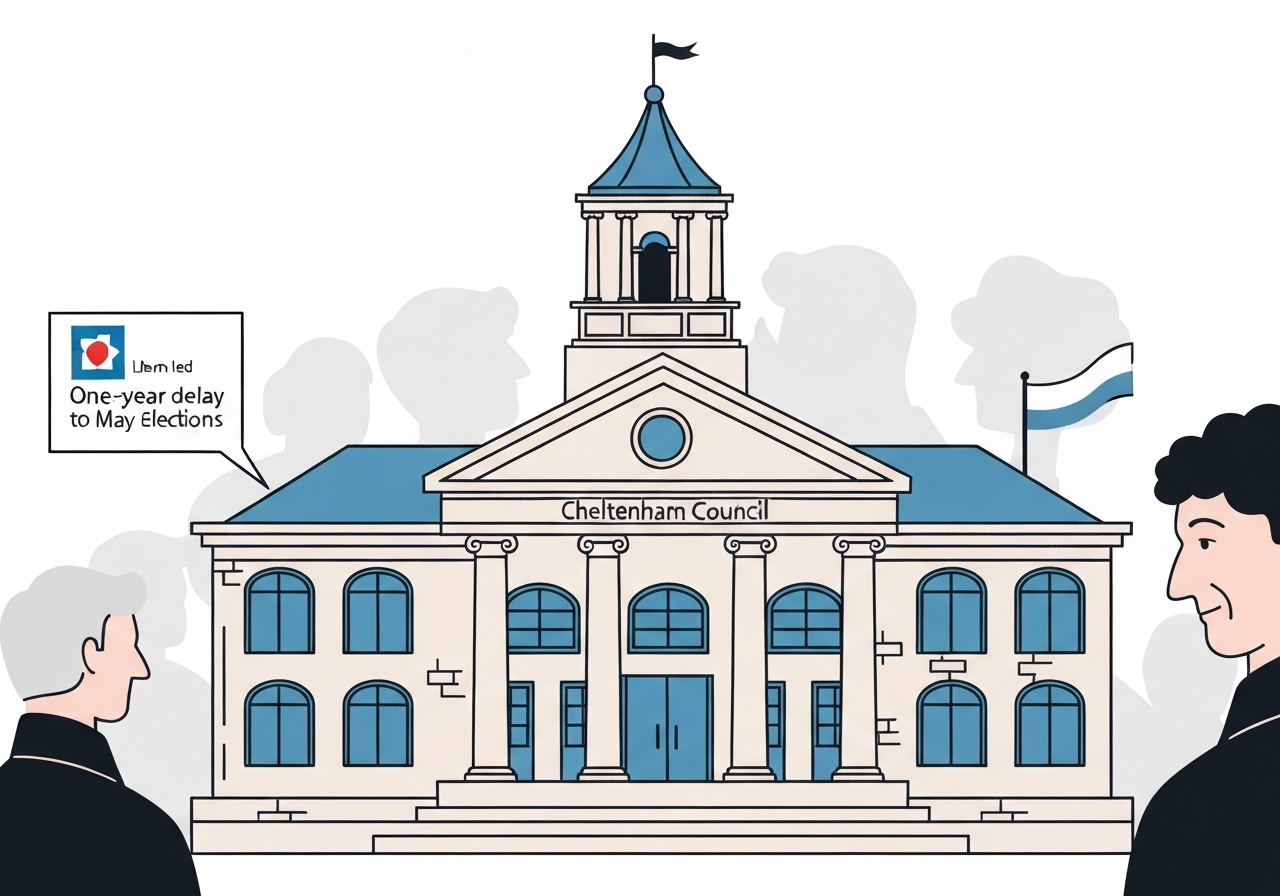
Cheltenham Borough Council has decided it will ask the government to postpone its local elections scheduled for 7 May, seeking a 12-month deferral because of cost and resource pressures. The move comes just over two weeks after Liberal Democrat leader Sir Ed Davey warned such postponements could breach the right to free elections under the Human Rights Act. Council leader Rowena Hay said the authority would prefer to hold the vote as planned but judged a delay to be the most responsible course given funding and reorganisation strains. The request is tied to planned local government restructuring in Gloucestershire that would replace seven councils with two unitary authorities in 2028.
Key takeaways
- Cheltenham Borough Council will ask for a 12-month postponement of the 7 May local elections, citing cost and operational strain.
- Since 2002, Cheltenham has elected half its councillors every two years; it held full council elections in 2024.
- Lib Dem leader Sir Ed Davey previously wrote to the Equality and Human Rights Commission citing Article 3 of Protocol 1 of the Human Rights Act and warned of democratic harm if delays proceed.
- The council says reorganisation plans would place Cheltenham in an eastern unitary authority with Tewkesbury and the Cotswolds; new authority elections are slated for May 2027 and vesting in April 2028.
- A Lib Dem spokesperson highlighted that Cheltenham’s councillors have only served around 18 months, contrasting with some Conservative-controlled areas last elected in 2021.
- Ministers earlier invited all 63 councils affected by reorganisation to flag whether they needed postponements; Local Government Minister Alison McGovern said “multiple councils” had requested delays.
- Political reactions have ranged from concern about democratic rights to acceptance that specific local circumstances may justify a delay.
Background
England’s local election calendar is under strain because of government proposals to reorganise some counties into unitary authorities. The government’s timetable envisages elections to new Gloucestershire councils in May 2027, with the new authorities taking over in April 2028. In preparation for that transition, ministers offered affected areas the option to postpone elections that would otherwise take place in the interim.
Since 2002 Cheltenham has run elections by halves every two years, but the council held full elections in 2024, meaning current councillors have comparatively short terms so far. In February the government allowed nine areas to delay 2025 contests into 2026 to help manage the restructuring, and later contacted all 63 councils in scope to assess whether further postponements were needed. The prospect of further delays has prompted debate about the balance between administrative practicality and voters’ rights.
Main event
Cheltenham Borough Council announced this week it will formally ask the government to push its 7 May elections back by 12 months. The council framed the decision around costs and the operational burden of running an election that may only produce representatives who serve for a short transitional period ahead of unitary change. Leader Rowena Hay emphasised a preference to proceed with the ballot where possible but said the current funding and organisational environment makes that difficult.
The council’s statement notes “major under-funding of local government” and the pressures of preparing for a county-wide reorganisation that will remove the existing county council and six district councils. Under the proposals Cheltenham would join Tewkesbury and the Cotswold district in a new eastern unitary authority. The council argued that running a resource-intensive election that might deliver councillors with at most a 12-month term is not responsible at this time.
The request comes after Sir Ed Davey urged the Equality and Human Rights Commission in December to investigate ministers’ suggestions that they would agree to postponements for councils that asked for them. In his letter he cited Article 3 of the first protocol to the Human Rights Act, stressing the right to free elections. A Lib Dem spokesperson told the BBC that Cheltenham’s circumstances differ from councils last elected in 2021, where councillors would otherwise approach seven years in office before facing voters again.
Analysis & implications
At the legal and rights level, the dispute turns on whether a blanket or repeated postponement of scheduled polls would violate protections for free elections. Sir Ed Davey frames the issue as a possible human-rights infringement; ministers and councils frame it as a pragmatic response to logistical and financial obstacles created by reorganisation. If the government approves multiple postponements, it may face legal challenges or heightened scrutiny from rights bodies and opposition parties.
Administratively, delaying an election can free local authorities to redeploy scarce staff and budget towards statutory services during a period of change. However, delays also compress terms, complicate local accountability, and may affect policy continuity. In Cheltenham’s case, councillors elected in 2024 have already served only around 18 months, a fact the Lib Dem group cites to justify a shorter transitional cycle compared with areas last contested in 2021.
Politically, the decision exposes tensions within and between parties. Conservatives have accused ministers of being “scared of the voters,” while some Conservative leaders have signalled they will not block requests from Tory-led councils. Reform UK has signalled it would seek parliamentary action to oppose widespread postponements. A pattern of selective delays risks feeding public scepticism about fairness, even if individual councils make pragmatic cases based on finance and capacity.
Comparison & data
| Council / Area | Last full/most recent election | Implication if May 2025 delayed |
|---|---|---|
| Cheltenham Borough Council | Full election in 2024 | Councillors would have served ~18 months before next poll if delayed to 2026 |
| Essex, Hampshire, Sussex (examples) | Last elections in 2021 | Councillors could serve ~7 years before facing re-election if 2025 polls postponed |
| Gloucestershire (reorganisation area) | N/A (reform timetable) | New unitary elections planned for May 2027; vesting April 2028 |
The table highlights why councils argue that local contexts differ: Cheltenham’s full election in 2024 means its members have had shorter service so far, while other councils could see unusually long intervals between votes if delays are allowed. Those contrasts feed the political debate over fairness and the urgency of a consistent national approach.
Reactions & quotes
Party leaders and local officials have framed the decision through differing lenses of principle and practicality. Below are concise excerpts and the surrounding context.
“Article 3 of the first protocol of the Human Rights Act spells out in black and white the right to free elections.”
Sir Ed Davey, Liberal Democrat leader (letter to EHRC)
Davey used that legal framing to urge the Equality and Human Rights Commission to examine ministers’ suggestions that they might grant delays to councils requesting them, warning of broad democratic consequences.
“We have to take a balanced and pragmatic view as to how we can continue to prioritise our residents and deliver the high-quality services they rightly expect.”
Cllr Rowena Hay, Leader of Cheltenham Borough Council
Hay emphasised service delivery and fiscal responsibility as the motivating considerations for the council’s request, while reiterating a preference to hold elections when feasible.
“The councillors there have only been in place for 18 months as they had full council elections in 2024.”
Lib Dem spokesperson (comment to media)
The party spokesperson used that point to distinguish Cheltenham from areas with longer-serving councillors, framing the case as a specific, not universal, situation.
Unconfirmed
- Whether the government will approve Cheltenham’s formal request for a 12-month postponement is not yet confirmed.
- Sir Ed Davey’s estimate that “nearly 10 million” voters could have their vote affected is a projection and has not been independently validated in this report.
- The full number and identities of other councils that will submit or have already submitted formal delay requests remain incomplete in public records.
Bottom line
Cheltenham’s planned request to delay the 7 May elections underscores a broader tension between pragmatic local management during structural reform and the principle of regular, enforceable voting rights. The council frames the step as necessary given funding shortfalls and the resource intensity of running a poll that would quickly be overtaken by unitary change; opponents see a slippery slope that could erode democratic norms if applied unevenly.
The immediate next steps are procedural: Cheltenham will submit its request and ministers will decide whether to grant it, while legal and political scrutiny is likely to continue. How the government responds will shape not only the timetable for Gloucestershire’s reorganisation but also perceptions of fairness and accountability across areas facing similar choices.
Sources
- BBC News — national news report summarising council statements, party responses and government context.