
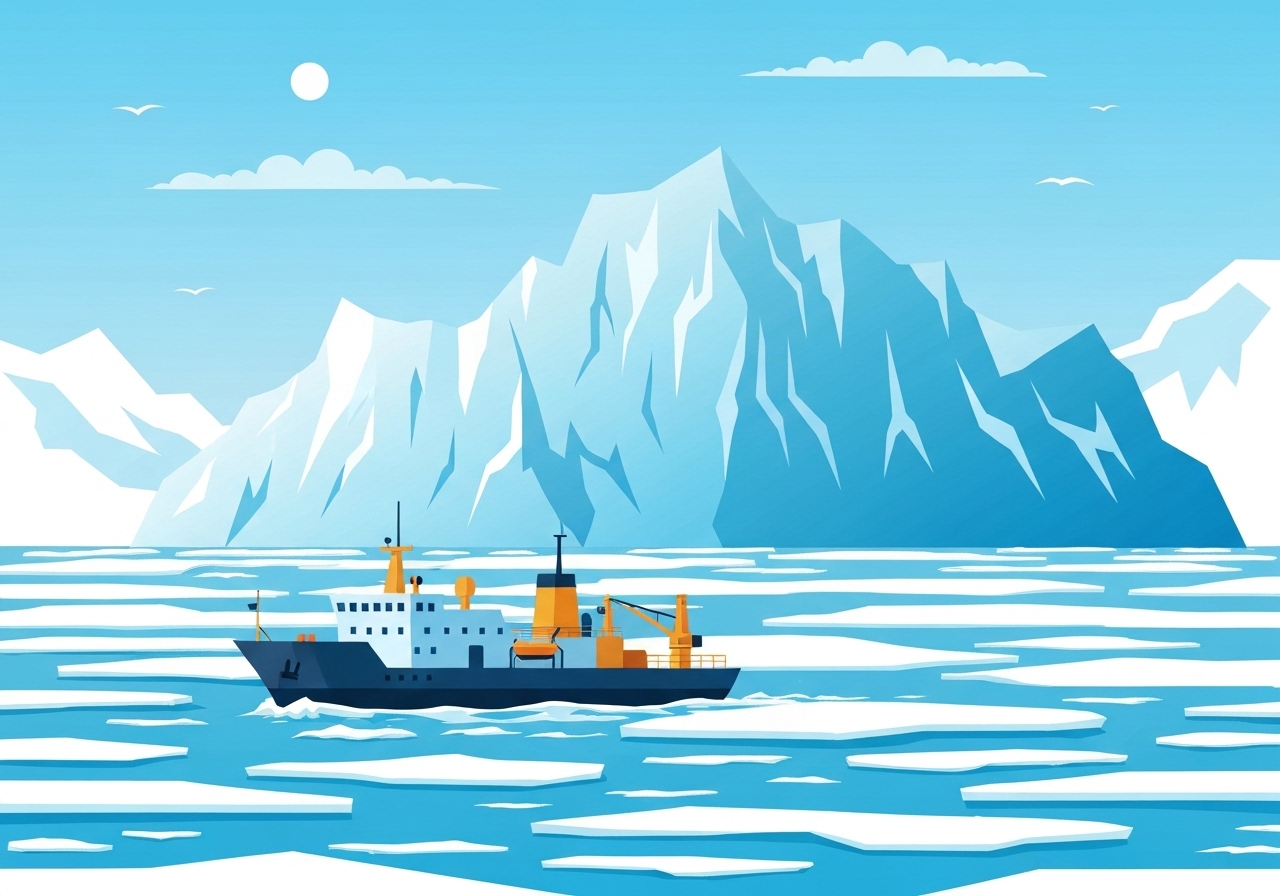
Lead: On Jan. 7, 2026, after a 12-day voyage from New Zealand, the South Korean icebreaker Araon arrived in the waters off the Thwaites Glacier in the Amundsen Sea and began deploying a multi-platform scientific campaign. Nearly 40 scientists are aboard, preparing airborne, undersea and on-ice instruments to study one of Antarctica’s fastest-melting glaciers. The ship battled exceptionally dense sea ice in the days before arrival; only around midnight on Wednesday did the thickest ice begin to clear, allowing teams to move equipment toward field operations.
Key Takeaways
- The Araon reached the Thwaites Glacier sector on Jan. 7, 2026 after a 12-day crossing from New Zealand, with nearly 40 scientists on board.
- Crew and researchers encountered an unusually dense band of sea ice beginning Monday, Jan. 5, forcing repeated course changes and slow progress for hours.
- Field work will combine airborne surveys, undersea measurements and surface-based sampling to probe ice, ocean and atmosphere interactions around Thwaites.
- The ship experienced repeated impacts with pack ice; the captain, Kim Gwang-heon, had not slept for more than 30 hours before the thick ice started to clear.
- Logistics and safety remain central concerns: dense ice can delay access to planned study sites and complicate deployment of autonomous systems.
Background
Thwaites Glacier sits in the Amundsen Sea and is widely regarded by scientists as a critical point for future global sea-level rise because of its size and the speed at which parts of it are thinning. Over recent decades, warm ocean water reaching the glacier’s underside has accelerated ice loss, prompting repeated international research campaigns aimed at understanding the mechanisms and timelines for collapse. Those campaigns combine oceanography, glaciology, airborne remote sensing and on-ice measurements to build the datasets needed to improve models.
Access to Thwaites is logistically difficult: sea ice, extreme weather and remote location require ice-capable ships, airborne platforms and well-drilled field teams. National polar programs and international collaborations have staged multiple expeditions to the region in recent years; each season’s window for work is narrow, making timely arrival and safe station-keeping essential. Stakeholders include national research bodies, climate modelers and coastal planners who use Thwaites data to refine sea-level projections.
Main Event
The Araon’s voyage from New Zealand took 12 days, during which routines shifted from transit to field readiness as researchers prepared instruments and sampling plans. On Monday, Jan. 5, the ship entered a zone of exceptionally dense pack ice that forced the crew to grind through floes, backtrack and seek narrow leads of open water. The vessel’s hull repeatedly came into contact with ice, producing heavy vibrations and making movement slow and noisy.
Only around midnight on Wednesday, Jan. 7 did the most obstructive ice begin to open sufficiently for the ship to hold position near the glacier front. Crews immediately began preparing winches, autonomous vehicles and airborne sensors, staging them for rapid deployment once safety checks were completed. Teams plan to conduct surveys from the air, lower instruments beneath the ice, and establish short-duration camps on the glacier surface for direct sampling.
Field teams emphasize safety and redundancy: remote robotic platforms will gather data where human access is risky, and shipborne laboratories will process oceanographic samples. The campaign’s multi-pronged approach is designed to capture coupled processes—ocean conditions, ice-shelf structure and surface mass balance—that together govern how fast ice can be lost to the sea. Operational timelines remain flexible to accommodate further sea-ice changes and weather windows.
Analysis & Implications
The arrival of the Araon and the immediate start of field operations matter because observations near Thwaites are both scarce and urgently needed. Models of future sea-level rise are sensitive to processes that occur at glacier fronts and under floating ice shelves; direct measurements reduce uncertainty in projections used by coastal planners worldwide. Each season of observation helps constrain how quickly grounded ice could retreat and what that implies for global mean sea level over coming decades.
Logistical delays from dense sea ice underscore a broader vulnerability in polar research: changing and variable ice conditions—driven in part by climate trends—can both motivate study and hinder it. More unpredictable access increases the cost and risk of campaigns, which may push programs to invest more heavily in autonomous systems, long-duration sensors and international sharing of ship time. That shift could accelerate data collection but also requires upfront investment and coordination.
Politically and economically, new Thwaites data can influence national adaptation planning and international climate assessments. If the campaign yields evidence of accelerating instability, it could strengthen calls for earlier and deeper emissions reductions as well as prompt re-evaluation of coastal defenses. Conversely, refined measurements that narrow uncertainties may allow more targeted, phased adaptation strategies where urgent investment is most needed.
Comparison & Data
| Metric | Expedition Figure | Context |
|---|---|---|
| Transit duration | 12 days | Voyage from New Zealand to Amundsen Sea |
| Personnel | Nearly 40 scientists | Multidisciplinary teams: oceanography, glaciology, atmospheric science |
| Sea-ice episode | Dense pack ice beginning Jan. 5, 2026 | Repeated slow-and-back maneuvers; cleared around midnight Jan. 7 |
The simple table above places the Araon campaign’s basic metrics in context: a relatively short transit compared with longer circumpolar cruises, a concentrated science team size appropriate for intensive short-window work, and a sea-ice disruption that highlights operational risk. Those elements shape what data can be collected this season and how robustly teams can deploy instruments.
Reactions & Quotes
We pushed through hours of compacted floes and were relieved to find open water near midnight, which finally let us set up for science operations.
Captain Kim Gwang-heon, Araon
Preparations began immediately: airborne sensors, submersible platforms and surface teams will be used together to capture cross-disciplinary snapshots of the glacier and adjacent ocean.
Expedition scientist (on board)
Unconfirmed
- Whether the Araon will be able to reach the glacier grounding line this season remains unconfirmed; access depends on ice conditions and safety assessments.
- Specific measurements and their preliminary results have not been released; any claims about rapid new trends from this campaign are currently unconfirmed.
Bottom Line
The Araon’s arrival at Thwaites on Jan. 7, 2026 marks the start of a concentrated effort to observe processes that strongly influence global sea-level projections. Dense sea ice episodes delayed arrival and highlight operational constraints that will shape what can be measured within the current season’s narrow windows. For policymakers and coastal managers, outcomes from this campaign could refine near-term risk assessments and help prioritize adaptation investments.
Readers should watch for rapid provisional releases from the expedition and follow-up peer-reviewed analyses over the coming months; immediate field notes will inform model updates, while comprehensive interpretation will take longer. Given Thwaites’s outsized role in sea-level uncertainty, each season’s data add materially to the global understanding of future coastal risks.
Sources
- The New York Times — news reporting from the Araon in the Amundsen Sea (Jan. 7, 2026).