
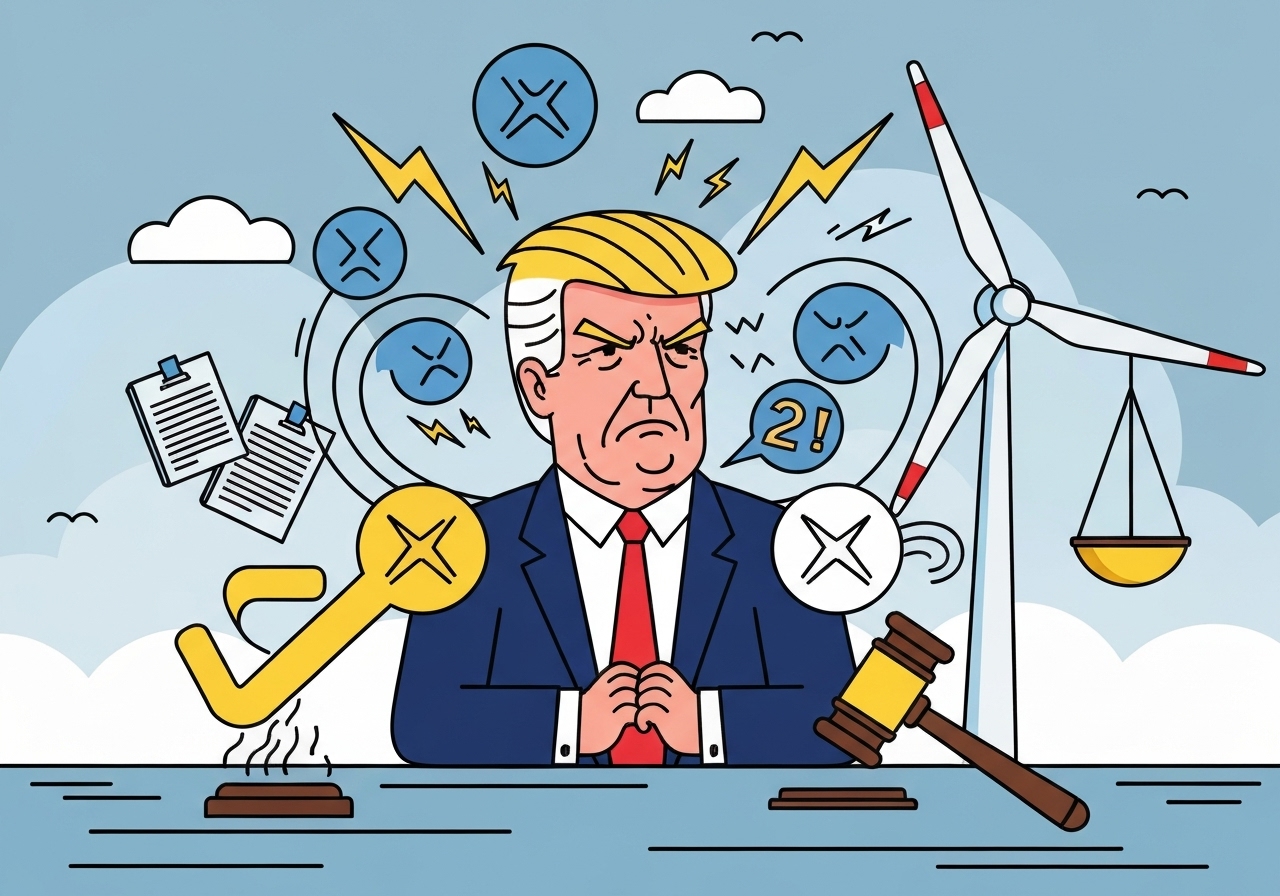
Lead: Developers and two states have filed federal lawsuits after the Trump administration on Dec. 22 ordered a pause on leases for five large East Coast offshore wind projects, citing national security concerns. The suits, filed in early January 2026, name the administration and seek to lift the suspension so construction can resume. Equinor has told a court that its Empire Wind project faces “likely termination” if work cannot restart by Jan. 16; Connecticut and Rhode Island have sought emergency relief for Revolution Wind. The legal actions set up a test of the administration’s authority to halt approved renewable projects while invoking undisclosed security reasons.
- Five projects affected: Empire Wind (Equinor), Sunrise Wind (Ørsted), Vineyard Wind (Avangrid/Copenhagen Infrastructure Partners), Revolution Wind (Ørsted/Skyborn), and Coastal Virginia Offshore Wind (Dominion Energy Virginia).
- The administration announced on Dec. 22 a suspension of leases for at least 90 days; the order gave no public specifics about the national security concerns cited.
- Empire Wind LLC asked the U.S. District Court for D.C. for expedited consideration, saying construction likely must resume by Jan. 16 or financing and project viability will be in jeopardy.
- Ørsted and Equinor filed civil suits late Tuesday; Dominion Energy Virginia filed the first lawsuit earlier, calling the pause “arbitrary and capricious” and unconstitutional.
- Ørsted says it has spent billions on Sunrise Wind and met weekly with the U.S. Coast Guard throughout 2025 with no security objections raised.
- Revolution Wind work was previously paused on Aug. 22, 2025; a federal judge permitted a resumption a month later after finding likely success on the merits for developers.
- Equinor finalized its federal lease for Empire Wind in March 2017; federal approval for Empire Wind’s last permit came in February 2024.
Background
Offshore wind has been a central element of East Coast clean-energy plans, with large leases awarded and multi-billion-dollar investments by European and U.S. developers. The five projects halted by the administration represent years of permitting, vessel scheduling and financing tied to tightly managed construction windows. The Interior Department framed the pause as necessary to protect military readiness and maritime operations, a rationale echoed by agency spokespeople but described publicly only in broad terms.
President Trump has publicly favored fossil fuels such as oil, coal and natural gas and has previously taken actions that slowed or canceled clean-energy programs. The current pause follows earlier intermittent halts: the administration briefly stopped work on Empire Wind in April 2025 before allowing it to resume a month later. That history adds legal and political complexity as developers and affected states press courts to restore progress.
Main Event
On Dec. 22, the administration announced a lease suspension for at least 90 days on five large offshore wind projects along the East Coast, citing unspecified national security concerns. The notice did not disclose the specific threats or risks that prompted the action, triggering immediate concern from project owners and state officials who had invested in planning and construction.
Equinor — owner of the Empire Wind project off New York — filed for emergency court consideration, warning that vessel schedules and financing will collapse if work cannot restart by Jan. 16. The company said the pause disrupts a “tightly choreographed” construction campaign dependent on specialized ships with limited availability, producing delay costs that imperil project financing.
Ørsted, which owns Sunrise Wind and is co-developer of Revolution Wind, also sued to vacate the order. Its filing notes billions invested in Sunrise Wind and maintains the company met regularly with the U.S. Coast Guard and other agencies throughout 2025 without objections being raised about national security impacts.
Connecticut and Rhode Island filed a joint action seeking a preliminary injunction to allow work on Revolution Wind to continue, arguing that project delays immediately raise energy costs for consumers and threaten regional clean-energy targets. Dominion Energy Virginia, developing the Coastal Virginia Offshore Wind project, was the first to sue, labeling the agency action arbitrary, capricious and unconstitutional.
Analysis & Implications
The administration’s invocation of national security — without public specifics — creates a legal hinge point. Courts will weigh whether the agency provided a reasoned explanation and followed required procedures before pausing leases that were previously issued and relied upon by private investors and state energy plans. If a judge finds the action arbitrary, the pause could be reversed quickly; if the administration’s rationale withstands scrutiny, projects may face lengthy reviews and additional mitigation requirements.
For the projects themselves, timing is critical. Offshore wind construction depends on narrow seasonal windows and specialized vessels; delays can cascade into mounting costs, loan defaults and investor pullback. Empire Wind’s Jan. 16 timing claim illustrates how calendar constraints can translate into existential financial risks for a project that has already completed permitting milestones.
Broader economic and policy effects are likely. A sustained halt could slow U.S. offshore wind deployment, affecting jobs, supply-chain contracts and state renewable energy targets. It may also chill future investment: developers price regulatory and political risk into bids and financing, and an unpredictable approval environment raises the cost of capital for clean-energy infrastructure.
Comparison & Data
| Project | Owner(s) | Primary State | Status (as of Jan 7, 2026) | Key date |
|---|---|---|---|---|
| Empire Wind | Equinor | New York | Leases paused; emergency court filing (expedited) | Lease finalized Mar 2017; final federal approval Feb 2024 |
| Sunrise Wind | Ørsted | New York | Leases paused; Ørsted suit filed | Billions invested; weekly agency meetings in 2025 |
| Revolution Wind | Ørsted / Skyborn | Rhode Island / Connecticut | Work paused; states seeking injunction | Paused Aug 22, 2025; judge allowed resumption a month later (previously) |
| Vineyard Wind | Avangrid / Copenhagen Infrastructure Partners | Massachusetts | Leases paused; developer has not confirmed joining suits publicly | Under construction (per reports) |
| Coastal Virginia Offshore Wind | Dominion Energy Virginia | Virginia | Leases paused; Dominion filed suit first | Developer litigation initiated |
The table summarizes owners, locations and the immediate legal status of the five affected projects. The mix of developers includes European firms with multi-billion-dollar investments and U.S. utilities; each project is at a different stage of permitting or construction, which explains the variety of legal strategies and urgency levels in filings.
Reactions & Quotes
The Interior Department framed the pause as a measured action to safeguard national security and maritime operations. The administration emphasized multi-use management of federal waters while signaling it will prioritize defense and operational compatibility in approvals.
“We will not sacrifice national security or economic stability for projects that make no sense for America’s future.”
Matt Middleton, Interior Department spokesperson (official statement)
Developers and some state officials sharply dispute that claim, saying agencies coordinated with project teams through 2025 and raised no security red flags. They argue the administration’s action was sudden and lacks a public evidentiary basis, prompting litigation to restore construction schedules and preserve financing.
Connecticut’s attorney general highlighted immediate consumer impacts if projects stall, framing the dispute in terms of energy costs and vetted approvals.
“Every day this project is stalled costs us hundreds of thousands of dollars in inflated energy bills when families are in dire need of relief.”
William Tong, Connecticut Attorney General (state official)
Dominion Energy Virginia, which is developing the Coastal Virginia project, sought judicial relief first and described the pause as legally unsupported. Its filing and public statements focus on the administrative record and constitutional claims.
“The administration’s order is arbitrary and capricious.”
Dominion Energy Virginia (company filing)
Unconfirmed
- No specific public evidence has been released detailing the precise national security vulnerabilities cited by the administration.
- The total near-term financial losses to each project from the current pause have not been publicly itemized by developers or agencies.
- Avangrid has not confirmed whether it will join the litigation challenging the lease suspensions for Vineyard Wind.
Bottom Line
The dispute puts U.S. offshore wind deployment at a legal and operational crossroads. Developers warn that a short pause can trigger cascading schedule and financing failures tied to vessel availability and seasonal work windows, while the administration argues national security concerns require a pause to reassess coordination with military and maritime operations.
Court decisions in the coming weeks will determine whether projects can restart quickly or face extended review, with implications for energy costs, jobs and the broader pace of America’s clean-energy transition. Observers should watch for the administration’s evidentiary record and any judicial rulings on whether the pause meets legal standards for reasoned decision-making.
Sources
- PBS NewsHour (news media) — original reporting on lawsuits and agency statements.
- U.S. Department of the Interior (official federal agency) — official statements on management of public lands and waters.
- Bureau of Ocean Energy Management (BOEM) (federal agency) — context on offshore leasing and permitting.