
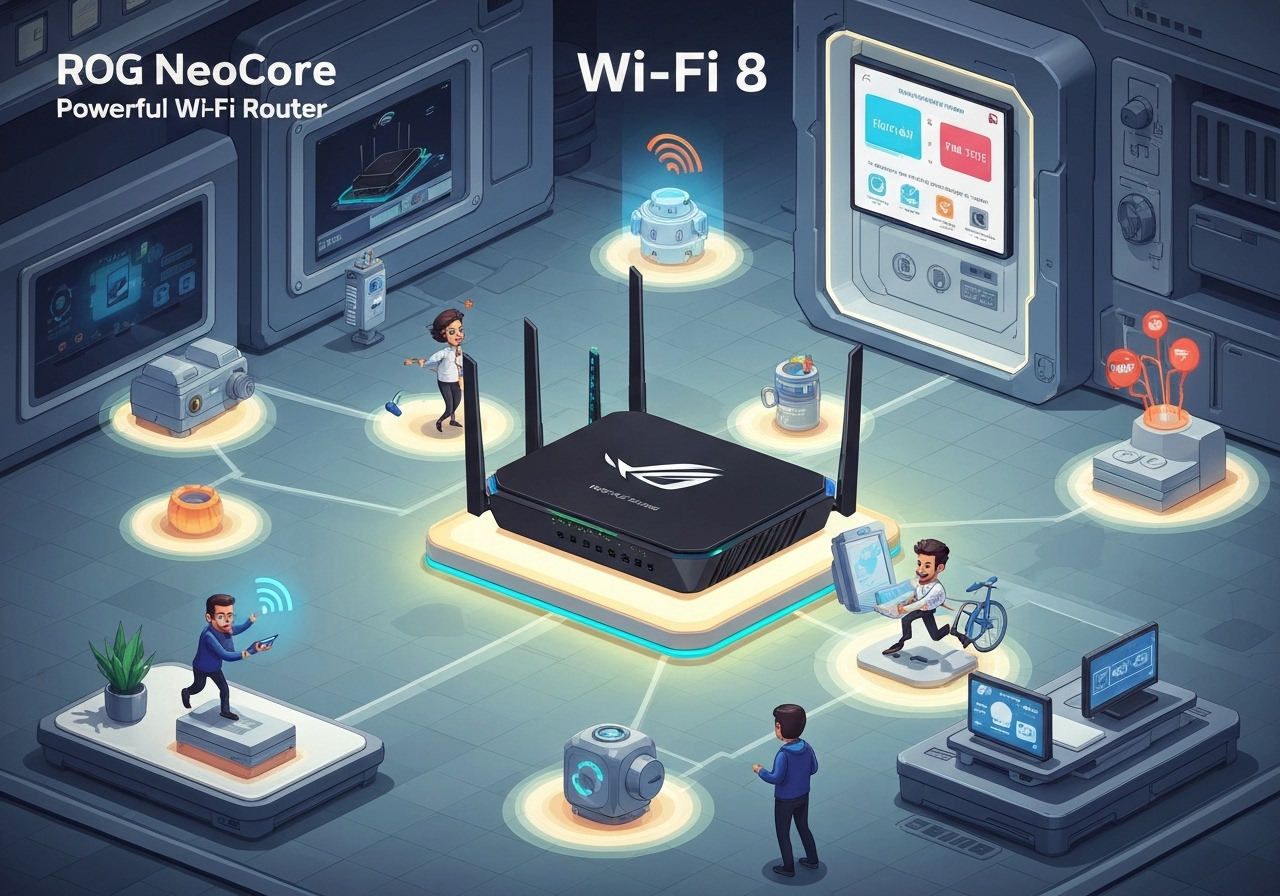
Lead: At CES 2026, Asus unveiled the ROG NeoCore, a proof‑of‑concept Wi‑Fi 8 router shown as an icosahedron design that emphasizes wireless stability and low latency. The demonstration, seen in person by ZDNET’s Kyle Kucharski, included visible Ethernet ports, vents and a wall‑mount hook. Asus framed the move as a step toward routers that prioritize reliability for crowded homes and IoT devices. The company says its first Wi‑Fi 8 home routers are planned for release later in 2026, though the NeoCore itself may remain a concept.
Key Takeaways
- Asus previewed the ROG NeoCore Wi‑Fi 8 concept at CES 2026, showing an unusual 20‑sided chassis and a wall‑mount option.
- The company positions Wi‑Fi 8 as primarily improving stability: reducing speed degradation and strengthening low‑power two‑way links for IoT devices.
- Asus claims Wi‑Fi 8 can deliver up to 2× midrange throughput versus Wi‑Fi 7, 2× IoT coverage, and up to 6× lower P99 latency.
- Concrete hardware details (chipset, supported bands, full port count) were not disclosed at the preview.
- ZDNET’s Kyle Kucharski reported visible cues—three Ethernet ports, heat vents and a power input—during the CES demonstration.
- The IEEE has projected the Wi‑Fi 8 standard (IEEE 802.11be successor) to be finalized in 2028, meaning early vendor prototypes may precede final specs.
- Asus says it will ship its first Wi‑Fi 8 home routers later in 2026, suggesting vendor‑driven adoption ahead of standard finalization.
Background
Wi‑Fi 7 only recently reached consumers, promising higher peak speeds and expanded spectral efficiency; nonetheless, vendors and standards bodies have continued work toward the next generation. Industry attention has already shifted to Wi‑Fi 8, which aims less at headline speeds and more at predictable performance in multi‑device, dense environments. Device makers and network vendors face growing pressure as homes accumulate smart lights, sensors and always‑on gadgets that stress radios in different ways.
Asus has historically released pioneering designs under its ROG brand, often targeting gamers and power users who value latency and reliability. The company’s public messaging around Wi‑Fi 8 emphasizes four connectivity challenges: reduced degradation, improved stability, better two‑way links for low‑power devices, and improved congestion management. That framing aligns with technical proposals in the Wi‑Fi 8 roadmap, which include coordinated spatial reuse and other interference‑mitigation tools.
Main Event
At CES 2026 Asus displayed the ROG NeoCore as an attention‑grabbing prototype rather than a retail product. The icosahedron shape is visually novel for a router, and attendees noted a hook for wall mounting that could make the geometric form practical for some installations. ZDNET’s on‑floor reporting captured a unit with three visible Ethernet ports, cooling vents and a standard power connector, but Asus did not release a full spec sheet.
Asus’ public announcement emphasized the benefits Wi‑Fi 8 brings to everyday use—chiefly steadier connections and lower tail latency—rather than promising specific throughput figures for the NeoCore. Company materials listed performance comparisons against Wi‑Fi 7 (up to 2× midrange throughput, 2× IoT coverage, and up to 6× lower P99 latency) without describing the precise mechanisms implemented in the prototype hardware.
Observers at CES flagged the timing. The IEEE’s timeline indicates Wi‑Fi 8 standardization is not expected until 2028, so Asus previewing hardware in 2026 suggests a vendor‑led push to ship compatible routers before the standard is finalized. That approach can accelerate real‑world testing but carries interoperability and compliance risks if the standard changes.
Analysis & Implications
Asus’ focus on stability over peak speed reflects how home networking needs are evolving: multiple active clients, latency‑sensitive gaming, and many low‑power IoT devices demand predictable behavior more than occasional top speeds. If Wi‑Fi 8 delivers the latency and coverage improvements Asus cites, users should see fewer hiccups in video calls, cloud gaming sessions and smart home routines during congested periods.
Technologies expected in Wi‑Fi 8—such as Coordinated Spatial Reuse—allow devices to adapt transmit power and timing based on neighbors, which reduces mutual interference. That capability is especially valuable in apartments and dense urban settings where overlapping networks create persistent contention. Router firmware and network‑management features will determine how effectively vendors translate standard capabilities into real‑world gains.
Launching vendor hardware before a standard is final can create early advantages: first movers collect customer feedback, shape ecosystems and set expectations. However, the risk is product fragmentation if draft features are altered in the final IEEE spec; manufacturers may need firmware updates or new silicon to maintain compliance over time. Consumers should watch for software upgrade commitments and third‑party interoperability testing results.
Comparison & Data
| Metric | Wi‑Fi 7 | Claimed Wi‑Fi 8 Improvement |
|---|---|---|
| Midrange throughput | Baseline | Up to 2× |
| IoT coverage | Baseline | Up to 2× |
| P99 (tail) latency | Baseline | Up to 6× lower |
The table summarizes Asus’ public claims comparing Wi‑Fi 8 to Wi‑Fi 7. These figures come from Asus’ announcement and reflect potential architectural benefits rather than independently validated measurements. Real‑world gains will depend on device support, environmental factors, and firmware optimization. Independent lab tests and interoperability trials will be important to verify the magnitude of the improvements in typical home deployments.
Reactions & Quotes
“Our ROG NeoCore concept demonstrates a shift: Wi‑Fi 8 is about reliable, low‑latency connectivity for modern homes, not just raw peak speed,”
Asus (official announcement)
Asus framed the NeoCore as a concept that highlights connectivity priorities rather than a finished consumer product. The company reiterated plans to ship consumer Wi‑Fi 8 routers later in 2026.
“Coordinated Spatial Reuse and other Wi‑Fi 8 proposals could significantly cut interference in crowded networks,”
Steven Vaughan‑Nichols, ZDNET (Wi‑Fi 8 explainer)
Independent commentary from industry observers points to protocol‑level changes that underpin Asus’ stability claims; experts stress the need for ecosystem support across client devices and routers to realize those benefits.
Unconfirmed
- Whether the ROG NeoCore prototype will be sold in its icosahedron form or reworked into a conventional enclosure remains unverified.
- Asus has not published the NeoCore’s chipset, supported frequency bands or full port specifications; these technical details are still unknown.
- The exact mechanisms and firmware features Asus will use to deliver the claimed 2× throughput, 2× IoT coverage and 6× lower P99 latency have not been independently confirmed.
- How early 2026 commercial routers will interoperate with future devices and with the final IEEE Wi‑Fi 8 specification (expected 2028) is uncertain.
Bottom Line
Asus’ NeoCore at CES 2026 serves primarily as a statement of intent: the company is prioritizing stability, latency and IoT friendliness for the next generation of home Wi‑Fi. The geometric design draws attention, but the technical messaging—about managing congestion and improving tail latency—is the more consequential element for most users.
Consumers should welcome a focus on dependable connections, but they should temper expectations until independent tests and interoperability reports appear. Watch for Asus’ retail Wi‑Fi 8 models later in 2026 and for third‑party lab results that validate latency, throughput and coverage claims as the standard work continues toward IEEE finalization in 2028.
Sources
- ZDNET — Asus ROG NeoCore hands‑on at CES 2026 (press coverage / journalism)
- Asus official site (company announcement / official)
- IEEE Standards Association (standards body / timeline information)