
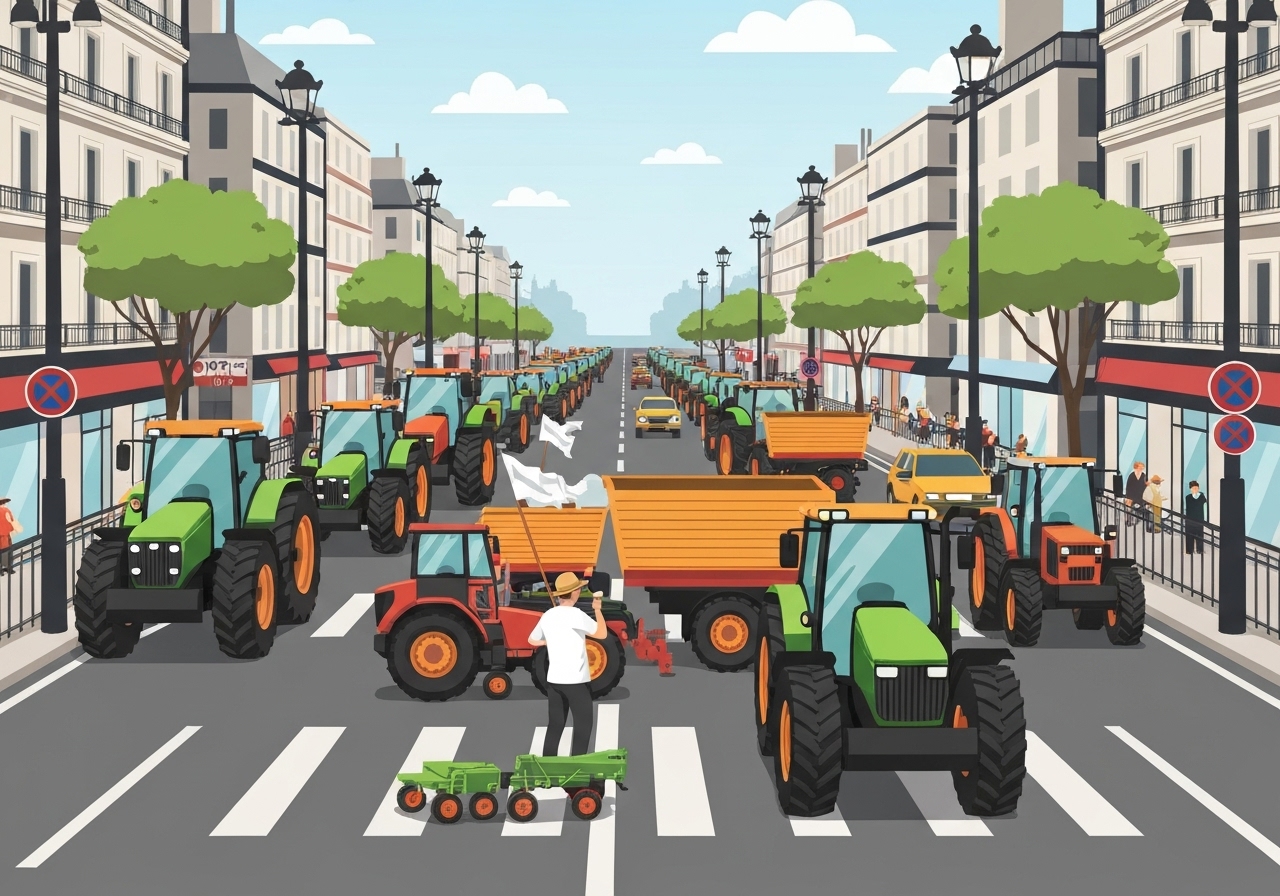
Lead: On Jan. 8, 2026, dozens of French farmers drove convoys of tractors into Paris and staged a demonstration outside the National Assembly to oppose renewed European Union talks to finalize a trade agreement with the Mercosur bloc. Protesters — organized by the Rural Coordination union — said the deal would damage local farming incomes and amplified anger about recent sanitary controls for bovine disease. Police contained many vehicles at Paris’s edges while roughly 20 tractors reached central landmarks near the Arc de Triomphe and the Eiffel Tower. The demonstration sought to pressure Paris into taking firmer steps against the pact ahead of possible signatures in Paraguay on Jan. 12.
Key Takeaways
- Date and place: Protest occurred on Jan. 8, 2026, outside France’s National Assembly in Paris.
- Participation: Organizers said about 100 tractors were driven toward Paris; the Interior Ministry reported about 20 tractors reached the city center.
- Cause: Farmers oppose an EU-Mercosur free trade deal covering Brazil, Argentina, Bolivia, Paraguay and Uruguay, citing threats to beef, poultry, sugar, ethanol and honey sectors.
- Organizers: The Rural Coordination union led the action; the group has acknowledged links to the political far right.
- Government response: Police blocked many tractors at Paris’s boundary roads; authorities said convoys bypassed some controls to reach inner districts.
- Timing: EU negotiations were renewed the same week, with speculation a deal could be signed in Paraguay on Jan. 12, 2026.
- Political context: Protesters criticized President Emmanuel Macron and called on him to publicly and forcefully oppose the pact.
Background
For several years French farm groups have warned that a comprehensive trade agreement between the European Union and Mercosur countries would increase imports of cheaper agricultural goods and undermine domestic producers. French officials and unions say Mercosur producers benefit from lower production costs and different regulatory regimes, creating price pressures on French farms. Agriculture has been a politically sensitive issue in France, where rural protests and blockades have repeatedly drawn national attention and shaped electoral discourse.
The Mercosur negotiations resumed internally within the EU this week amid a split between member states: Germany and other supporters seek to advance the deal, while France and Poland have voiced concerns. French farmers’ organizations say longstanding grievances — including sanitary measures related to bovine disease and perceived weak government defenses — have added urgency to the demonstrations. The Rural Coordination union, which organized Thursday’s action, represents regional farming interests and has mounted similar road and market protests in past years.
Main Event
The day’s action began when convoys of tractors from multiple regions entered Paris on Jan. 8, aiming to gather at the National Assembly. Law enforcement established checkpoints on major peri-urban arteries and prevented many tractors from penetrating deep into central Paris. Still, the Interior Ministry reported about 20 tractors were present in high-profile districts, including near the Arc de Triomphe and the Eiffel Tower.
Organizers framed the demonstration as both symbolic and strategic: they wanted to bring complaints “closer to those who have the power,” a regional Rural Coordination leader said, stressing the need for direct appeals to lawmakers. Protesters carried banners and chanted demands for stricter state action to shield French production from imported competition, while also criticizing sanitary controls they view as burdensome or inconsistently applied. Police monitored the gathering and contained traffic disruptions; no major violence was reported.
Several demonstrators traveled long distances; one participant from Corsica described a multi-leg journey by boat, tractor and train to join the Paris action. Rural Coordination called on the government for “quick, effective decisions” to address agricultural pressures. Officials reiterated that breaching city bans and bypassing controls would not be tolerated, while also acknowledging the complexity of balancing freedom to protest with public order and traffic safety.
Analysis & Implications
The protest highlights growing friction between national farming constituencies and EU trade policy. If the EU proceeds with a Mercosur agreement, French producers fear immediate competition in price-sensitive markets such as beef and poultry; over time, market share shifts could affect rural employment and downstream processors. Policymakers must weigh those domestic economic and social costs against broader EU goals of market access, diplomatic ties, and export opportunities for other sectors.
Domestically, the action places pressure on President Emmanuel Macron’s centrist administration to reconcile its pro-European trade orientation with the political sensitivity of agricultural constituencies. A public, forceful French objection could influence bloc-level decision-making or extract concessions — but it also risks straining relations with Mercosur partners and EU allies advocating the deal. The government’s maneuvering will be watched closely ahead of the potential Jan. 12 signing in Paraguay.
Beyond immediate trade mechanics, the protests intersect with sanitary and regulatory disputes. Farmers cited recent bovine disease controls as an added grievance, illustrating how health rules and trade policy interact to shape producer sentiment. If unaddressed, such compound grievances can feed broader rural disaffection and spur further actions — from market blockades to votes of no confidence in local representatives — amplifying political risk for national leaders.
Comparison & Data
| Item | Reported figure |
|---|---|
| Tractors driven toward Paris | ~100 (organizers’ estimate) |
| Tractors in central Paris | ~20 (Interior Ministry) |
| Potential signing date | Jan. 12, 2026 (speculated) |
| Mercosur members named | Brazil, Argentina, Bolivia, Paraguay, Uruguay |
These figures show a gap between organizers’ claims and official tallies, a common feature of mass demonstrations. The near-term political calendar — including EU internal deliberations and the possible Paraguay signing — frames the urgency felt by both protest organizers and government negotiators. Economic data on sector-specific import flows and price differentials will be central to any technical exemptions or transitional measures negotiators might propose.
Reactions & Quotes
“The goal today is to come to Paris to express our demands closer to those who have the power,”
José Perez, Rural Coordination (Lot-et-Garonne)
Perez framed the mobilization as a symbolic appeal to lawmakers and a response to perceived insufficient government defense of farmers’ interests.
“We want President Macron to stand by the side of farmers. He needs to clearly tell it out loud and to impose it, too,”
Ludovic Dupeux, Rural Coordination (Corsica)
Dupeux criticized the president for not doing enough to block or reshape the proposed accord and emphasized the political expectations placed on the executive.
Police said convoys “bypassed and forced their way,”
French Interior Ministry (official statement)
The ministry described the law-enforcement response and the logistics of containment, noting that most tractors were intercepted at Paris’s outskirts.
Unconfirmed
- Exact total number of tractors that entered Paris remains disputed between organizers’ claims (~100) and official counts (about 20 in central Paris).
- Whether the EU will finalize a signing in Paraguay on Jan. 12, 2026, and what concessions (if any) France might extract remain unresolved.
- Attribution of responsibility for any breaches of road bans is under investigation; precise routes and tactics used by convoys are not fully verified.
Bottom Line
Thursday’s tractor demonstration underscores how trade policy can rapidly become a domestic flashpoint when combined with local grievances such as sanitary controls and rural economic stress. The visible disruption in Paris was as much about sending a political message to national leaders as it was about the technicalities of any trade text. For negotiators in Brussels and capitals across Europe, the protest is a reminder that trade outcomes carry distributional consequences that can provoke sustained political pushback.
In the days ahead, two dynamics will matter: whether Paris can leverage formal objections or seek carve-outs to protect sensitive farm sectors, and whether rural mobilization sustains itself or escalates. Observers should watch official EU deliberations and French government statements closely; any compromise or hardline stance will shape both market forecasts for French agriculture and the broader political landscape ahead of upcoming votes and consultations.
Sources
- NBC News (news — republishes Associated Press reporting)
- The Associated Press (news wire) — reporting and field dispatch cited in original coverage
- French Interior Ministry (official) — public statements on policing and traffic control