
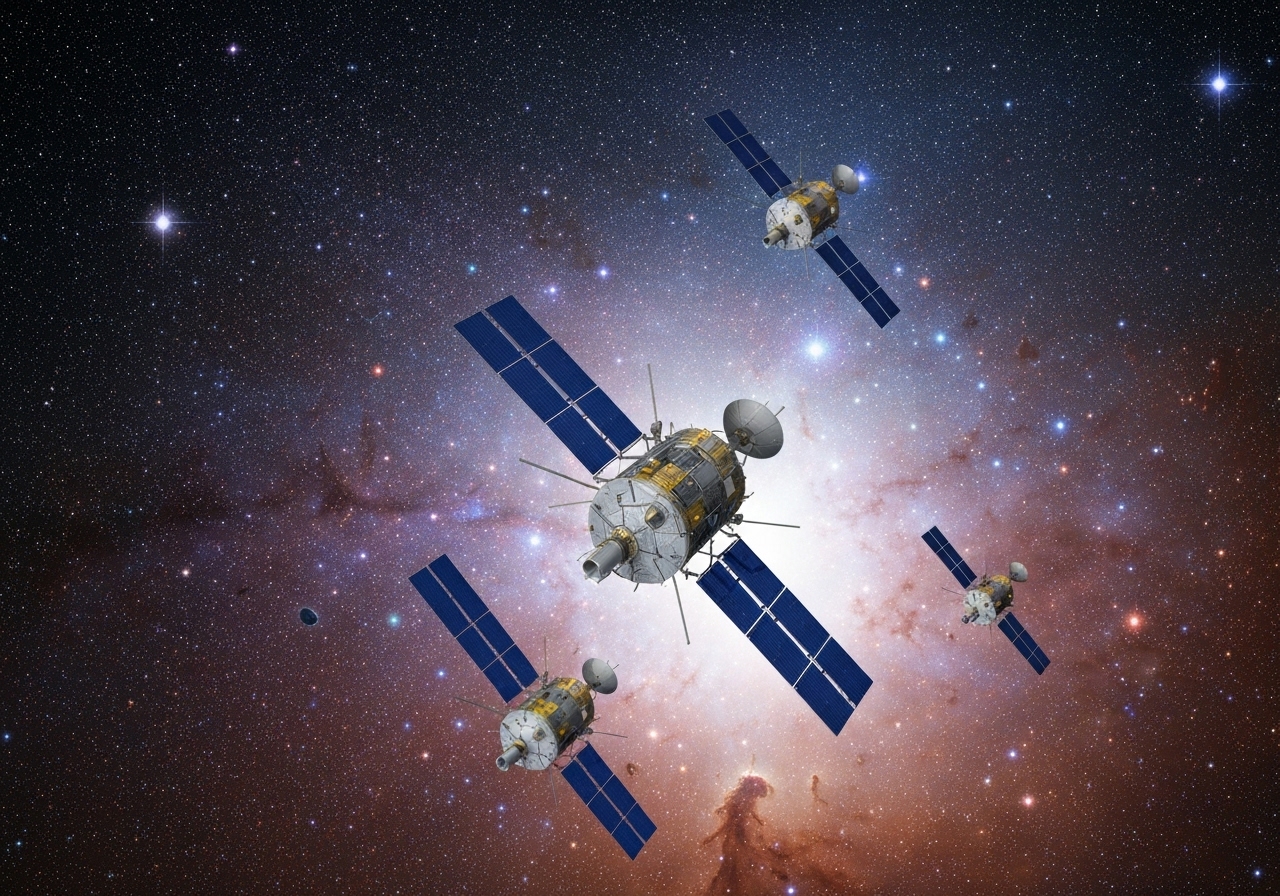
Researchers warn that, in a worst-case emergency such as an extreme solar storm, satellites circling Earth could begin colliding in under three days — a dramatic reduction from seven years ago that shortens response windows for operators worldwide. A newly proposed metric, the Collision Realization And Significant Harm (CRASH) Clock, estimates how long it would take for the first collision if every spacecraft lost maneuvering capability simultaneously. The study’s preprint was posted to arXiv on Dec. 10 and finds the CRASH Clock for late 2025 is roughly 2.8 days, with a 30% chance of a collision within 24 hours of such an event. Authors caution the result is preliminary and subject to revision, but they emphasize the rapid tightening of margins in low Earth orbit (LEO).
- CRASH Clock (end of 2025): ~2.8 days estimated, with a 30% probability of at least one collision within 24 hours after a mass-disablement event.
- Change since 2018: The clock is 125 days shorter than the 2018 estimate of 128 days, reflecting much denser traffic in LEO.
- Satellite population: At least 11,700 active satellites were operating around Earth as of May 2025, most within LEO (up to 1,200 miles / 2,000 km altitude).
- Growth rate: That total represents a roughly 485% increase from about 2,000 LEO satellites at the end of 2018, before the first Starlink launches.
- Launch cadence: Orbital launches reached a record 324 in 2025, about a 25% increase over 2024, accelerating orbital densification.
- Primary trigger scenario: A large solar storm is the most plausible single event to disable many satellites simultaneously by disrupting electronics and positioning.
Background
Low Earth orbit has become significantly more crowded in the last decade, driven largely by commercial ‘‘megaconstellations’’ deploying thousands of small communications satellites. Operators rely on active control systems — sensors, ground commands and onboard propulsion — to avoid close approaches; if those systems fail en masse, spacecraft will drift on ballistic trajectories. The CRASH Clock was developed to translate that crowded environment into a single, comprehensible timescale: how long until the first collision if no avoidance is possible. The metric does not predict cascading outcomes directly but provides a standardized indicator of how little time remains to act after a disabling event.
Regulatory, commercial and technical stakeholders have different incentives and capabilities in LEO. Operators can de-orbit or maneuver working satellites, but many small satellites lack robust end-of-life propulsion or hardened electronics. Governments track objects for collision avoidance, yet tracking accuracy and data-sharing arrangements vary across nations and companies. Historically, collision risk was lower when only a few thousand satellites populated LEO; today’s tens of thousands of objects — including inactive debris — change that calculus and reduce margins for coordinated response.
Main event
The team modeled spacecraft positions and altitudes across LEO and then simulated the timeframe to the first close approach that could produce an impact if all active avoidance stopped. By this method, they estimate the CRASH Clock at about 2.8 days for late 2025 — a steep decline from the estimated 128 days in 2018. The study highlights that a single large solar storm, which can inject high-energy particles into near-Earth space and disrupt onboard systems, is a plausible trigger that could render many satellites unable to communicate or maneuver.
Lead author Sarah Thiele (Princeton University) and co-author Aaron Boley (University of British Columbia) emphasize that the CRASH Clock is an aggregate, statistical signal rather than a precise countdown. They note that uncertainties in object catalogues, atmospheric drag during geomagnetic storms, and differing satellite designs all affect exact timing, but the trend toward shorter CRASH Clock values is robust. The authors also acknowledge the preprint has not yet passed peer review and that subsequent refinement of inputs may change the numerical value.
The simulations do not assume immediate, instantaneous fragmentation from the first impact; rather, they record the time until the first collision under the no-avoidance hypothesis and discuss how multiple impacts could follow. If collisions do begin, subsequent debris could increase collision probability for remaining spacecraft, raising the specter of a self-sustaining cascade — the so-called Kessler Syndrome. The paper stops short of declaring that Kessler Syndrome is imminent, citing many poorly constrained factors that govern whether a chain reaction can become irreversible.
Analysis & Implications
The most direct implication is operational: satellite operators and national space agencies would have only days, or even hours, to detect a disabling event and take preventive steps to reduce collision risk. That window matters for decisions such as activating redundant systems, issuing coordinated maneuver plans, or placing critical spacecraft into safe modes. Shorter CRASH Clock values raise the value of hardened electronics, autonomous fault management, pre-authorized collision avoidance maneuvers and international data-sharing agreements that speed decision-making during crises.
Strategically, a compressed response window amplifies systemic vulnerability: a single solar storm or coordinated cyberattack could produce outsized impacts if many satellites are affected simultaneously. For commercial services that depend on continuous connectivity — Earth imaging, communications, navigation — even temporary loss of a portion of a constellation could cascade into economic and societal effects. Regulators face pressure to update debris mitigation standards, require redundancy and improve cross-operator coordination to reduce the chance that a short CRASH Clock translates into long-term loss of LEO utility.
Economically, industries that invest in large fleets may now need to price in higher resilience costs: radiation-hard parts, spare satellites, or insurance premiums that reflect the elevated collision hazard. Politically, the findings could accelerate calls for standardized emergency protocols and joint situational-awareness platforms to give diverse operators the best chance of coordinated responses. International negotiation will be difficult because norms and liability are still evolving, but the growing density of LEO creates a shared incentive to reduce systemic risk.
| Metric | 2018 | 2025 (reported) |
|---|---|---|
| Active satellites in LEO | ~2,000 | 11,700 |
| Estimated CRASH Clock | 128 days | ~2.8 days |
| Orbital launches (year) | — | 324 (2025) |
The table highlights the rapid change in orbital population and the corresponding compression of the CRASH Clock. These figures illustrate why the authors view the trend as alarming: more objects plus denser orbital shells reduces the time available for corrective action after a mass-disablement event.
Reactions & Quotes
Context: The CRASH Clock was framed by the authors as a communicative tool as much as a technical metric, intended to give operators and policymakers an intuitive sense of orbital fragility. One co-author described the clock’s intended role in plain terms.
The CRASH Clock is a statistical measure of the timescale expected for a close approach that could give rise to a collision.
Aaron Boley, astronomer, University of British Columbia
Context: The lead author highlighted the most plausible initiating event for a simultaneous loss of maneuver capability: severe space weather. She emphasized the navigational uncertainty a major storm can introduce.
During such an event, it becomes impossible to estimate where objects are going to be in the future.
Sarah Thiele, astrophysics researcher, Princeton University
Context: Independent experts and industry representatives contacted by reporters noted that while precise probabilities are model-dependent, the overall message — shrinking margins in a crowded LEO — demands policy and technical responses. Operators also pointed to the practical challenges of coordinating maneuvers among many owners under time pressure.
Unconfirmed
- Whether the CRASH Clock numerical estimate (2.8 days) will be materially revised when the preprint completes peer review — authors expect adjustments but have not published a final value.
- Exactly how many subsequent collisions would follow an initial impact under different fragmentation models; the threshold for an irreversible Kessler cascade remains uncertain.
- The precise role and impact of untracked debris fragments smaller than typical radar tracking thresholds during a mass-disablement event are not fully constrained in the current simulations.
Bottom line
The CRASH Clock concept translates orbital congestion into a single, actionable timescale: how long until the first collision if satellites can no longer avoid one another. Whether the clock reads days or months, the compelling signal is the trend — a sharp compression of available reaction time as LEO fills with satellites and debris. That trend increases the value of resilience measures: hardened systems, automated onboard safety responses, routine data-sharing agreements and updated international norms for rapid crisis coordination.
Policymakers, operators and insurers should treat the CRASH Clock as an early-warning index that justifies investment in mitigation and cooperative frameworks. Even if the precise 2.8-day estimate is refined, the broader conclusion is unchanged: denser traffic in LEO reduces the margin for error and raises both operational and systemic risk. Without stronger technical protections and international cooperation, a disabling event could produce collisions that are difficult to reverse and that undermine the long-term usability of vital orbital services.
Sources
- Live Science — news report summarizing the preprint and interviews with the study authors (news).
- arXiv search: CRASH Clock — preprint server where the study was uploaded on Dec. 10 (academic preprint).
- SpaceNews — industry coverage reporting 324 orbital launches in 2025 and related launch statistics (industry news).