
Lead
Pope Leo XIV, the first United States–born pope, delivered a high-profile address to the international diplomatic corps at the Vatican on January 9, 2026, warning that the post–World War II prohibition on cross‑border force has been eroded. Speaking in his native English before ambassadors gathered in the Apostolic Palace, he highlighted rising tensions in the Caribbean Sea and along the American Pacific coast and called for respect for the will of the Venezuelan people and a return to stability. Leo framed the erosion of multilateral restraints as a broader threat to international law and humanitarian protections. His remarks came amid reports of a recent U.S. operation in Venezuela and ongoing Russian military action in Ukraine.
Key Takeaways
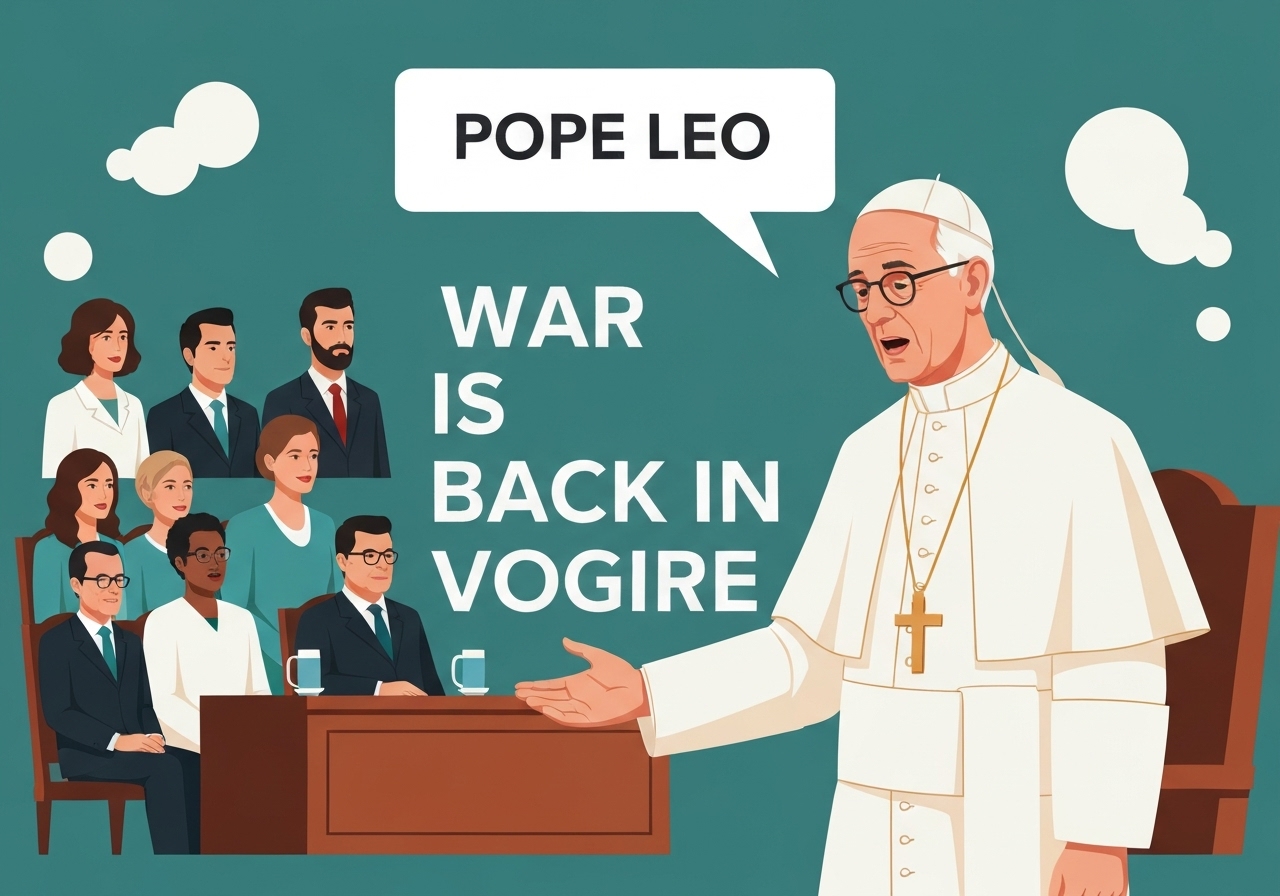
- Pope Leo declared that “war is back in vogue,” saying the prohibition on nations using force to violate others’ borders has been “completely undermined.”
- The address took place on January 9, 2026, and lasted roughly 43 minutes; Leo spoke mainly in English to the Vatican’s diplomatic corps.
- He singled out escalating tensions in the Caribbean Sea and the American Pacific coast and urged respect for the “will of the Venezuelan people.”
- Leo emphasized the primacy of international humanitarian law, warning that diplomacy based on consensus is being replaced by diplomacy backed by force.
- The speech criticized trends in the West on freedom of expression, and condemned abortion, surrogacy and euthanasia while defending conscientious objection by health professionals.
- He used comparisons to the fifth century and Saint Augustine to underline a perceived shift in global order marked by migration and geopolitical change.
- The speech followed an Extraordinary Consistory of cardinals that concluded on January 8, 2026, and signals Leo’s intent to consult the College of Cardinals more regularly.
Background
The Vatican traditionally summons the international diplomatic corps each year for a “state of the world” address in which a pope outlines priorities and concerns. Pope Leo, born in Chicago and the first U.S.-born pontiff, used his first annual address to set tone for his early months in office. He inherits a papacy after Pope Francis, whose synodal reforms and outreach on contested pastoral issues provoked both praise and resistance within the College of Cardinals.
The post–World War II international order, including norms against territorial conquest and the humanitarian protections embedded in international law, has long underpinned global stability. In recent years those norms have been tested by Russia’s 2022 invasion of Ukraine and by regional interventions and crises in Latin America and elsewhere. Vatican diplomacy traditionally champions multilateral institutions—particularly the United Nations—as guardians of the fragile arrangements that followed 1945.
Main Event
On January 9, 2026, Pope Leo addressed ambassadors in the Apostolic Palace, describing the erosion of the prohibition on cross‑border force as both a legal and moral crisis. He said multilateral approaches are weakening while calls to resolve disputes through force or coercion are growing louder. The pope explicitly contrasted his appeal to international law with comments attributed to U.S. political leaders who have questioned the binding force of international norms.
Leo singled out rising tensions in the Caribbean Sea and the American Pacific coast and asked that the “will of the Venezuelan people” be respected as the country seeks stability. His remarks came after media reports claiming a U.S. military operation had seized Venezuelan leader Nicolás Maduro; Leo did not elaborate on those reports but used the moment to underscore legal and humanitarian limits on coercion.
The pontiff also used the forum to reiterate long-standing Church teachings: he condemned abortion, surrogacy and euthanasia and defended the right of medical professionals to conscientious objection. He warned that efforts to expand inclusive language in Western societies risk excluding those who dissent from prevailing ideological currents, a comment delivered while also urging protection for migrants and refugees against degradation in the name of law enforcement.
Analysis & Implications
Pope Leo’s framing of a return to force as a systemic problem places the Vatican squarely in the camp defending the post‑1945 legal order. For states committed to multilateralism, that rhetorical stance reinforces pressure on governments to use diplomatic and legal channels rather than unilateral military options. The pope’s comments could strengthen Vatican engagement in conflict mediation and international legal advocacy, including renewed appeals to the United Nations and humanitarian agencies.
Regionally, Leo’s mention of the Caribbean and the American Pacific coast signals heightened Vatican concern about instability in the Western Hemisphere. By invoking the “will of the Venezuelan people,” the pope implicitly urged external actors to weigh popular legitimacy and humanitarian consequences before intervening. If influential states interpret the speech as a moral argument against covert operations, it could complicate certain foreign policy options in Latin America.
Domestically within the Church, Leo’s speech balances doctrinal firmness on bioethical issues with procedural openness—he has asked the College of Cardinals for regular input and emphasizes listening in governance. That mix may appeal to both reformers and conservatives: reformers because of his willingness to consult and conservatives because of his clear statements on abortion and euthanasia. How cardinals and national bishops respond will shape implementation of synodal processes and potential pastoral shifts.
Comparison & Data
| Item | Recent benchmark |
|---|---|
| Length of address | ≈43 minutes |
| Consistory conclusion | January 8, 2026 |
| Pope’s origin | Chicago, United States |
The table above highlights the concrete markers tied to this speech: its duration, the close timing with the January 8 consistory, and Leo’s U.S. background. Those facts help explain the speech’s bilingual delivery and procedural emphasis: a U.S.-born pontiff speaking in English and prioritizing regular consultations with the College of Cardinals.
Reactions & Quotes
Vatican diplomats and visiting envoys reacted publicly and privately to the speech, interpreting it as both a moral rebuke to unilateral force and a policy blueprint for increased Vatican diplomatic activism.
“War is back in vogue and a zeal for war is spreading.”
Pope Leo XIV, address to diplomatic corps, January 9, 2026
That sentence became the focal point of media coverage, summarized by ambassadors as a deliberate appeal to revive respect for the principles that followed World War II.
“The principle established after the Second World War…has been completely undermined.”
Pope Leo XIV
Diplomats interpreted the remark as a direct defense of the UN-centered order; some foreign-policy analysts said the pope was signaling a clear preference for law-based conflict resolution.
“I’m here to listen.”
Pope Leo XIV, to the College of Cardinals, January 8, 2026
Cardinals who attended the January 8 consistory described the pope’s approach as intentionally consultative; several noted Leo’s repeated references to synodality and evangelization as priorities for future discussion.
Unconfirmed
- Media reports that the United States captured Venezuelan leader Nicolás Maduro in a military raid remain unverified in official government statements and should be treated as unconfirmed.
- Assertions about a rapid shrinkage of freedom of expression in Western countries reflect the pope’s judgment; metrics and independent studies vary by country and are not uniformly cited in his address.
Bottom Line
Pope Leo’s January addresses to the diplomatic corps and to the College of Cardinals have set a clear, if measured, agenda for his early pontificate: defend international law, protect humanitarian norms, and pair doctrinal clarity with broader consultative governance. By invoking the post‑1945 order and warning against a resurgence of force, the pope seeks to reassert the Vatican’s role as a moral and diplomatic voice in global crises.
For foreign governments and Church leaders, the immediate implication is a renewed expectation that the Vatican will press for legal remedies, mediation and respect for human dignity in hotspots from Latin America to Europe. How secular leaders respond—whether by reasserting multilateral channels or pursuing unilateral courses—will determine whether Leo’s appeal influences policy or remains primarily rhetorical.