
Lead
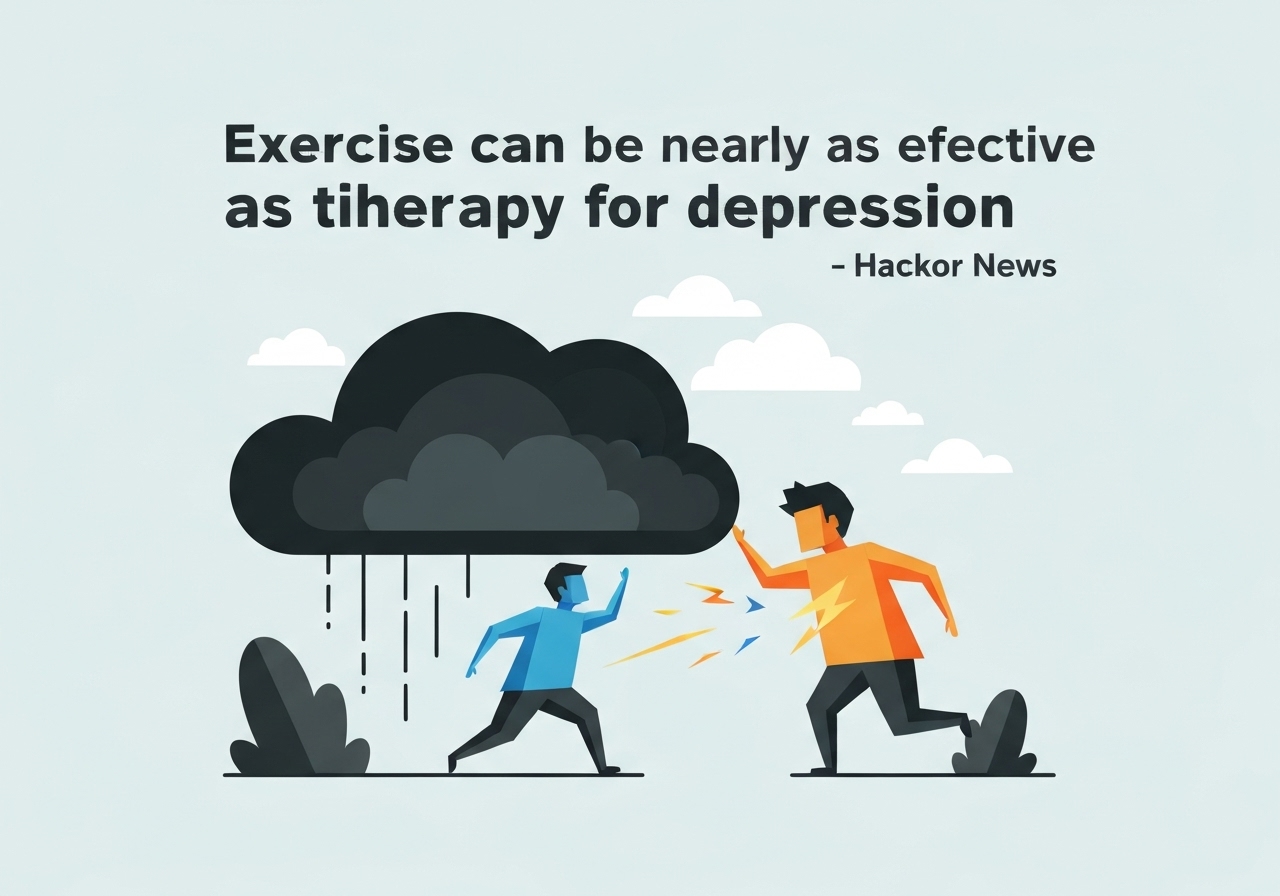
A recent conversation on Hacker News, linked to a ScienceDaily summary of systematic evidence, revived a recurring finding: structured exercise can substantially reduce depressive symptoms and, in some trials, approach the effect size seen with psychotherapy. The Cochrane-style synthesis cited in the thread pooled dozens of randomized trials and reported a standardized mean difference favoring exercise at the end of treatment. Commenters on the Hacker News thread emphasized that exercise helps many people but also warned about barriers — low motivation, comorbid conditions and the limits of generalizing averages to individuals.
Key takeaways
- The systematic evidence pooled 57 trials with about 2,189 participants, reporting a pooled standardized mean difference (SMD) of roughly −0.67 for depressive symptoms at end of treatment versus control (low‑certainty evidence).
- When analyses were restricted to higher‑quality trials (seven trials, 447 participants), the pooled SMD decreased to approximately −0.46, indicating a more modest but still measurable benefit.
- Long‑term follow‑up is sparse and uncertain: pooled data from nine trials (405 participants) produced a very uncertain SMD (≈ −0.53) with wide confidence intervals that crossed zero.
- Hacker News engagement was high: the thread received 222 points and 161 comments in the snapshot cited, illustrating widespread public interest and varied lived experience.
- Clinical and lived‑experience reports in the discussion showed heterogeneity: some people report exercise alone resolved major depressive episodes, others found no benefit without medication or therapy, and some cited executive‑function barriers that prevent exercising during severe depression.
Background
Research on exercise for depression spans decades and includes randomized trials, observational cohorts and systematic reviews. A prominent synthesis aggregated tens of trials to estimate average symptom change compared with control conditions; those pooled statistics are typically reported as standardized mean differences to combine different rating scales. Standardized metrics show the magnitude of effect in standard deviation units rather than raw points on a single scale.
Depression is heterogeneous clinically and etiologically: episodes may reflect biological vulnerability, situational stressors, trauma, medical comorbidity (e.g., endocrine or inflammatory disorders) or combinations of these. Because randomized trials enroll people who can and will participate, trial populations do not always represent the full range of people with severe, treatment‑resistant, or comorbid depression.
Main event
The Hacker News thread began by linking a ScienceDaily summary of a systematic review and quickly turned into a broad discussion about applicability. The Cochrane‑style pooled estimate (57 trials, ~2,189 participants) was cited repeatedly; commenters debated what a standardized effect size means in clinical terms and whether it translates to meaningful improvement for individual patients.
Many commenters described personal stories: some credited routine exercise, small‑step movement (walking, daily chores) or Parkrun‑style commitments with preventing or resolving severe episodes. Others said they experienced no benefit from exercise and required medication, psychotherapy, or both. A frequent theme was the chicken‑and‑egg problem — severe depression often removes the motivation necessary to begin an exercise program.
Practical tactics recommended in the thread included: schedule‑based routines to remove decision friction, incremental goals (short walks, two‑minute tasks), friction reduction (autopay, visible cues), and combining exercise with social connection. Several contributors with neurodivergence or executive‑function deficits warned that routine advice can be unhelpful or even harmful if it ignores underlying cognitive barriers.
Analysis & implications
Interpreting the pooled SMDs requires caution. An SMD of −0.67 (unrestricted pooled trials) is statistically meaningful and suggests a moderate effect on average, but standardized effect sizes do not map intuitively onto clinical thresholds without additional context (minimal clinically important differences, remission rates, or responder analyses).
When higher‑quality trials were isolated, the effect shrank (SMD ≈ −0.46), which is typical in meta‑analytic work: smaller, lower‑quality studies often inflate effect estimates. This pattern argues for cautious optimism — exercise appears beneficial for many people but is not a guaranteed substitute for established treatments in all cases.
Mechanistically, exercise plausibly affects mood through multiple pathways: acute neurochemical changes (endorphins, monoamines), improved sleep and circadian regulation, anti‑inflammatory effects, and psychosocial gains from mastery and social contact. Because these are broad, system‑level effects, exercise can complement targeted interventions (CBT, antidepressants) and sometimes produce clinically meaningful change on its own.
Policy and clinical implications: given low material cost and additional physical benefits, exercise should be offered as a core, evidence‑based option in stepped care models. However, services must also address access barriers (mobility, pain, socioeconomic constraints), provide behavioral activation support for people with low motivation, and integrate exercise with other treatments when needed.
Comparison & data
| Analysis set | Trials | Participants | Pooled SMD (approx.) |
|---|---|---|---|
| All randomized trials pooled | 57 | 2,189 | −0.67 (low‑certainty) |
| Higher‑quality trials (alloc. concealment, ITT, blinded outcome) | 7 | 447 | −0.46 |
| Long‑term follow‑up pooled | 9 | 405 | −0.53 (very uncertain) |
Context: standardized effect sizes are useful to synthesize across scales but do not by themselves specify clinical meaning. Clinically relevant metrics (percentage achieving remission, change on a familiar scale like the PHQ‑9 or BDI, or the minimal clinically important difference) are needed to judge patient‑level impact. The meta‑analytic literature on psychotherapy and pharmacotherapy provides similar average effects with wide interindividual variability.
Reactions & quotes
“Motivation is fleeting but routine persists.”
Hacker News commenter (online forum)
Commenters used this line to illustrate a behavioral activation principle: pre‑committed schedules remove the moment‑to‑moment decision that often fails during low‑energy periods.
“In higher‑quality trials the effect is smaller but still present.”
Systematic‑review summary (research synthesis)
This phrasing summarizes the statistical finding that restricting to methodologically stronger trials produced a reduced pooled SMD, a common meta‑analytic observation that lowers certainty.
“For some people exercise was transformative; for others it made no difference without meds or therapy.”
Multiple personal accounts (online forum)
These lived‑experience comments underscore heterogeneity of response and the need for personalized treatment plans.
Unconfirmed
- The universality claim: that exercise will help most people with depression is unconfirmed — trial averages do not predict individual outcomes.
- Long‑term durability: pooled long‑term follow‑up evidence is sparse and inconsistent, so sustained benefit after program end is uncertain.
- Mechanistic primacy: whether improvement is driven mainly by neurobiology, sleep, social contact, or behavioral activation (or some combination) remains incompletely resolved.
Bottom line
On average, randomized‑trial evidence indicates that structured exercise reduces depressive symptoms with a small‑to‑moderate effect size; when limited to higher‑quality trials the estimated effect is smaller but still present. Exercise is low‑risk, provides broad physical and psychosocial benefits, and should be recommended as a core option in stepped‑care models for depression.
However, clinicians and patients should treat the evidence as probabilistic, not deterministic: some people will need psychotherapy, medication, or a combination to achieve remission. Practical implementation matters — low‑friction routines, behavioral support to overcome initiation barriers, and adaptations for comorbidity and neurodivergence will determine whether exercise can be a feasible, sustained component of care.