
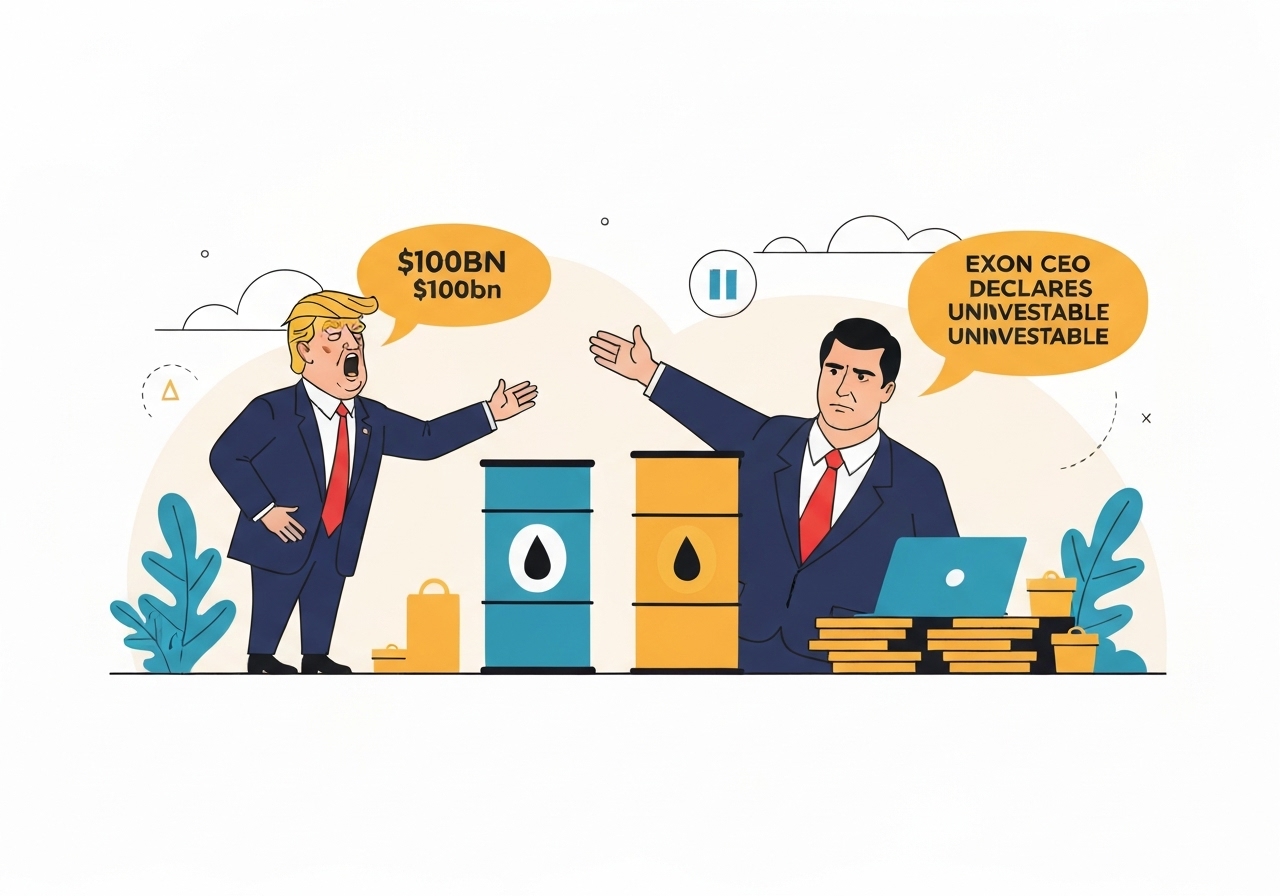
Lead: US President Donald Trump urged major oil companies at the White House to commit at least $100bn in investment to Venezuela’s petroleum sector, saying US control of sales could lower global energy costs. The meeting, held in Washington, followed a US operation cited as the 3 January seizure of Venezuela’s leader, Nicolás Maduro, and produced no immediate large-scale financial pledges. Senior industry executives acknowledged Venezuela’s vast reserves but warned that security, legal certainty and fiscal reforms would be necessary before opening their checkbooks. ExxonMobil’s chief executive characterized the country as ‘uninvestable’ in its current state.
Key Takeaways
- President Trump requested roughly $100 billion in oil-sector investment for Venezuela during a White House meeting; no major commitments were announced at the session.
- ExxonMobil CEO Darren Woods said the company has had assets seized twice in Venezuela and described the country as ‘uninvestable’ under current conditions.
- Venezuela’s current crude output is roughly 1 million barrels per day, about 1% of global supply; Chevron supplies around one-fifth of that production.
- Smaller firms may invest in the near term with ticket sizes near $50 million, while majors would demand security, legal guarantees and competitive fiscal terms before deploying billions.
- Rystad Energy estimates $8–9 billion per year would be needed to triple Venezuelan production by 2040; analysts say the $100bn figure would likely require subsidies and political stability.
- The US has signaled it will selectively unwind sanctions and intends to control crude sales through US-managed accounts and authorizations for which firms may operate.
Background
Venezuela sits atop some of the world’s largest proven oil reserves, but decades of mismanagement, disinvestment and sanctions have reduced its output dramatically. Once a heavyweight supplier, the country now produces roughly one million barrels per day, a fraction of its past levels and under 1% of global supply. International firms have had a fraught relationship with Venezuela since oil was discovered there more than a century ago; Chevron remains the last major US company still operating at scale inside the country.
Foreign independents and several European firms, including Spain’s Repsol and Italy’s Eni, have continued limited operations and were represented at the White House meeting. Past nationalizations and asset seizures have left many majors cautious: executing a long-term recovery plan would require physical security, contractual certainty and a transparent fiscal regime. Industry consultancies and analysts have repeatedly warned that rebuilding output will be capital- and time-intensive even under optimistic scenarios.
Main Event
The White House convened executives from the largest US and international oil companies to press for rapid private investment in Venezuelan oil fields. President Trump framed access to Venezuela’s crude as a strategic prize, saying US-managed sales could reduce energy prices and that Washington would decide which firms would be permitted to operate. Attendees acknowledged Venezuela’s appeal but made few concrete promises.
ExxonMobil’s CEO, Darren Woods, told the group the country remains unsafe for major investments, citing two prior episodes in which assets were seized and saying a third re-entry would demand significant, structural changes before the company would commit. Chevron said it expected to expand output built on its current foothold, while ExxonMobil announced plans to send a technical team to assess conditions in coming weeks.
Smaller operators signaled eagerness. Bill Armstrong, who heads an independent driller, described Venezuela as ‘prime real estate’ and said his firm was ready to proceed. Repsol stated its current Venezuelan output of about 45,000 barrels per day could be tripled over time given the right security, legal and commercial conditions.
US officials have also moved to control crude shipments: several tankers carrying sanctioned oil were seized recently and Washington says it is establishing a sales mechanism that would place proceeds into US-managed accounts. The White House emphasized it will ‘selectively’ ease sanctions but retain oversight to preserve leverage over interim authorities reportedly led by Vice-President Delcy Rodríguez.
Analysis & Implications
Short-term increases in Venezuelan production are plausible but constrained. Physical security of fields and export infrastructure has deteriorated, and repairing pipelines, storage and refining capability requires both capital and stable operations. For major integrated oil companies, the risk-reward calculus rests on guarantees that expropriations will not recur and that fiscal terms are transparent and competitive.
Even if Washington facilitates access and offers selective sanctions relief, legal uncertainty remains a barrier: companies need clear, enforceable contracts and a dispute-resolution framework before greenlighting multibillion-dollar projects. Analysts note that commitments on the order of $100bn would almost certainly require incentives or direct subsidies, as well as visible political stabilization inside Venezuela.
Economically, a substantial and sustained rise in Venezuelan output could help relieve regional supply tightness, but given current base production of ~1 million bpd, the immediate global price impact would be modest unless investment translated into rapid, large-scale restoration. Strategically, US control of sales channels would increase Washington’s leverage over Caracas’ interim authorities and could reshape geopolitical alignments around Latin American energy markets.
Comparison & Data
| Metric | Current | Needed / Target |
|---|---|---|
| Venezuela crude production | ~1,000,000 bpd | 3,000,000+ bpd (long-term goal) |
| Estimated annual investment to triple output (Rystad) | — | $8–9 billion per year to 2040 |
| Trump-proposed investment | — | $100 billion (one-off figure floated) |
The table highlights that the scale of investment needed to meaningfully expand Venezuela’s production is large but well below the headline $100bn unless rapid, frontier-scale rehabilitation is required. Rystad’s $8–9bn/year figure suggests a steady, multi-year funding stream rather than a single lump-sum infusion; industry sources say majors will only invest at scale with credible security and contractual guarantees.
Reactions & Quotes
White House framing: the president presented access to Venezuelan oil as both an economic and strategic prize, promising firms they’d ‘deal directly’ with the US rather than Caracas; officials said the administration will select which companies may operate and control receipts to maintain leverage.
‘One of the things the United States gets out of this will be even lower energy prices.’
President Donald Trump (White House meeting)
Industry caution: executives stressed that past seizures and legal uncertainty make re-entry costly and risky for majors, even as some companies signaled limited exploratory steps.
‘We have had our assets seized there twice… Today it’s uninvestable.’
Darren Woods, CEO, ExxonMobil
Independent operator view: smaller firms framed Venezuela as an opportunistic market where quick returns are possible for those willing to accept higher near-term risk.
‘We are ready to go to Venezuela… In real estate terms, it is prime real estate.’
Bill Armstrong, independent driller
Unconfirmed
- The exact timetable and legal framework by which the US would lift or ‘selectively’ ease sanctions remains undefined and subject to further announcements.
- Whether the administration’s assertion that US forces seized Nicolás Maduro on 3 January will be substantiated by international observers or additional official documentation is not independently verified here.
- No formal list has been published identifying which companies the US will allow to operate in Venezuela or under what legal terms; negotiations appear to be ongoing.
Bottom Line
President Trump’s proposal to mobilize up to $100bn for Venezuelan oil attracted industry attention but produced cautious responses rather than immediate financial commitments. Majors repeatedly emphasized that prior asset seizures, security deficits and legal uncertainty make large-scale re-entry untenable without deep structural changes and guarantees.
Smaller firms may pursue near-term opportunities with modest investments, but restoring Venezuela to a meaningful share of global supply would take sustained multi-year investment, technical work and political stabilization. Observers should watch for concrete policy steps: published sanction-relief criteria, authorized company lists, and credible mechanisms guaranteeing revenue flows and legal protections.
Sources
- BBC News — International news report summarizing the White House meeting and industry responses.
- ExxonMobil — Corporate site; cited for executive statements and company posture (corporate).
- Chevron — Corporate site; company noted as the largest remaining US operator in Venezuela (corporate).
- Rystad Energy — Energy consultancy; provided investment estimates cited in reporting (consultancy).
- Goldwyn Global Strategies — Energy consultancy; former US State Department envoy comments on industry reluctance (consultancy).