
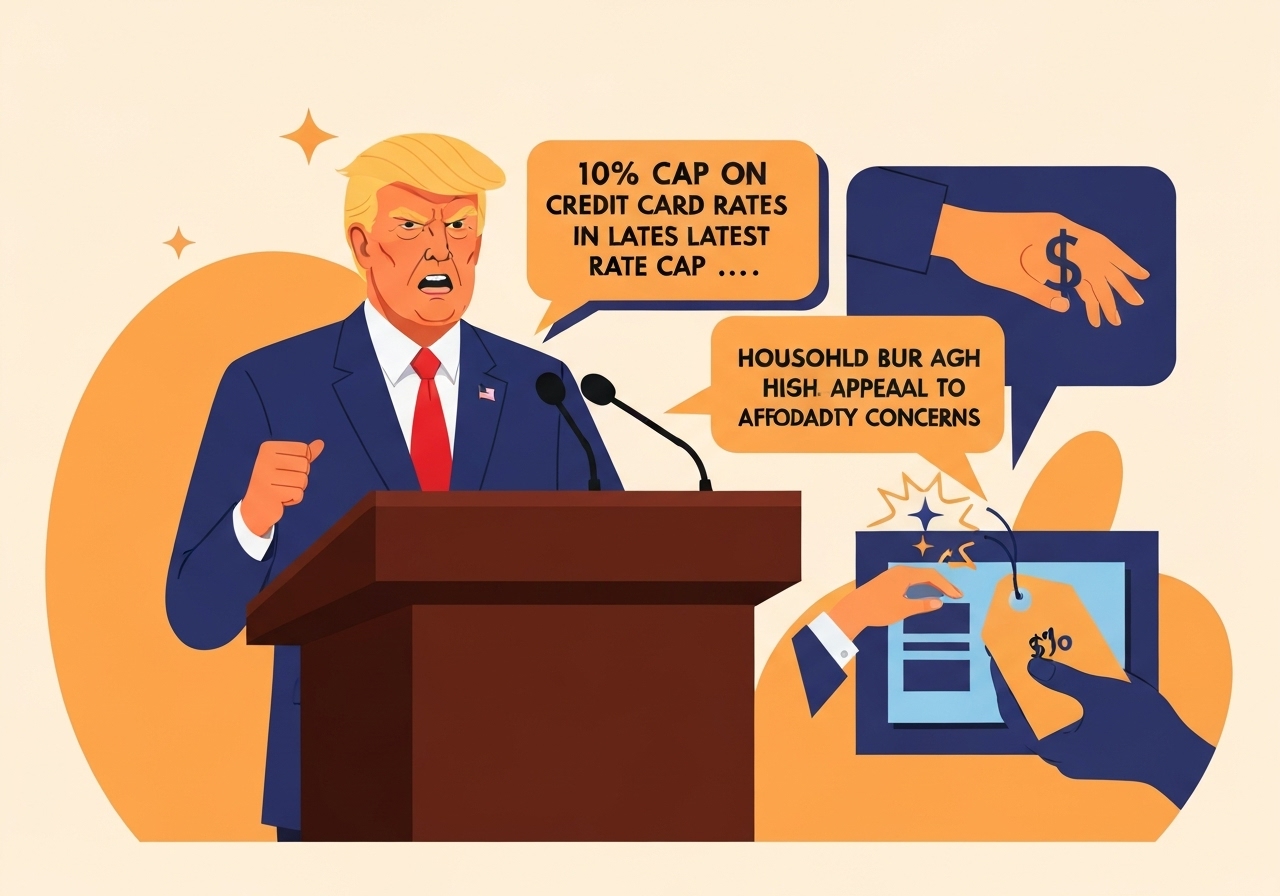
President Donald Trump on Friday proposed a temporary, one-year cap of 10% on credit card interest rates, saying Americans are being “ripped off” in a Truth Social post and urging the limit to take effect on January 20, the anniversary of his return to the White House. He framed the measure as an affordability step amid sustained price pressures that many voters cite as a central economic worry. The post did not detail whether the cap would rely on voluntary bank cooperation, regulatory action, or new legislation, leaving the enforcement mechanism unclear. The announcement follows a week of other populist affordability items the president posted on social platforms.
Key Takeaways
- Trump called for a one-year 10% cap on credit card APRs to start on January 20, 2027, tied to his return to the White House.
- The proposal was posted on Truth Social and flagged by the president as an affordability measure amid ongoing inflationary pressure.
- The administration gave no specifics on implementation, leaving voluntary versus mandatory enforcement unresolved.
- Last year the administration reversed a Biden-era limit tied to credit-card fees; the CFPB had estimated that Biden’s action would save families more than $10 billion annually by cutting fees from an average of $32.
- A federal judge blocked the Biden-related effort in 2024, and the Trump administration later joined banks in opposing that rule’s enactment.
- Banks derive a material share of revenue from card interest; analysts warn a hard cap could prompt tighter lending standards and reduced access for lower-credit borrowers.
- Polling context: CNN found 61% of Americans say Trump’s policies have worsened economic conditions, and the New York Fed reported job-finding expectations hit a record low recently, underscoring public concern about affordability.
Background
Rising household costs and accumulated inflation have made affordability a persistent topic in American politics. For many voters, higher prices on essentials and elevated borrowing costs have eroded purchasing power since the sharp inflationary spike in 2021 and 2022. Credit card interest and fees are part of that pressure: card interest is a direct cost for consumers carrying balances, while fees add another predictable charge.
Regulatory interventions have been contested in recent years. The Biden administration supported measures to limit some card-related fees and sought rules the Consumer Financial Protection Bureau estimated would generate more than $10 billion in annual savings for families. Those regulatory efforts encountered legal blocks in 2024, and the current administration later backed the banks in litigation over those rules.
Political dynamics matter as well: proposals aimed at lowering consumer costs can be politically potent but run into trade-offs between affordability, credit availability, and bank profitability. Interest-rate caps historically raise questions about borrower selection and whether institutions will offset revenue losses through fees or tighter underwriting.
Main Event
On Friday, Trump used his Truth Social account to call for a 10% cap on credit card interest rates for one year, specifying January 20 as the proposed start date but offering no legislative or regulatory road map. He invoked affordability as the core rationale and directly blamed previous administrations for leaving consumers exposed to high borrowing costs. The post was part of a string of social-media economic proposals from the president during the week, including moves related to mortgage bond purchases and restrictions on institutional purchases of single-family homes.
The administration has not provided legislative text or executive directives tied to the rate cap, and White House officials did not give immediate comment to reporters. CNN contacted the White House and the American Bankers Association for responses; neither provided a substantive public reply at the time this piece was filed. That omission leaves the practical pathway for implementing a rate ceiling unspecified.
Observers note that a 10% ceiling would be a dramatic shift from prevailing card APRs for many consumers and would represent a policy reversal in tone: last year the administration abandoned a Biden-era constraint tied to card fees and aligned with banks in court. That history complicates the credibility and enforceability calculus for the current proposal.
Analysis & Implications
Economically, a binding cap on card APRs would reallocate revenue within the financial system. Interest income on unsecured consumer credit is a major revenue line for card issuers; limiting that stream could prompt banks to tighten underwriting criteria, increase fixed fees, or reduce promotional offerings. Those responses could reduce credit access for borrowers with lower credit scores, counteracting the stated affordability intent.
Legally and administratively, implementing a national APR cap raises questions. Congress could enact a statutory ceiling, but the timetable and political will are uncertain. Alternatively, regulators such as the Office of the Comptroller of the Currency or the CFPB would face legal and operational hurdles to impose a uniform cap that applies across issuers and products. Given past court intervention in related rulemaking, new actions would likely encounter rapid litigation.
Politically, the proposal is aimed at addressing voter anger over living costs, but prior polling suggests skepticism: 61% of respondents in a recent CNN poll said Trump’s policies have worsened economic conditions. If enforcement is seen as symbolic or unworkable, the political payoff may be limited. Conversely, if paired with clear, enforceable steps, the move could reshape debates over consumer finance regulation ahead of upcoming elections.
Comparison & Data
| Policy element | Proposed cap | Previous Biden-era action | CFPB estimate |
|---|---|---|---|
| Primary target | APR on credit cards (10%) | Limits on certain credit-card fees | — |
| Duration | One year (starting Jan 20) | Ongoing rulemaking | — |
| Projected consumer impact | Unspecified; might lower interest costs for cardholders | CFPB estimated >$10B saved annually | Average fee cited at $32 before cuts |
The table compares the president’s outline — a fixed 10% APR limit for one year — with the Biden administration’s prior fee-focused action, which the CFPB estimated would have trimmed average fees and yielded more than $10 billion in annual savings to families. The mechanics and likely trade-offs differ: an APR cap affects ongoing interest revenue, while fee limits target discrete charges.
Reactions & Quotes
Trump’s post framed the move as a response to public complaints about costs and borrowing. Two brief excerpts from public statements capture the tone and analyst responses:
“AFFORDABILITY!”
Donald Trump (Truth Social)
“Americans are being ‘ripped off,'”
Donald Trump (Truth Social)
“A hard cap on APRs could reduce access to credit for higher‑risk borrowers and prompt banks to adjust underwriting and fees,” (paraphrased)
Independent economists and consumer‑finance analysts (paraphrased)
Beyond those short public lines, banking trade groups have not issued a detailed public position in response to the president’s Friday post as of publication; CNN reached out to the American Bankers Association for comment. Consumer advocates welcomed attention to costs but stressed that design details matter to avoid unintended harm to credit access.
Unconfirmed
- Whether the administration will pursue the 10% cap through executive rulemaking, legislation, or rely on voluntary bank cooperation remains unspecified.
- It is not yet confirmed whether major banks or card networks would accept a 10% cap; their formal positions had not been published at the time of reporting.
- The scale of credit‑availability effects (how many consumers would face reduced access) if a cap were imposed is uncertain and would depend on banks’ specific responses.
Bottom Line
President Trump’s call for a one-year, 10% cap on credit card APRs is a high-profile attempt to address affordability concerns but lacks an articulated enforcement path. The proposal highlights the political salience of consumer costs while exposing deep trade-offs between reducing interest burdens and preserving credit access for higher‑risk borrowers.
Absent detailed implementation plans, the measure is likely to trigger legal scrutiny and vigorous debate among regulators, banks, consumer advocates, and lawmakers. For consumers, the immediate takeaway is practical uncertainty: the proposal signals political focus on borrowing costs but does not yet change pricing or access.
Sources
- CNN (news report covering the president’s announcement and context)
- Consumer Financial Protection Bureau (official regulator referenced for past fee estimates and rulemaking context)
- American Bankers Association (trade association contacted for comment)
- Federal Reserve Bank of New York (official source for labor‑market and consumer expectation data referenced)