
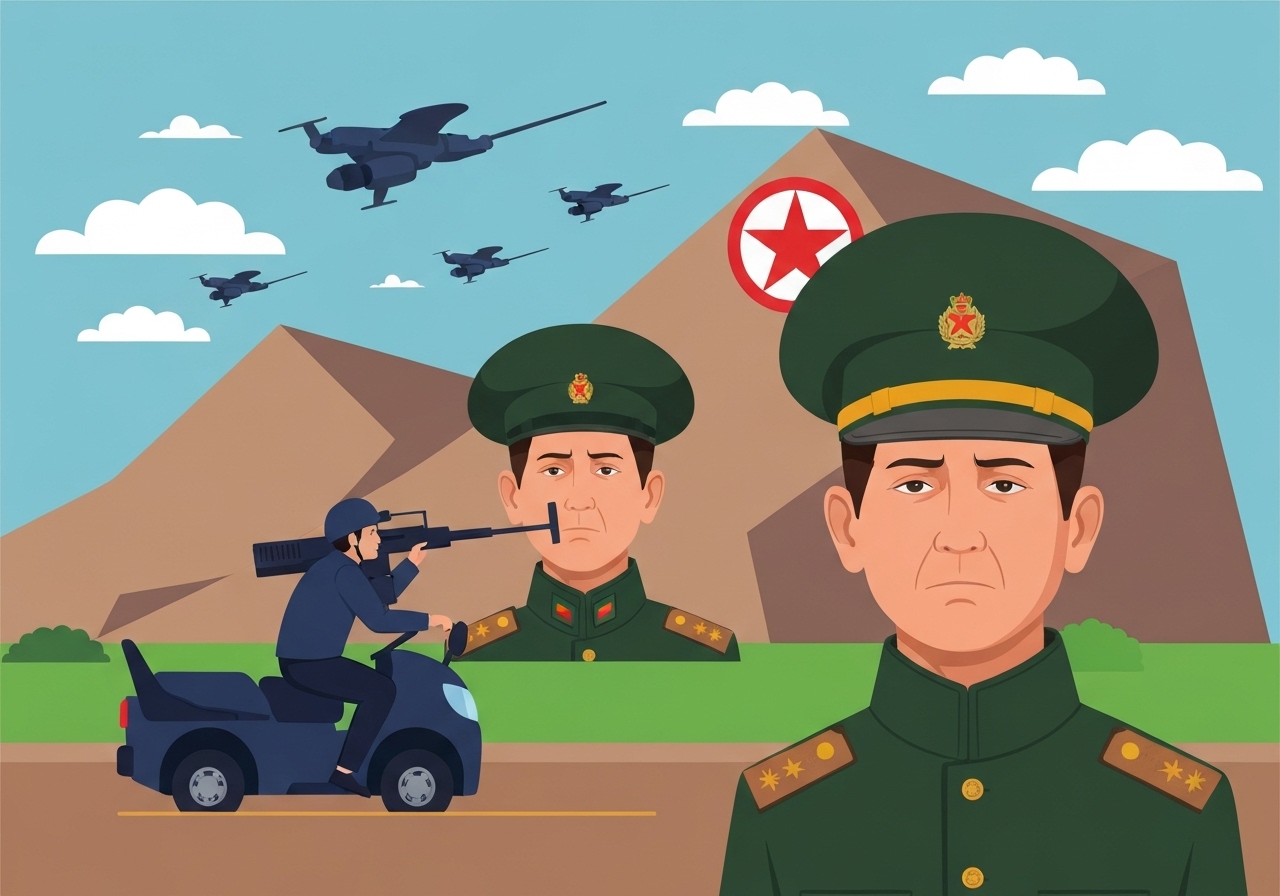
North Korea’s military on Jan. 9, 2026 accused South Korea of flying surveillance drones across the inter-Korean border and warned that Seoul would face consequences for what Pyongyang described as “unpardonable hysteria.” South Korea’s Defense Ministry promptly denied operating drones on the dates mentioned and President Lee Jae Myung ordered a full investigation into the claims. The exchange, carried in North Korean state media and reported by international outlets, raises fresh obstacles to Seoul’s efforts since June to reopen talks with Pyongyang. If confirmed, the episode would mark the latest in a series of drone-related incidents that have periodically escalated tensions on the Korean Peninsula.
Key Takeaways
- On Jan. 9, 2026 North Korea’s General Staff said North Korean forces used electronic-warfare systems to bring down a South Korean drone near a North Korean border town; the statement said the drone carried two cameras that recorded unspecified areas.
- Seoul’s Defense Ministry denied it had operated drones on the dates cited and President Lee Jae Myung ordered a thorough investigation into the allegations.
- Pyongyang also claimed an earlier intrusion on Sept. 27 when, it said, another drone was forced to crash after electronic strikes and contained video of major North Korean objects.
- North Korea framed the incidents as deliberate provocations and warned that the “ROK military warmongers will be surely forced to pay a dear price,” language carried by state media.
- Drone flights have been a recurring point of friction: Pyongyang accused Seoul of leaflet-dropping flights over Pyongyang in Oct. 2024, while Seoul has reported occasional DPRK drone incursions and took countermeasures in Dec. 2022.
- President Lee asked Chinese President Xi Jinping to act as a mediator during their recent summit; Xi reportedly urged patience, but Pyongyang has so far rebuffed Seoul’s overtures.
Background
Since June 2025, President Lee Jae Myung’s administration has prioritized restoring dialogue with North Korea after years of stalled diplomacy. Lee’s outreach has included high-level contacts with regional partners, and he asked Chinese leader Xi Jinping in a recent summit to help ease tensions on the peninsula. Pyongyang, however, has largely resisted Seoul’s moves, maintaining a posture shaped by its aborted nuclear talks with the United States in 2019.
North Korea’s foreign and defense posture hardened after the collapse of high-profile U.S.–DPRK diplomacy, and the regime has focused on advancing its nuclear and missile capabilities. Pyongyang has also declared a new, hostile two-state framework intended to end inter-Korean relations as previously structured, complicating conventional channels for communication and conflict control.
Drones have repeatedly featured in bilateral disputes. In Oct. 2024 North Korea accused South Korea of sending drones over Pyongyang to drop propaganda leaflets; Seoul said it could not confirm that claim. In Dec. 2022 Seoul reported DPRK drones over South Korean territory and said it responded with warning shots, fighter scrambles and surveillance flights. These recurring incidents have contributed to episodic spikes in tensions without leading to sustained escalation—so far.
Main Event
In a statement carried by North Korean state media on Jan. 9, the DPRK General Staff said North Korean forces used specialized electronic-warfare assets on Sunday to incapacitate a drone that was flying over a border town. The statement specified the drone had two cameras that captured video of unspecified locations inside North Korea and asserted that authorities recovered data from the aircraft.
Pyongyang also recalled an earlier incident, saying a drone infiltrated North Korean airspace on Sept. 27 and was later forced to crash by electronic countermeasures; that device, North Korea alleged, also contained imagery of major North Korean sites. The DPRK characterized these events as repeated violations of its sovereignty and an example of what it called Seoul’s provocative behavior.
Seoul’s Defense Ministry swiftly rejected the operational claim. Officials told reporters the ministry did not operate drones on the dates North Korea cited and that President Lee ordered an urgent and comprehensive probe to determine the facts. South Korean officials have not publicly confirmed recovering any DPRK wreckage or video that would substantiate Pyongyang’s version.
The timing complicates Lee’s domestic and diplomatic calculations. His government has invested political capital in reopening ties, but Pyongyang’s accusations and aggressive rhetoric may bolster hard-line domestic critics in both Koreas who oppose rapprochement without concrete reciprocal concessions.
Analysis & Implications
If verified, the DPRK account would indicate a further intensification of electronic-warfare tactics along the maritime and land boundaries that divide the two Koreas. Electronic jamming and cyber-kinetic measures lower the visibility of incidents for outside observers and can produce deniable results—downed drones, corrupted data—without immediately escalating to conventional strikes. That ambiguity increases the risk that misunderstandings could spiral.
For Seoul, the immediate implication is a policy dilemma: pressing for de-escalation and dialogue risks appearing conciliatory if Pyongyang continues aggressive actions, while retaliation or visible military responses could derail diplomatic openings. Lee’s request that Xi act as a mediator highlights Beijing’s central role, but Beijing’s call for patience suggests limited appetite for forcing Pyongyang toward compromise.
Regionally, repeated drone incidents complicate alliance management. The United States and South Korea coordinate on surveillance and deterrence; ambiguous low-intensity engagements like drone incursions may prompt Washington to press for stronger responses or improved air-defenses, potentially provoking North Korean countermeasures that raise broader tensions.
Comparison & Data
| Date | Claim | Reported Action |
|---|---|---|
| Dec. 2022 | First DPRK drone flights in 5 years (per Seoul) | Seoul fired warning shots, scrambled jets, flew surveillance drones |
| Oct. 2024 | Pyongyang accused Seoul of leaflet-dropping flights over Pyongyang | Seoul said it could not confirm the claim; tensions rose, then eased |
| Sept. 27 (year not specified) | North Korea says a drone infiltrated and crashed after electronic strikes | Pyongyang claimed recovered video data of major sites |
| Jan. 9, 2026 | North Korea says it downed a South Korean drone using electronic warfare | Seoul denied operating drones on the dates cited; investigation ordered |
The table contextualizes the Jan. 9 claim against prior incidents that show a pattern of disputed drone activity and asymmetric responses. While some earlier claims remained unverified, the recurrence underscores drones and electronic countermeasures as persistent vectors of friction.
Reactions & Quotes
North Korea presented its account in strident language through state channels, framing the events as violations of sovereignty and issuing a direct warning.
“The ROK military warmongers will be surely forced to pay a dear price for their unpardonable hysteria.”
North Korean General Staff (state media)
Seoul rejected the operational allegations and emphasized fact-finding. Officials also signaled an intent to avoid premature attribution while collecting evidence.
“The Defense Ministry did not operate drones on the dates cited by North Korea.”
South Korea Ministry of National Defense (official)
International and regional stakeholders are watching closely; China was asked by President Lee to mediate and reportedly urged patience, a stance that reflects Beijing’s preference to limit rapid escalation while preserving influence in inter-Korean affairs.
Unconfirmed
- Whether the Jan. 9 downed drone definitively belonged to South Korea has not been independently verified by third-party observers.
- The Sept. 27 incident cited by North Korea lacks a publicly confirmed year and independent evidence linking the device to Seoul.
- Claims that recovered drone video shows “major objects” inside North Korea have not been publicly produced or authenticated.
Bottom Line
The episode sharpens a familiar risk on the Korean Peninsula: low-visibility, drone- and electronic-warfare incidents can produce rapid spikes in tension without clear pathways for de-escalation. For Seoul, verifying facts is urgent; premature assumptions could either embolden Pyongyang or constrain South Korea’s diplomatic options.
For Pyongyang, invoking strong rhetoric while asserting successful electronic countermeasures serves both domestic signaling and deterrence purposes. International actors, notably China and the United States, are likely to press for restraint, but bridging the trust deficit between Seoul and Pyongyang will require verifiable confidence-building steps—something made harder if incidents continue to be shrouded in ambiguity.
Sources
- Associated Press via ABC News — news agency report republished by ABC News (media)
- South Korea Ministry of National Defense — official statements and notices (official)
- Korean Central News Agency (KCNA) — DPRK state media carrying General Staff statements (state media)