
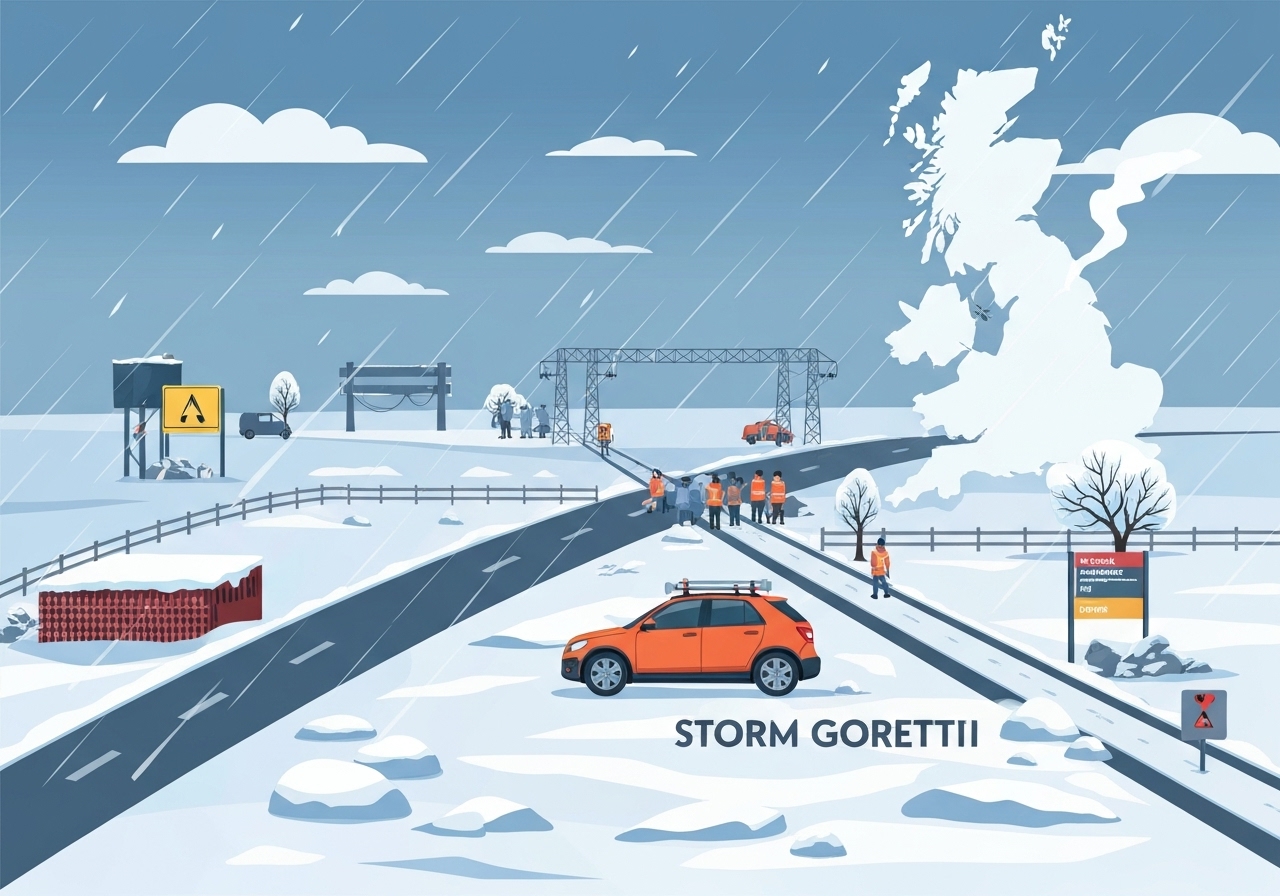
Storm Goretti swept across the UK this week, bringing heavy snow, widespread ice and damaging winds that left tens of thousands of homes without electricity and caused at least one fatality. The most severe effects were reported in Cornwall and the South West, where a rare red wind alert was in force when a tree fell on a caravan, killing a man. More than 34,000 premises remain offline in the South West, while work continues to restore almost 170,000 properties nationwide. Meteorological warnings for snow and ice extend across large parts of the country through the weekend, with an amber snow alert for central Scotland on Sunday.
Key Takeaways
- Storm Goretti has produced heavy snow, strong winds and freezing temperatures across the UK between Thursday and Saturday, prompting multi-region weather warnings.
- Over 34,000 premises are still without power in the South West; operators report nearly 170,000 properties have been restored so far.
- Smaller but notable outages remain: about 2,000 premises in the West Midlands, more than 1,000 in the East Midlands and roughly 130 in Wales.
- A rare red wind warning was active in parts of Cornwall when a tree struck a caravan, resulting in one confirmed death reported by police.
- Temperatures reached -8.1°C at Loch Glascarnoch and -7.0°C in Katesbridge overnight; milder air is expected to move in from Sunday, turning many snowfalls to rain.
- St Michael’s Mount near Penzance reportedly lost about 80% of its trees during the storm, and local authorities describe the event as among the most severe in living memory for the county.
- Amber and yellow Met Office warnings remain in force across Scotland, northern England, the Midlands, Wales and parts of southern England through Saturday and into Sunday in places.
Background
Atlantic low-pressure systems frequently affect the UK during winter months, but Storm Goretti combined heavy precipitation with strong, gusting winds to produce a broad area of disruption. The Met Office issued a sequence of yellow warnings for snow and ice across most regions and an amber warning for central Scotland for Sunday, reflecting the risk of travel disruption and infrastructure damage. Distribution network operators and the National Grid mobilised crews to respond to widespread outages; repair efforts often take longer when access is impeded by fallen trees, ice and blocked roads. Local authorities in affected counties, notably Cornwall Council, declared extensive emergency clearance and repair operations to reopen roads and restore essential services.
Previous UK winter storms have produced severe local impacts, but the combination of coastal gusts, inland snow and freezing surfaces amplified hazards this week. Rural and exposed communities are particularly vulnerable to tree-fall, roof damage and loss of power because of long spans of overhead lines and delayed crew access. Emergency services and councils typically prioritise life-safety incidents and critical infrastructure, leaving some residential areas waiting longer for reconnection. The political and economic stakes are heightened when prolonged outages hit remote communities or essential facilities such as care homes.
Main Event
Conditions deteriorated rapidly on Thursday evening in parts of southwest England as Storm Goretti intensified; the Met Office issued a red wind alert for some areas of Cornwall, an infrequent highest-level warning. Police said a man’s body was found after a tree fell on a caravan in Cornwall during that period, marking the most serious human cost recorded so far. On the ground, residents reported fallen roofs, smashed conservatories and downed trees; one teenager in St Buryan described her family home losing its chimney and part of its roof.
Power disruption was widespread: network operators and the National Grid reported crews working continuously to restore service, with almost 170,000 properties brought back online but significant numbers still affected. The largest concentration of outages remained in the South West, where more than 34,000 premises were reported without electricity; the West Midlands, East Midlands and parts of Wales also listed outages in the hundreds or low thousands. Local MPs and council officials warned some communities might face issues into Sunday as repair work continues and access remains constrained by debris and weather.
Transport and travel were affected across multiple regions: roads were blocked by fallen trees, and snow and ice prompted warnings for drivers and public transport operators. In Scotland, central mountain and high-ground routes saw persistent snow and the amber warning aimed to reduce travel demand during the most hazardous window on Sunday. By contrast, forecasters expected a turnaround from Sunday with milder, wetter air moving in from the southwest, which will change some lingering snow to rain and reduce the very lowest temperatures in many areas.
Analysis & Implications
Infrastructure resilience was tested by Storm Goretti: the scale of tree-fall—particularly at coastal and exposed sites—caused substantial physical damage and complicated restoration efforts. Overhead power lines remain vulnerable to falling branches and whole-tree collapses, which prolonged outages and forced priority repairs. The near-simultaneous demand for road clearance and power restoration strained local authority and private contractor capacity, illustrating friction points in emergency response under rapidly evolving conditions.
The human and economic costs are concentrated where outages intersect with vulnerable populations and critical facilities. Prolonged loss of heating and electricity in colder hours raises health risks for older residents and those with medical dependencies, while businesses face lost trade and additional recovery expenses. For emergency planners, the storm underscores the need for targeted support—temporary shelters, priority reconnection for care providers and pre-positioned equipment in high-risk areas—to reduce harm during similar events.
Looking ahead, the short-term meteorological outlook indicates milder air arriving from Sunday, which should reduce the depth of the freeze and turn many snowfalls to rain across lower ground. That shift will ease some immediate cold-related risks but could create secondary hazards like flood run-off or rapid thawing of snow that has already accumulated on saturated soils. Strategically, the episode may prompt renewed debate on grid hardening, undergrounding of key lines in high-risk corridors, and investment in tree management near critical infrastructure.
Comparison & Data
| Region/Measure | Reported figure |
|---|---|
| South West outages | More than 34,000 premises |
| Properties restored (total) | Almost 170,000 |
| West Midlands outages | Approximately 2,000 premises |
| East Midlands outages | More than 1,000 premises |
| Wales outages | About 130 premises |
| Lowest recorded temperature | -8.1°C (Loch Glascarnoch) |
| Coldest night (Northern Ireland) | -7.0°C (Katesbridge) |
The table above summarises the most widely reported outage figures and notable temperature readings from the event. While restoration numbers indicate substantial progress, the concentration of remaining outages in rural and coastal pockets suggests unequal recovery timelines. Temperature readings demonstrate how localized cold spots increased ground icing risk, complicating repairs and travel. Forecasts of milder weather from Sunday imply that some impacts will shorten, but derivative risks—such as flooding where snow melts quickly—should be monitored.
Reactions & Quotes
Network operators and local officials described large-scale, coordinated recovery efforts and emphasised safety and priority work for critical sites.
“Crews are working tirelessly to restore supplies and make the network safe,”
National Grid / distribution operator (official)
National Grid and regional operators highlighted the scale of mobilised teams and the challenges posed by blocked routes and continuing hazardous conditions.
“Properties across mid Cornwall are expected to face electricity issues until Sunday,”
Noah Law, MP (local representative)
The MP’s statement reflected local assessments of repair timeframes while acknowledging crews’ ongoing efforts; that projection remains subject to access and weather. Local residents described direct damage to homes and community landmarks.
“The chimney had fallen off the top of the house onto the conservatory and smashed through,”
Tia White, resident of St Buryan (witness)
Personal accounts like this underscore the immediate material damage residents faced and the emotional toll of losing homes or community trees in the storm.
Unconfirmed
- The precise cause of the tree collapse that led to the fatality in Cornwall is under police investigation and has not been publicly confirmed.
- Local reports on the exact percentage of trees lost at St Michael’s Mount are provisional and based on early surveys; full ecological assessment is pending.
- Predicted restoration times for some mid Cornwall areas (to Sunday) come from local statements and may change if crews face further access issues or equipment constraints.
Bottom Line
Storm Goretti brought a combination of strong winds, snow and sub-zero temperatures that produced significant local damage, notable power outages and at least one confirmed fatality in Cornwall. While restoration teams have returned service to the majority of affected properties, tens of thousands remain without power and recovery times vary by location depending on access and damage severity.
Short-term forecasts point to milder air moving in from Sunday, which should reduce extreme cold and convert many snow events to rain, but that transition could create additional hazards such as flooding or rapid thaw-related infrastructure stress. Policymakers, utilities and local authorities will now assess longer-term resilience measures, including vegetation management and targeted investment in vulnerable network segments, to reduce similar disruption in future winters.
Sources
- BBC News (news report summarising event and local impacts)
- Met Office (official weather warnings and forecasts)
- Cornwall Council (local authority statements and emergency response)
- National Grid / Distribution Operators (official statements on power restoration efforts)