
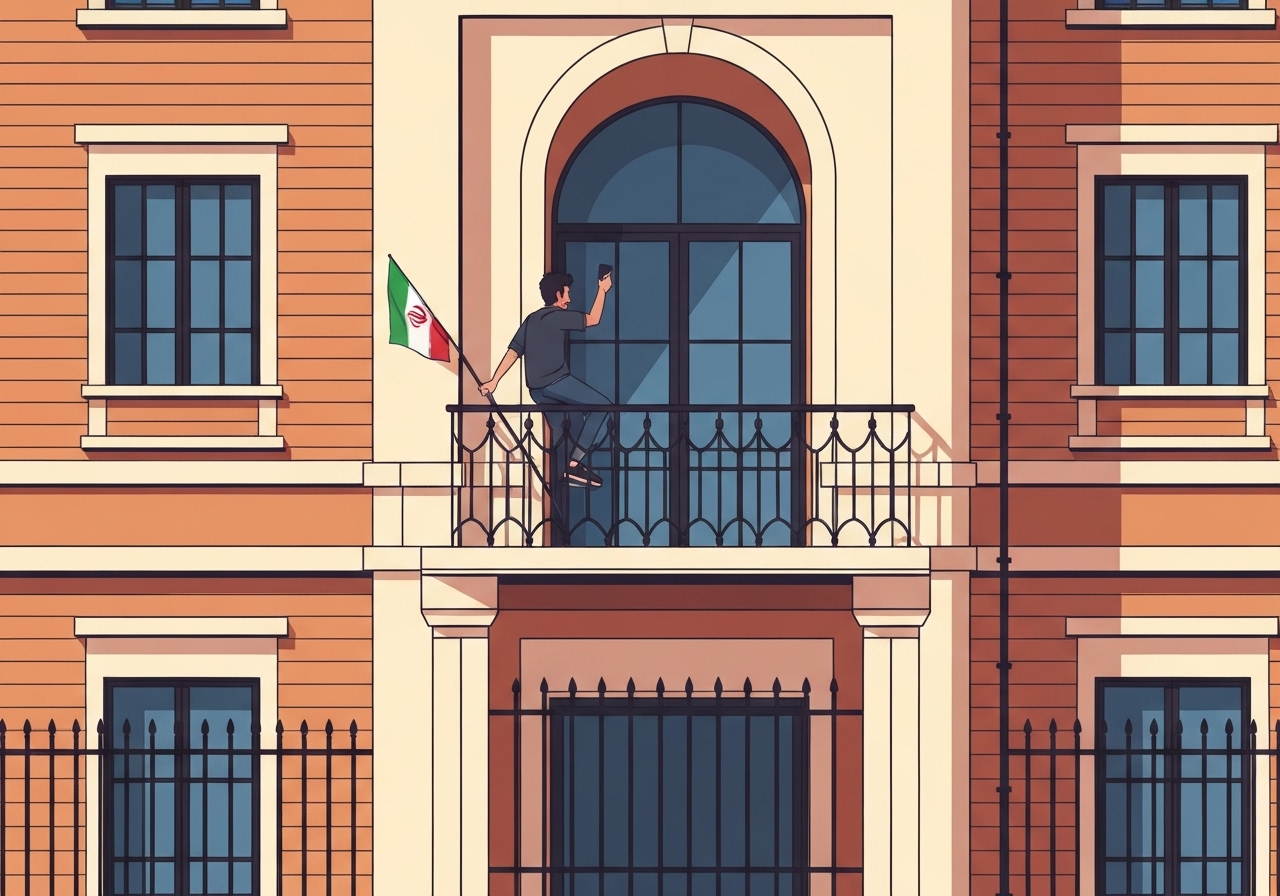
Lead: A demonstrator climbed onto the balcony of Iran’s embassy in west London on Saturday as hundreds gathered outside, waving flags and chanting anti-government slogans. The Metropolitan Police said two people were arrested — one for aggravated trespass and assault on an emergency worker, the other for aggravated trespass — and officers were seeking a further individual for trespass. The rally in Kensington came amid nationwide unrest in Iran that began on 28 December; two human rights groups report at least 50 protest-related deaths. Authorities described the London protest as being “safely policed” while the wider crisis in Iran continues with an internet blackout.
Key Takeaways
- Location: Demonstration occurred outside the Iranian embassy in Kensington, west London; footage showed a man on the embassy balcony removing the Iranian flag.
- Arrests: Metropolitan Police confirmed two arrests on Saturday evening — one for aggravated trespass and assault on an emergency worker, one for aggravated trespass — and said officers sought another trespass suspect.
- Scale: Hundreds attended the London gathering, reflecting a wave of protests outside Iranian diplomatic missions worldwide.
- Iran context: Protests in Iran began on 28 December and have entered their 13th day, with at least 50 fatalities reported by two human rights organisations.
- Political figures: UK Prime Minister Sir Keir Starmer joined France’s Emmanuel Macron and Germany’s Friedrich Merz in a joint statement condemning reported violence by Iranian security forces.
- Security measures: The Metropolitan Police deployed additional officers to deter disorder and stated there was no serious disorder at the scene.
- Communications: An internet blackout is in effect across Iran, limiting independent verification of events on the ground.
Background
Widespread unrest in Iran began on 28 December, initially sparked by economic grievances but quickly expanding into broader anti-government demonstrations. Protesters inside Iran and in diaspora communities have held vigils and rallies demanding accountability and change; some are explicitly calling for the return of Reza Pahlavi, the exiled son of Iran’s last shah. International human rights groups have reported dozens of deaths; those figures have become a focal point for diplomatic criticism of Iranian security forces.
Diplomatic missions worldwide have become focal points for the Iranian diaspora to express solidarity with protesters in Iran. In several capital cities demonstrators have gathered outside embassies, carrying placards, images of exiled opposition figures and national flags. Governments in Europe and elsewhere have issued statements urging restraint by Iranian authorities and emphasising the right to peaceful assembly, while also warning demonstrators in host countries not to breach diplomatic premises.
Main Event
On Saturday, hundreds assembled outside the Iranian embassy in Kensington. Reports and video widely circulated on social media showed a man standing on the embassy balcony and taking down the Iranian flag; police later confirmed arrests linked to aggravated trespass. The Metropolitan Police said additional officers had been deployed earlier in the day to prevent disorder and to ensure the embassy’s security.
Police described the protest as continuing into the evening but emphasised it was being “safely policed,” noting no serious disorder was observed at the scene. Among those attending were demonstrators holding images of Reza Pahlavi; some rallying chants and signs called for political change in Iran and for the return of exiled opposition leaders. Organisers said the London gatherings were in solidarity with those inside Iran, where restrictions and security responses have intensified the unrest.
Witnesses said the atmosphere ranged from vocal and defiant to tense when the balcony incident occurred. Officers arrested two people on site: one detained for aggravated trespass and an alleged assault on an emergency worker, the other for aggravated trespass. Police also said they were seeking another person suspected of trespass in relation to the balcony climbing.
Analysis & Implications
The embassy incident in London is emblematic of how events inside Iran are resonating with expatriate communities and turning diplomatic sites into stages for international pressure. While symbolic acts — such as removing a flag — attract media attention, they also raise legal and security questions about the protection of diplomatic premises under the Vienna Convention on Diplomatic Relations. Host-state police must balance the right to protest with obligations to safeguard embassies and prevent criminal offending.
Diplomatically, the protests and reports of deaths place European governments in a delicate position: they face domestic pressure to condemn violence and protect protesters’ rights, but direct intervention in Iran’s internal affairs is limited. Joint statements by leaders in London, Paris and Berlin underscore growing Western concern; such statements can increase political isolation for Tehran and may lead to coordinated diplomatic measures if reported abuses continue.
Economically and geopolitically, sustained unrest and internet blackouts can have broader implications for energy markets, regional stability and sanctions dynamics. An extended communications shutdown complicates independent verification and impedes humanitarian and human-rights monitoring. For opposition figures and exiled communities, international rallies help maintain visibility but also risk escalation or legal consequences in host countries if protests breach diplomatic property.
Comparison & Data
| Item | Figure/Date |
|---|---|
| Protests in Iran began | 28 December |
| Reported protest-related deaths | At least 50 (two human rights groups) |
| Days of unrest at time of report | 13th day |
| Arrests in London protest | 2 confirmed; 1 sought |
The table summarises documented dates and counts cited by official and non-governmental sources. Numbers for casualties inside Iran are reported by human rights organisations and have not been independently verifiable due to the communications blackout; they should be regarded as current best estimates rather than definitive totals.
Reactions & Quotes
“We saw no serious disorder and officers will remain in the area to ensure the continued security of the Embassy.”
Metropolitan Police — public statement
The police framed their response as proportionate: extra officers were deployed to deter disorder and to protect the embassy while enabling lawful protest outside the mission.
“The Iranian authorities have the responsibility to protect their own population and must allow for the freedom of expression and peaceful assembly without fear of reprisal.”
Joint statement — Sir Keir Starmer, Emmanuel Macron, Friedrich Merz
Leaders in the UK, France and Germany issued a joint rebuke of reported violence, signalling coordinated diplomatic concern and emphasising human-rights obligations.
“Protesters inside Iran have been calling for significant political change, and many in the diaspora are echoing those demands abroad.”
Independent analyst (paraphrase)
Analysts note that the diaspora protests amplify domestic dissent, but they also underline the limits of external influence absent internal political shifts.
Unconfirmed
- The identity and motive of the individual who climbed the embassy balcony have not been verified beyond on-scene video and police enquiries.
- Casualty figures inside Iran are reported by two human rights groups but cannot be independently corroborated due to the nationwide internet blackout.
- Claims that specific external actors are directing the protests have not been substantiated by concrete evidence.
Bottom Line
The London embassy incident is a high-visibility manifestation of wider unrest in Iran that has spilled into diaspora communities. While the act of removing a flag and the arrests in Kensington drew immediate attention, the deeper concern is the mounting death toll and communications blackout inside Iran that hinder independent verification and heighten diplomatic tensions.
For policymakers and observers, the immediate challenge is to protect lawful protest in host countries while ensuring diplomatic security and pursuing credible avenues for accountability in Iran. The coming days will show whether international pressure, media scrutiny and domestic resistance in Iran lead to de-escalation or further entrenchment.