
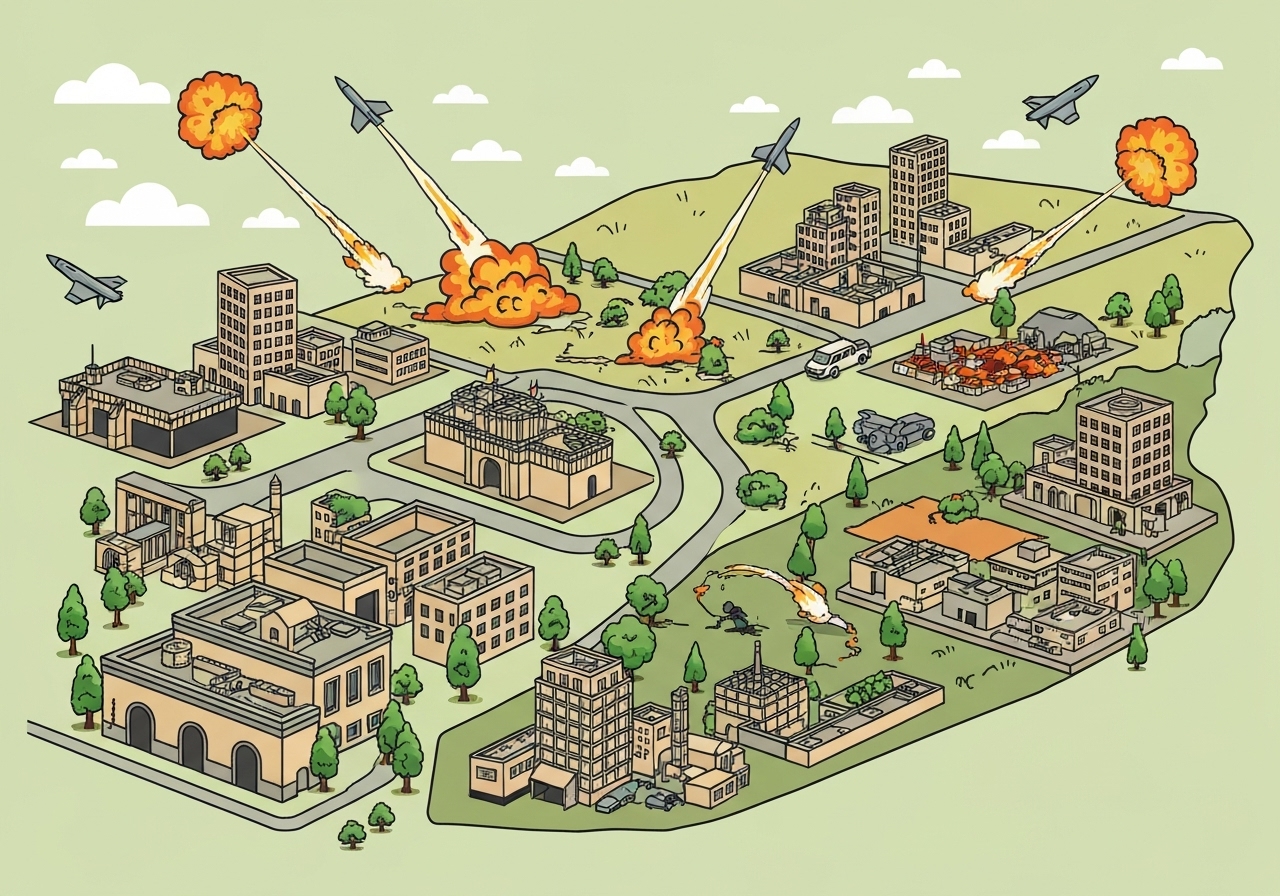
On Saturday, US forces and allied partners carried out large-scale air and precision strikes against Islamic State (IS) targets across central Syria, the US Central Command (Centcom) announced. The operation, ordered by President Donald Trump and conducted under the banner of Operation Hawkeye Strike, followed a deadly IS ambush on 13 December that killed two US soldiers and a US civilian interpreter. Centcom said the strikes aimed to degrade IS capabilities and protect US and partner forces in the region; officials reported the use of scores of precision munitions and more than 20 aircraft. The precise locations hit and the full extent of damage or casualties have not yet been confirmed by independent observers.
Key takeaways
- Operation Hawkeye Strike: The latest raids were directed by President Donald Trump as part of an operation first announced in December 2024.
- Scale of the strike: US and partner forces fired more than 90 precision munitions at over 35 targets in the most recent action, involving more than 20 aircraft.
- Aircraft and partners: Participating platforms reported include F-15Es, A-10s, AC-130Js, MQ-9 drones and Jordanian F-16s.
- Preceding actions: Between 20 and 29 December, US forces said they killed or captured nearly 25 IS members across 11 missions linked to the same campaign.
- Earlier massive strike: On 19 December a US-Jordanian mission struck more than 70 targets with over 100 precision munitions, Centcom stated.
- Trigger: The strikes were cited as retaliation for a 13 December ambush in Palmyra that killed two US soldiers and a US civilian interpreter.
- Political context: Syria remains fragile after the fall of Bashar al-Assad’s regime in December 2024; a former rebel leader, Ahmed al-Sharaa (Abu Mohammed al-Jolani), is now serving as president.
Background
Syria entered a new phase in December 2024 when the long-standing rule of President Bashar al-Assad ended, effectively concluding a civil conflict that lasted roughly 13 years. After Assad’s departure, rebel factions consolidated control across parts of the country; Ahmed al-Sharaa, known by the nom-de-guerre Abu Mohammed al-Jolani, emerged as the country’s head of state. That political fracturing has left security gaps in central and eastern Syria, where militant groups including remnants of the Islamic State have continued to operate.
The US has maintained a counter‑IS presence in Syria for years, shifting between large campaigns and smaller, targeted missions as the local balance of power changed. Operation Hawkeye Strike was publicly announced by the Trump administration in December following an IS ambush on 13 December in Palmyra that killed two US soldiers and a US civilian interpreter. Since that announcement, US and partner forces have conducted multiple missions aimed at degrading IS infrastructure and personnel across central Syria.
Main event
Centcom said Saturday’s operation saw US and partner aircraft engage more than 35 targets, employing over 90 precision munitions. A US official speaking to CBS News described participation by a mix of manned and unmanned platforms, naming F-15Es, A-10s, AC-130Js, MQ-9 drones and Jordanian F-16s as involved assets. The public statements framed the strikes as both punitive—retaliation for the 13 December attack—and preventive, intended to protect personnel in the theater.
Officials have not released detailed target coordinates or an itemised damage assessment. Centcom’s public message reiterated a hardline posture toward forces that attack US personnel: it said US forces will pursue and strike those who harm US warfighters. Defence Secretary Pete Hegseth also posted a strongly worded message on social media reaffirming the administration’s intent to respond decisively to such attacks.
US statements confirm this action follows a series of prior missions: between 20 and 29 December, nearly 25 IS members were reported killed or captured across 11 discrete operations tied to the campaign. Earlier, on 19 December, a joint US-Jordanian mission reportedly struck more than 70 targets using over 100 precision munitions against known IS infrastructure and weapons sites in central Syria.
Analysis & implications
Operationally, the strikes are consistent with a US tactic of using precision airpower and partner cooperation to disrupt insurgent networks without deploying large ground contingents. The reported employment of a mix of fighters, attack aircraft, gunships and remotely piloted vehicles suggests a layered approach intended to hit hardened positions, command nodes and weapons caches while limiting exposure of personnel.
Politically, the strikes underscore the Trump administration’s message of immediate retaliation for attacks on US forces. That posture may deter some militant activity but also risks escalation if strikes hit assets tied to other armed groups or if civilian harm is alleged. In Syria’s fragmented environment, attribution and collateral effects are politically sensitive and can affect relations with local authorities and partners such as Jordan.
For Islamic State, repeated precision strikes reduce freedom of movement and can degrade logistics and leadership, but the group has continued to mount deadly attacks even after being weakened. Analysts caution that attrition of personnel and sites does not eliminate insurgent capabilities entirely; surviving cells often shift tactics to lower-profile, asymmetric attacks aimed at local security forces and coalition partners.
Comparison & data
| Operation | Date | Precision munitions | Targets struck | Reported IS losses |
|---|---|---|---|---|
| Initial major strike (US–Jordan) | More than 100 | More than 70 | Not specified | |
| Follow-up missions | — | 11 missions | Nearly 25 killed or captured | |
| Latest large strike | More than 90 | More than 35 | Not yet confirmed |
The table places the latest action in the context of a sustained campaign. While munitions and target counts are provided by Centcom and US officials, independent verification of damage and casualties remains limited. The campaign’s cumulative effect appears significant in attrition terms, but the persistence of IS attacks in 2025 indicates the group retains operational capacity in pockets.
Reactions & quotes
“Our message remains strong: if you harm our warfighters, we will find you and kill you anywhere in the world, no matter how hard you try to evade justice.”
US Central Command (Centcom) — official statement
Centcom used blunt language to underscore deterrence and retribution as explicit objectives of the operation. The statement was published on Centcom channels the day of the strikes and circulated by US military spokespeople to media partners.
“We will never forget, and never relent.”
Defence Secretary Pete Hegseth — social media post
Defence Secretary Hegseth’s post reinforced the administration’s public posture that the US will respond forcefully to attacks on its personnel. The comment echoed earlier statements made when Operation Hawkeye Strike was first announced in December.
Unconfirmed
- The exact geographic coordinates and facility types of the targets struck on Saturday remain unconfirmed by independent monitors.
- There is no independently verified count of IS casualties or of any possible civilian harm resulting from the strikes.
- Attribution of all destroyed or damaged assets to IS infrastructure rather than other armed groups has not been independently corroborated.
Bottom line
The US-led strikes on central Syria mark a continued, forceful implementation of Operation Hawkeye Strike in direct response to a lethal IS attack on 13 December. Officials report a high-volume precision-air campaign involving multiple platforms and partner aircraft, but key details on damage and casualties remain unverified by independent sources.
Strategically, the strikes aim to degrade IS operational capacity and signal deterrence to would-be attackers, yet they carry risks of escalation and political complications in Syria’s fragmented post‑Assad landscape. Observers should watch for post-strike assessments, any reports of civilian harm, and how Syrian authorities and regional partners respond in coming days.
Sources
- BBC News — media report summarising Centcom and US official statements
- US Central Command (Centcom) — official military statements and releases
- CBS News — media reporting citing a US official on platforms and munitions involved