
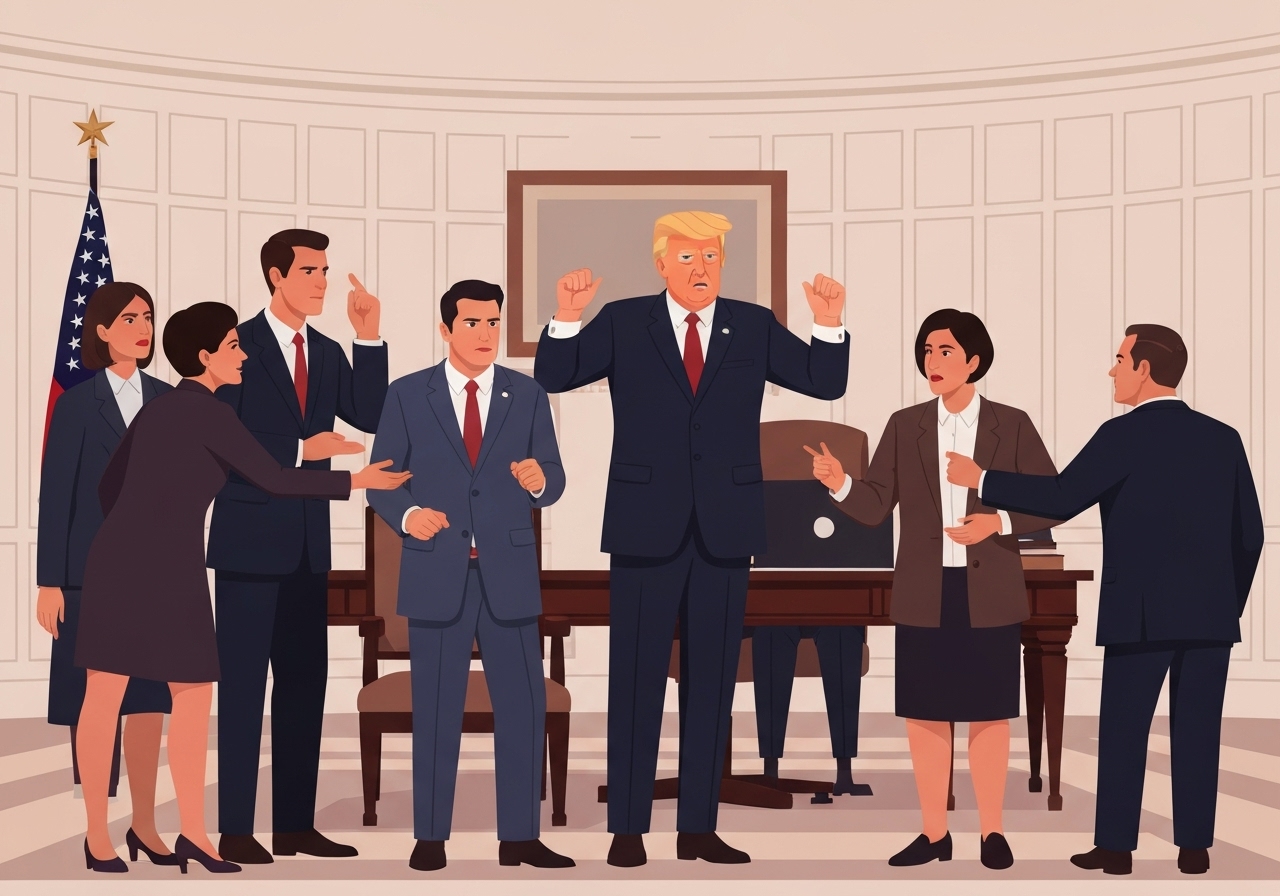
Lead: President Donald Trump was briefed in the days before Jan. 10, 2026 on a range of military options against Iran as Tehran faces mass protests that began in late December over a currency collapse. U.S. officials say Mr. Trump has not decided whether to authorize strikes but has been shown options that include attacks on nonmilitary sites inside Tehran. The briefings came amid reports from human rights groups that dozens of demonstrators have been killed as Iranian security forces move to suppress unrest. Iran’s supreme leader, Ayatollah Ali Khamenei, responded this week by saying the government will not back down.
Key Takeaways
- President Trump received classified briefings in early January 2026 outlining multiple strike options against Iran, including plans that target nonmilitary sites in Tehran.
- As of Jan. 10, 2026 Mr. Trump had not authorized any strikes; U.S. officials described the options as under active consideration.
- Mass demonstrations began in late December 2025 amid a sharp currency crisis and have spread nationwide, according to multiple reports.
- Human rights organizations report that dozens of protesters have died during the crackdown; precise casualty counts remain contested.
- Ayatollah Ali Khamenei stated on Jan. 9–10, 2026 that the government would not yield to the protests, signaling a potential intensification of security measures.
- U.S. public messaging from the president urged support for Iranian demonstrators and suggested readiness to assist politically or militarily.
Background
The demonstrations in Iran began in late December 2025 following a sudden and severe decline in the rial that worsened living costs and economic insecurity for many Iranians. What started as protests over economic hardship quickly broadened into calls for systemic political change, drawing people from multiple cities. Iran’s state apparatus has historically responded to major unrest with force, and past waves of protests have at times provoked international condemnation and sanctions.
The current movement has unfolded against a backdrop of long-standing tensions between Iran and the United States, including disputes over nuclear activity, regional influence, and economic sanctions. U.S. administrations have previously used a mix of diplomacy, sanctions and limited military actions to try to influence Iranian behavior. Domestic Iranian political actors—ranging from reformist activists to hardline clerical authorities led by the supreme leader—have competing incentives that shape the regime’s response to protests.
Main Event
U.S. officials briefed the president on the available military options in the days leading up to Jan. 10, 2026, presenting a menu of responses calibrated to different policy goals and risk tolerances. Sources told reporters those options included kinetic strikes on select facilities inside Tehran, with some scenarios mentioning nonmilitary targets to maximize pressure on regime leadership.
Officials emphasized to Mr. Trump that each option carries distinct operational, legal and diplomatic consequences, including the risk of escalation with Iran and potential broader regional fallout. The president publicly reinforced support for protesters on social media, saying Iran was “looking at FREEDOM” and that the United States “stands ready to help,” language that U.S. advisers said reflected a willingness to use pressure short of—or including—force.
Iranian authorities have declared an intent to restore order and have not ruled out harsher measures. State statements from Tehran this week reiterated that the government would not concede to demands that jeopardize the Islamic Republic’s core institutions. On the ground, security forces engaged demonstrators in several cities, and access for independent verification has been limited in many areas.
Analysis & Implications
A U.S. strike on Iran would represent a major escalation with wide-ranging implications. Militarily, even limited strikes risk retaliation against U.S. forces or partners in the region and could mobilize Iranian proxies across the Middle East. Diplomatically, an attack would strain relations with U.S. allies who favor containment and sanctions over kinetic action, complicating coalition-building for any sustained campaign.
Politically within the United States, authorizing strikes while protests are underway poses a fraught calculus: it signals clear opposition to Tehran’s suppression of demonstrators but risks appearing to intervene in a domestic political crisis. The prospect of striking nonmilitary targets further raises legal and normative questions about targeting thresholds and civilian harm, which advisers must weigh against perceived strategic benefits.
For Iran’s internal politics, external military pressure could either weaken hardline authority by emboldening protesters and fracturing elite cohesion, or it could strengthen the regime’s narrative of external threat and justify harsher repression. Economically, additional conflict would likely deepen instability in markets and energy supplies, with spillover effects for global oil prices and regional trade.
| Timeline | Key Events |
|---|---|
| Late Dec 2025 | Protests erupt after currency collapse; initial demonstrations over economic conditions. |
| Jan. 9–10, 2026 | Iranian leaders vow not to back down; President Trump is briefed on strike options. |
Those two entries provide context for how quickly the situation shifted from economic protest to an episode with international security implications. Publicly available casualty tallies remain contested, complicating efforts to assess the protests’ human cost in real time.
Reactions & Quotes
“Iran is looking at FREEDOM, perhaps like never before. The USA stands ready to help!!!”
President Donald Trump — social media post (public statement)
Mr. Trump’s public message framed the demonstrations as a contest over freedom and indicated rhetorical and potentially material U.S. support. U.S. officials said such messaging forms part of the broader pressure strategy while deliberations over military options continue.
“We will not back down before sedition and foreign plots,”
Ayatollah Ali Khamenei — official statement
The supreme leader’s remarks, delivered by state-aligned channels on Jan. 9–10, signal Tehran’s determination to quash unrest and to portray the protests as influenced by external enemies. Analysts say that rhetoric often precedes intensified security operations.
“Dozens have been killed in the course of these crackdowns, according to human rights monitors,”
Human rights organizations — consolidated reporting
Human rights groups’ casualty estimates underpin international concern about the scale of force used by Iranian security forces; however, independent verification remains limited in many localities.
Unconfirmed
- Whether the president will ultimately authorize any strikes remains undecided; officials described deliberations but no final order was reported as of Jan. 10, 2026.
- Specific target lists and the extent to which “nonmilitary” sites are included have not been publicly confirmed and stem from anonymous official accounts.
- Precise casualty counts from the protests are still unsettled due to constrained access for independent observers in many Iranian cities.
Bottom Line
The briefing of President Trump on strike options marks a significant moment: a domestic protest movement in Iran has evolved into an issue that could prompt direct U.S. military planning. Any decision to strike would carry serious operational, legal and diplomatic costs, and could reshape regional security dynamics.
For readers, the core fact to watch is whether the president moves from deliberation to authorization. If he does, policymakers and markets should brace for immediate fallout; if he abstains, U.S. influence will instead rely on sanctions, diplomacy and public messaging to affect outcomes inside Iran.
Sources
- The New York Times (Major newspaper — reporting)