
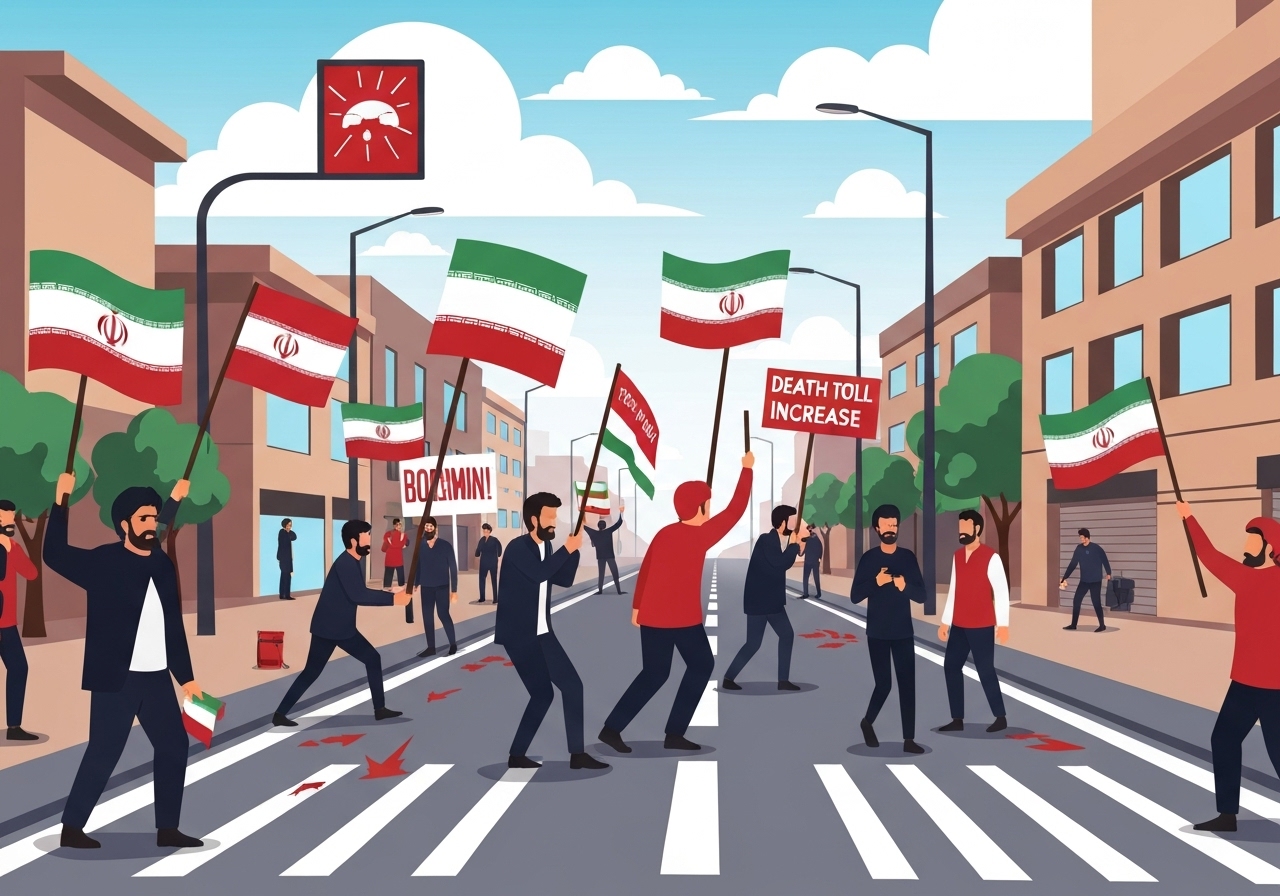
Lead: Nationwide antigovernment demonstrations intensified on Jan. 10, 2026, as Iranians staged a third consecutive night of mass protests from Tehran to other cities. Witnesses and verified video show thousands marching in Heravi Square and elsewhere, while security forces mounted a stronger response. At least one civilian was shot dead in Tehran during clashes, and the military warned it would deploy to public areas. The demonstrations follow two weeks of unrest and mark a new, more volatile phase in the confrontation between protesters and state forces.
Key Takeaways
- Protests entered their third night on Jan. 10, 2026, with large crowds reported in Tehran’s Heravi Square and other urban centers.
- At least one civilian was killed in Tehran after security forces opened fire on a group at a street corner; the victim was identified by a witness as a middle-aged man.
- Demonstrations trace back roughly two weeks and have escalated in scope and intensity in recent days, according to multiple verified video sources.
- Authorities signaled tougher measures, with the military saying it would take to the streets to respond to unrest.
- Videos verified by news organizations showed rhythmic marching, anti-leadership slogans and crowd sizes described by participants as stretching beyond visible limits.
- Witnesses report widespread fear at workplaces and in neighborhoods but also strong determination to continue protesting despite the risk of violence.
Background
The current wave of antigovernment unrest began roughly two weeks before Jan. 10, 2026, driven by grievances that include political repression, economic strain and long-standing tensions over governance. Previous demonstrations had been intermittent, but recent weeks saw broader geographic spread and younger participants visible in urban centers. Social media and Persian-language outlets have amplified footage of clashes and marches, helping mobilize protesters while also drawing the attention of security services.
Iran’s political landscape is shaped by powerful unelected institutions and a clerical leadership headed by Ayatollah Ali Khamenei, a frequent target of the chants and slogans recorded during protests. Past episodes of unrest have prompted tough crackdowns, arrests and restrictions on communications; those precedents inform both protesters’ tactics and authorities’ responses. International observers and rights groups have monitored the developments closely, noting the potential for rapid escalation when security forces and large civilian crowds confront each other in dense urban settings.
Main Event
On the evening of Jan. 10, thousands gathered in Heravi Square in Tehran and marched through adjacent streets, according to videos verified by international news organizations. Participants moved in coordinated clapping and chanted slogans directed at Iran’s supreme leader, creating visible, sustained flows of people that some cameraphone operators described as extending beyond what they could film. In one widely circulated clip, a protester filming from within the crowd said, “You can’t see the start and end of the crowd,” as the stream of marchers advanced.
A witness identified only as Parisa, a 35-year-old Tehran resident, described a sudden, fatal shooting. She recounted that security agents approached a middle-aged man and his teenage son at a corner; the officers opened fire and the father was killed, she said in voice messages verified by reporters. Parisa said she saw the man bending toward the ground, apparently to tie or fix a shoe, and that she did not observe a weapon; her account reflects the immediate impressions of onlookers but is not an official finding.
Videos and eyewitness reports also described confrontations in other neighborhoods and cities. Some participants threw rocks; others fled as security forces advanced. The government increased its visible readiness, and state-aligned channels posted statements indicating intention to restore order. Amid the clashes, ambulances and local volunteers were reported assisting the injured, though access to medical aid in some areas appeared strained as street conditions deteriorated.
Analysis & Implications
The third night of nationwide protests signals a shift from episodic demonstrations to a more sustained, widespread movement. When protests persist across multiple nights and multiple urban centers, organizers and participants can broaden tactical approaches while authorities may justify escalated security measures. That dynamic raises the risk of more casualties, arrests and disruptions to daily life, particularly if the military or paramilitary forces move from containment to proactive street deployments.
Economically, prolonged unrest can amplify existing strains: reduced commerce in affected districts, curtailed transport and investor caution. For a country already facing structural economic challenges, repeated mass demonstrations can speed deterioration in local markets and public services. Politically, persistent antigovernment sentiment—if durable—could pressure hardline and pragmatic factions within Iran’s elite to debate response strategies, potentially affecting appointments, internal security policies and external diplomatic postures.
Internationally, these events will draw scrutiny from human rights organizations, foreign governments and diasporic communities, possibly prompting condemnatory statements, targeted sanctions, or calls for investigations into civilian casualties. The balance between domestic control and international legitimacy will shape Tehran’s choices; a heavy-handed approach may stabilise short-term order while deepening long-term grievances and external isolation.
Comparison & Data
| Night | Reported status | Noted locations |
|---|---|---|
| Night 1 (≈two weeks in) | Widespread demonstrations begin to expand | Multiple cities (initial clustering) |
| Night 2 | Escalation in clashes and crowd size | Tehran neighborhoods, regional centers |
| Night 3 (Jan. 10, 2026) | At least one confirmed civilian death; military signals deployment | Heravi Square (Tehran) and other urban areas |
The table summarizes verified patterns across the three-night period without implying completeness of casualty counts. Independent confirmation of total injuries and fatalities remains incomplete; published totals may rise as hospital and field reports are reconciled. Visual verification by news organizations has been central to documenting locations and crowd dynamics but does not replace official casualty audits.
Reactions & Quotes
“Everyone still is going out to protest.”
Parisa, Tehran witness (voice messages verified by reporters)
This short statement from a 35-year-old marcher underscores the mix of fear and determination reported by many participants: workplace conversations are described as bleak, yet people continue to turn out. Witness testimony like Parisa’s has been cross-checked against video circulated on social platforms and verified by external journalists to establish timing and general circumstances.
“You can’t see the start and end of the crowd.”
Protester filming in Heravi Square (video verified)
The cameraphone remark highlights participants’ perception of scale during the Jan. 10 gatherings. Verified footage from multiple vantage points shows sustained flows of marchers and corroborates descriptions of large, continuous crowds in central Tehran.
Unconfirmed
- Comprehensive national death toll: independent consolidated counts from hospitals and morgues are not yet published; reported totals may increase.
- Full extent of any military street deployment beyond public statements remains unverified in many cities and districts.
- Specifics about whether security personnel misinterpreted ordinary movements (e.g., tying a shoe) as a threat have not been independently corroborated by an official investigation.
Bottom Line
The Jan. 10 demonstrations mark an intensification of protests that began about two weeks earlier, with thousands mobilizing in Tehran and other cities and at least one civilian death recorded in eyewitness accounts. The decision by security forces and state-aligned institutions to raise their response level, including threats of military deployment, increases the risk of further violence and societal disruption.
In the near term, monitoring independent verification of casualties, transparent reporting by authorities and access for medical and humanitarian services will be critical benchmarks. For observers, the key question is whether the protests will subside under pressure or crystallize into a more sustained movement that forces political concessions or deeper internal recalibration.
Sources
- The New York Times (international news organization; original reporting and video verification)
- BBC Persian (media outlet; Persian-language reporting and social media aggregation)
- Agence France-Presse (AFP) (international news agency; visual and field reporting)