
Lead
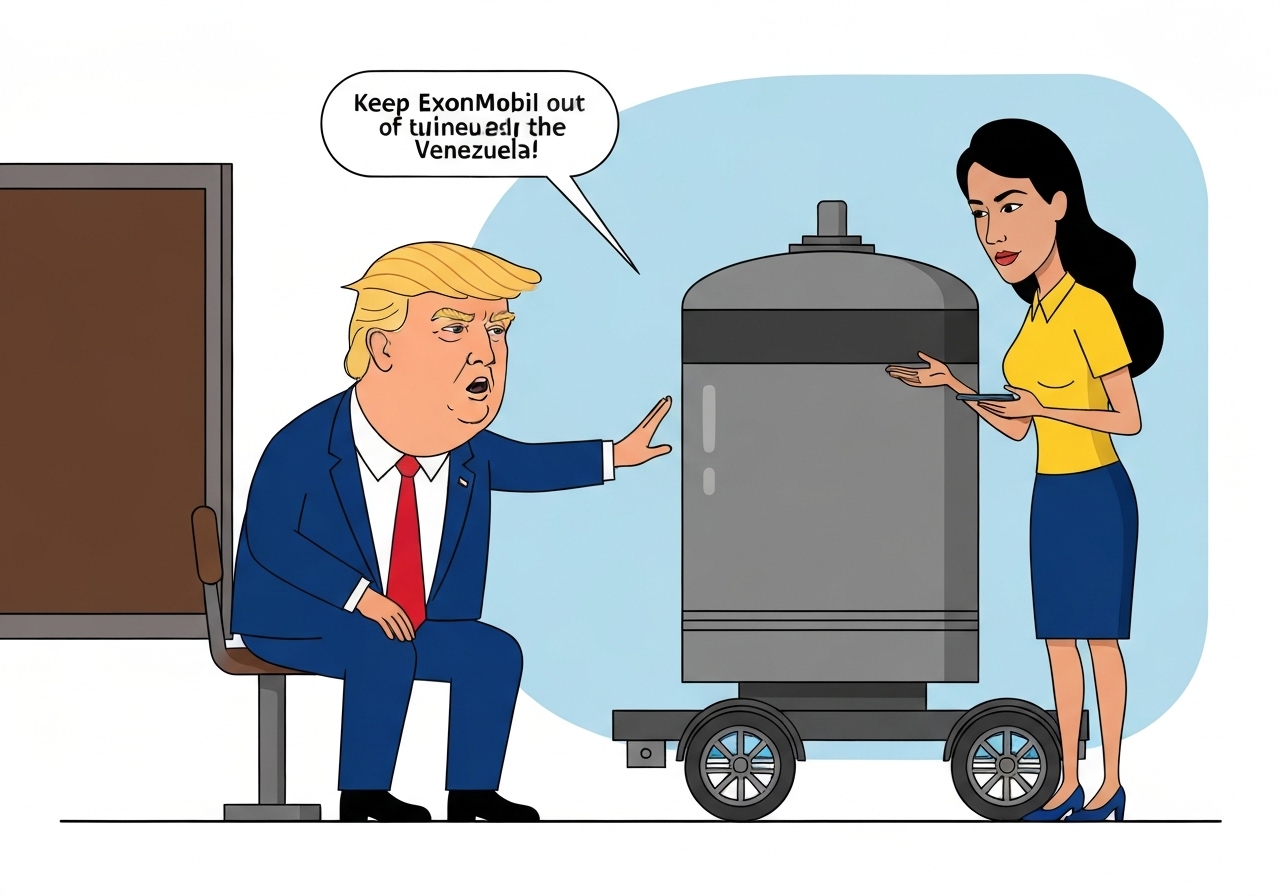
President Donald Trump said Sunday aboard Air Force One that he is “inclined” to keep ExxonMobil from operating in Venezuela after the oil giant’s CEO expressed doubts about investing there following the ouster of Nicolás Maduro. Trump told reporters departing West Palm Beach, Florida, that he “didn’t like Exxon’s response” and accused the company of “playing too cute.” The comment followed a Friday meeting between the president and U.S. oil executives intended to reassure firms they would work with the United States rather than Venezuelan authorities. The exchange came as the administration moves to secure Venezuelan oil revenues, including an executive order tied to asset seizures and U.S. control of certain crude sales.
Key Takeaways
- Trump said Sunday on Air Force One he is “inclined” to keep ExxonMobil out of Venezuela after CEO Darren Woods called the country “uninvestable.”
- Darren Woods, ExxonMobil CEO, told executives on Friday that current commercial frameworks in Venezuela make investment impractical.
- Trump met with oil-company leaders on Friday to discuss post-Maduro options and how U.S. firms would be managed by Washington rather than Caracas.
- On Friday the president signed an executive order, made public Saturday, aimed at protecting Venezuelan oil revenue from seizure in judicial proceedings.
- The administration has said it will control sales of an estimated 30 million to 50 million barrels of previously sanctioned Venezuelan crude and has seized tankers carrying Venezuelan oil.
- An ExxonMobil spokesperson had not immediately responded to a media request for comment, according to reporting.
Background
Venezuela sits atop some of the world’s largest crude reserves, but decades of political turmoil, mismanagement and sanctions have degraded output and infrastructure. The Trump administration has made attracting U.S. oil companies to Venezuela part of a broader strategy to stabilize the country economically after the removal of Nicolás Maduro. For firms, the prospect of re-entering Venezuela is complicated by legal exposure, asset-seizure risk and a web of U.S. sanctions that have targeted PDVSA and related entities for years.
Previous Venezuelan governments have nationalized or seized foreign assets on several occasions, leaving companies wary of reinvestment without strong legal and political guarantees. Washington’s recent actions — including tanker seizures and moves to directly manage certain crude sales — reflect that history and aim to prevent Venezuelan oil revenues from being diverted. Major U.S. oil producers, including ExxonMobil, now must weigh commercial opportunity against reputational, regulatory and operational risks.
Main Event
On Friday, President Trump convened executives from leading U.S. oil companies to discuss reconstruction and the management of Venezuelan energy assets after Maduro’s toppling. According to participants, the White House pitched a model in which Washington would coordinate sales and contracts, reducing direct exposure to Venezuelan authorities. Executives expressed a range of responses; some signaled conditional interest while ExxonMobil’s CEO, Darren Woods, described the commercial environment as effectively “uninvestable.”
Sunday on Air Force One, Trump said he was displeased with Exxon’s reaction and signaled openness to excluding the company from Venezuelan opportunities. He told reporters departing West Palm Beach that Exxon was “playing too cute,” a shorthand the president used to describe what he saw as insufficient enthusiasm. The exchange highlighted a rare public clash between the administration’s policy goals and a major U.S. corporation’s risk assessment.
Also last Friday, Trump signed an executive order intended to keep Venezuelan oil revenue insulated from judicial seizures, a move the White House said was necessary to protect U.S. stability efforts in Venezuela. The order, published Saturday, warns that use of those funds in judicial proceedings could “undermine critical U.S. efforts to ensure economic and political stability in Venezuela.” Simultaneously, administration officials say they have taken control of sales for roughly 30 million to 50 million barrels of previously sanctioned Venezuelan crude and have seized tankers carrying Venezuelan oil.
Analysis & Implications
Trump’s remarks and the executive order signal an administration intent on tightly managing Venezuela’s energy assets as part of a post‑Maduro transition. If Washington insists on steering which companies may operate in Venezuela, U.S. firms could face political conditions that override purely commercial decisions. That approach may attract some companies that value U.S. backing but deter others that prioritize legal certainty and predictable investment frameworks.
For ExxonMobil, staying out of Venezuela avoids near-term legal and operational risks but cedes potential upstream and downstream opportunities in a country with large remaining reserves. For the U.S. oil market, bringing Venezuelan barrels back online under U.S. oversight could increase supply and influence global pricing, but reconstruction of Venezuelan fields and facilities will require years and large capital outlays.
Geopolitically, Washington’s move to control Venezuelan crude sales could create friction with other consuming nations and rival producers that view the policy as U.S. overreach. It may also prompt countermeasures by political allies of Maduro or complicate multilateral negotiations aimed at a stable transition. The ultimate success of any U.S.-led reconstruction effort will depend on legal guarantees, security on the ground and the willingness of major oil companies to commit capital under those conditions.
Comparison & Data
| Item | Reported Amount / Note |
|---|---|
| Previously sanctioned Venezuelan crude under U.S. control | 30–50 million barrels (administration estimate) |
| Executive order announced | Signed Friday; public Saturday (administration) |
The table summarizes the administration’s publicly stated figures and timing. Restoring meaningful Venezuelan production would require sustained investment and time; historical output declines demonstrate that barrels on paper are not immediate market additions. Companies will weigh upfront capital needs against political guarantees and potential legal restrictions tied to U.S. oversight.
Reactions & Quotes
“I didn’t like Exxon’s response. They’re playing too cute,”
President Donald Trump
Trump made this remark to reporters on Air Force One as he left West Palm Beach, summarizing his displeasure with ExxonMobil’s public caution about investing in Venezuela.
“If we look at the commercial constructs and frameworks in place today in Venezuela, today it’s uninvestable,”
Darren Woods, CEO, ExxonMobil
Woods spoke at the Friday meeting of oil executives, conveying the company’s view that current legal and commercial conditions in Venezuela are not yet conducive to fresh investment.
Unconfirmed
- Whether the administration will formally ban ExxonMobil from Venezuelan opportunities has not been announced in a written directive and remains unconfirmed.
- The long-term U.S. plan to “control sales worldwide indefinitely” of Venezuelan crude lacks detailed public implementation steps and timelines.
- Precise legal protections that would be offered to investors returning to Venezuela have not been published and appear to be subject to future negotiation.
Bottom Line
The public exchange between President Trump and ExxonMobil’s CEO underscores a policy tension: Washington wants to shape who benefits from a post‑Maduro Venezuela, while major oil companies demand legal certainty before committing capital. The administration’s executive order and reported control of tens of millions of barrels show it is prepared to exert significant influence over Venezuelan oil revenues.
For investors and markets, the key questions are practical: what concrete guarantees will Washington offer, how quickly can Venezuelan production be restored, and which companies will accept political conditions in exchange for access. In the near term expect continued negotiation between the White House and energy firms, with market effects tied more to implementation than to rhetoric.