
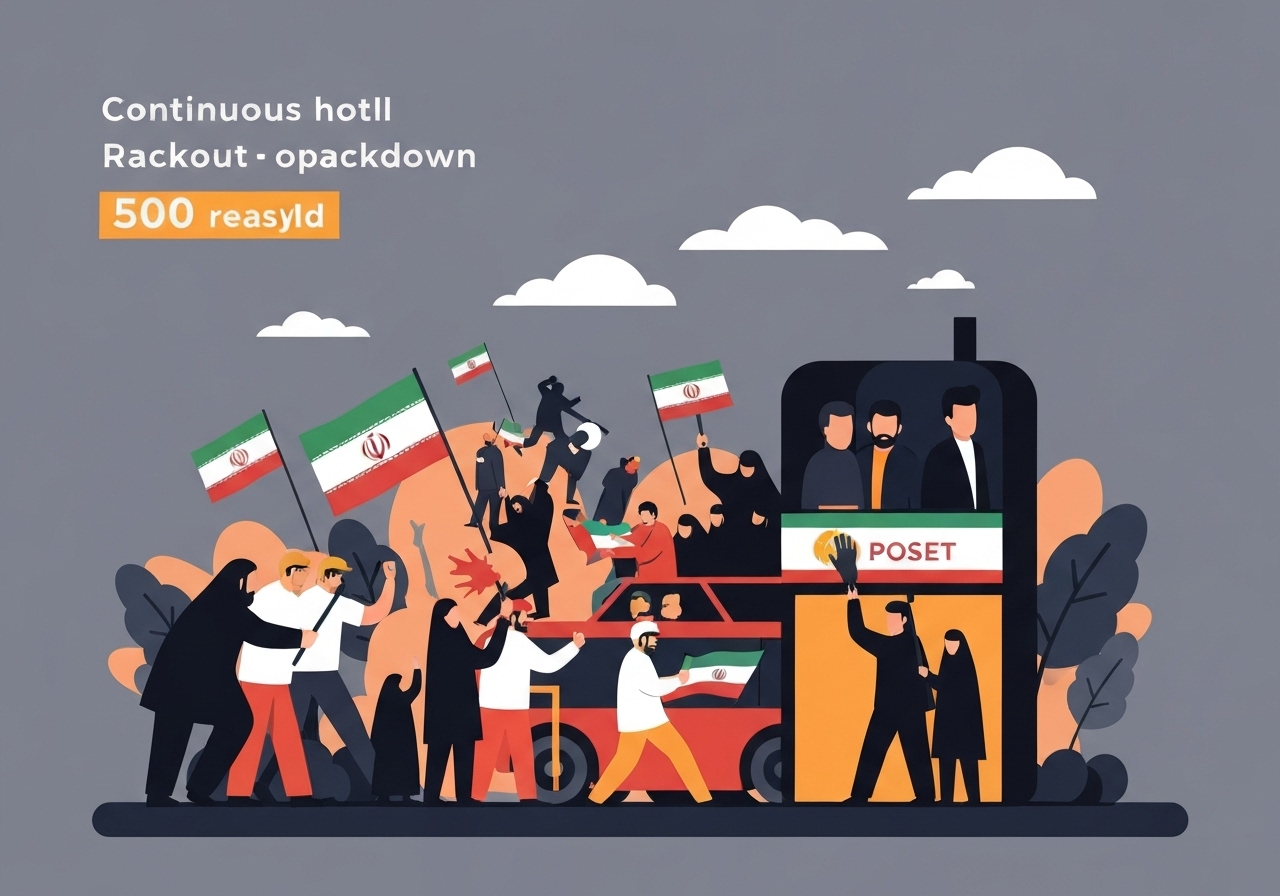
At least 544 people have died and thousands have been detained as Iran enters a third week of nationwide anti-government demonstrations, a US-based rights group reported on January 11, 2026. Authorities have imposed an internet and telephone blackout that cybersecurity monitor NetBlocks says has lasted more than 84 hours, complicating independent verification of events on the ground. State media and security institutions describe some deaths as the result of “riots” and have called for public demonstrations in support of the regime, while foreign governments and rights organizations warn of a harsh security response. International reactions and conflicting casualty tallies have heightened concerns about further escalation and regional fallout.
Key takeaways
- HRANA (Human Rights Activists News Agency) reported at least 544 dead over 15 days of unrest: 483 protesters, eight children, five non-protesting civilians, 47 military/law enforcement personnel and one government-affiliated non-civilian.
- The rights group said more than 10,681 people have been detained; a related HRA tally cited 10,675 arrests including 169 children, indicating small discrepancies between internal counts.
- NetBlocks reports Iran’s connectivity to the outside world is approximately 1% of normal and the blackout has exceeded 84 hours, obstructing independent casualty verification and reporting.
- Security forces deployed include the Islamic Revolutionary Guard Corps (IRGC) and Basij paramilitary units; state outlets report more than 100 security personnel killed, while HRANA’s tally lists 47.
- Videos geolocated by international outlets show large funerals, bodies at forensic facilities and chants at burials, but several clips’ dates and provenance remain unverified.
- U.S. President Donald Trump said Iran “called to negotiate” and that the U.S. is weighing options, including potential military or sanctions responses; U.S. officials also discussed providing satellite internet access.
- Protests have spread to diaspora communities; an incident in Los Angeles involving a truck driving into a crowd resulted in a detainment and is under FBI and LAPD investigation.
Background
The current wave of unrest began with local grievances and has broadened into mass anti-regime demonstrations across multiple provinces. Public anger has combined long‑running economic frustration, the impact of international sanctions, and widespread dissatisfaction with political repression. Analysts point to a weakened set of external and regional levers—damaged proxy networks and strikes on critical infrastructure in the prior year—that have exposed domestic vulnerabilities in the ruling establishment.
The Basij, an auxiliary militia under the IRGC formed after the 1979 revolution, has historically been deployed to suppress dissent and uphold state ideology. Recruited from conservative and often economically disadvantaged communities, Basij units operate locally and have been sanctioned in the past for human rights abuses. Their visible use in crowd control during prior episodes—2009, 2022 and others—makes them a central actor in both security responses and public fears about escalation.
Iran’s leadership has alternated between tactical concessions and hardline measures in past uprisings; this time, the government has combined information controls (a near-total internet blackout) with calls for pro-regime rallies and a rhetoric framing dissent as externally supported. That mix complicates observers’ ability to separate authentic grassroots protest dynamics from state and counter-state messaging.
Main event
Over the last 15 days, nationwide demonstrations intensified after initial protests spread from multiple cities to the capital. Human rights monitors compiled casualty reports; HRANA provided a detailed breakdown released January 11, 2026, that places the death toll at 544 and arrests above 10,600. Iranian state media concurrently announced three days of mourning and displayed footage of funerals for security personnel killed during the unrest.
Security forces have clashed with demonstrators in multiple provinces. Verified and locally sourced video shared on social platforms shows funerals where mourners chant anti‑leadership slogans and scenes at Tehran‑area forensic facilities where families attempt to identify bodies. State-affiliated outlets contest some characterizations, publishing interviews with relatives who say the deceased were not protesters or were unaffiliated civilians.
Authorities have restricted telecommunications nationwide. NetBlocks’ assessment of connectivity at roughly 1% of normal levels has persisted for more than 84 hours, limiting independent confirmation of casualty locations and timing. International news organizations and rights groups report that the blackout has hindered verification of videos, casualty lists and arrest tallies.
Outside Iran, protests and counter-protests have occurred. In Los Angeles, a moving truck struck people during a large demonstration; local police detained a suspect and the FBI joined the probe to establish motive and potential bias. Diplomatically, Iran summoned the British ambassador after a London protester tore down the Tehran embassy flag, prompting exchanges between foreign ministries.
Analysis & implications
The size and persistence of these demonstrations indicate a broader constituency of discontent than episodic protests seen in past cycles. Economically driven grievances—years of sanctions, inflation and diminished opportunities—have fused with anger at political repression, producing a protest movement with both urban and provincial reach. If security forces continue to rely on lethal force and mass arrests, the environment for sustained mobilization, international condemnation and potential sanctions will intensify.
The strategic deployment of Basij units and IRGC elements is consequential. The Basij’s local organization and history of rapid mobilization make them effective for immediate crowd control but also liable to escalate violence. Internationally, any overt U.S. intervention or strikes risk uniting disparate domestic groups around nationalist sentiment and could prompt retaliatory actions against US or regional assets—an outcome U.S. officials have said they seek to avoid.
Information denial via the prolonged internet cutoff creates multiple risks: obstruction of humanitarian monitoring, uneven reporting that benefits both state and opposition narratives, and operational challenges for journalists and NGOs trying to verify claims. This opacity also raises the probability of erroneous attributions—misidentifying perpetrators or victims—and complicates proportional policy responses by outside governments.
Economically, renewed instability could deepen Iran’s isolation and accelerate capital flight and investor hesitancy, further harming ordinary citizens. Regionally, neighbouring states and non-state actors will reassess ties to Tehran based on how the crisis evolves; an extended crackdown would likely harden existing regional alignments and afflict civilian populations beyond Iran’s borders.
Comparison & data
| Category | HRANA tally (Jan 11, 2026) |
|---|---|
| Protesters killed | 483 |
| Children (under 18) | 8 (not included above) |
| Non-protesting civilians | 5 |
| Military / law enforcement | 47 |
| Government-affiliated non-civilian | 1 |
| Total reported deaths | 544 |
| Arrests (approx.) | 10,675–10,681+ |
The table above reproduces HRANA’s breakdown published January 11, 2026. Other outlets and official state figures have provided different totals (reports of 490–496 protesters killed or more than 100 security personnel killed), underscoring the reporting gaps produced by the communications blackout. These discrepancies are explicitly noted in subsequent sections on verification and uncertainty.
Reactions & quotes
U.S. political and security leaders have signaled heightened engagement. President Trump said the Iranian government “called to negotiate” and that U.S. options are being weighed; he warned of severe retaliation if American bases are attacked. These remarks followed earlier public statements indicating the administration was considering military and sanctions responses.
“They called yesterday.”
President Donald Trump, Jan 11, 2026
The IRGC and state outlets framed parts of the unrest as foreign‑backed and threatened strong responses. State television and IRGC statements have also invoked recent regional conflicts as context for their posture and warned of retaliation against foreign military and commercial targets if external powers intervene.
“[The US] must await a crushing response from the resistant Iranian nation.”
IRGC, reported via Press TV
Human rights organisations and independent monitors emphasized the difficulty of verifying casualty and arrest figures due to the connectivity shutdown and stressed the need for transparency and access for international observers and journalists.
“Connectivity restrictions are obstructing independent verification and humanitarian monitoring.”
NetBlocks / Rights monitors
Unconfirmed
- Precise timing and provenance of multiple funeral and forensic‑center videos remain unverified; some clips indicate dates on-screen but independent confirmation is lacking.
- Claims by state outlets that many of the dead were unaffiliated “ordinary people” dragged into protests have not been systematically corroborated by independent investigators.
- Reports that as many as 250 bodies were visible on a forensic center monitor are based on observed video frames and have not been independently audited by external authorities or NGOs.
Bottom line
The crisis in Iran as of January 11, 2026, is both acute and opaque: human rights monitors report hundreds of deaths and thousands of arrests while a near‑total communications blackout prevents robust independent verification. The deployment of Basij and IRGC units, combined with state calls for pro‑government rallies and public mourning, signals a security response that could deepen polarisation and prolong instability.
International actors face a difficult calculus: support for protesters and pressure on Tehran may deter violence but also risks hardening nationalist sentiment and unintended escalation. For observers and policymakers, the immediate priorities should be restoring communications channels to permit independent oversight, securing humanitarian access, and pushing for transparent investigations into reported killings and arrests.
Sources
- CNN (live coverage — international media)
- NetBlocks (cybersecurity monitoring organization)
- Tasnim News Agency (state‑affiliated Iranian media)
- IRIB (Islamic Republic of Iran Broadcasting — state broadcaster)
- Reuters (international news agency)
- Human Rights Activists in Iran / HRANA (rights group and news arm)