
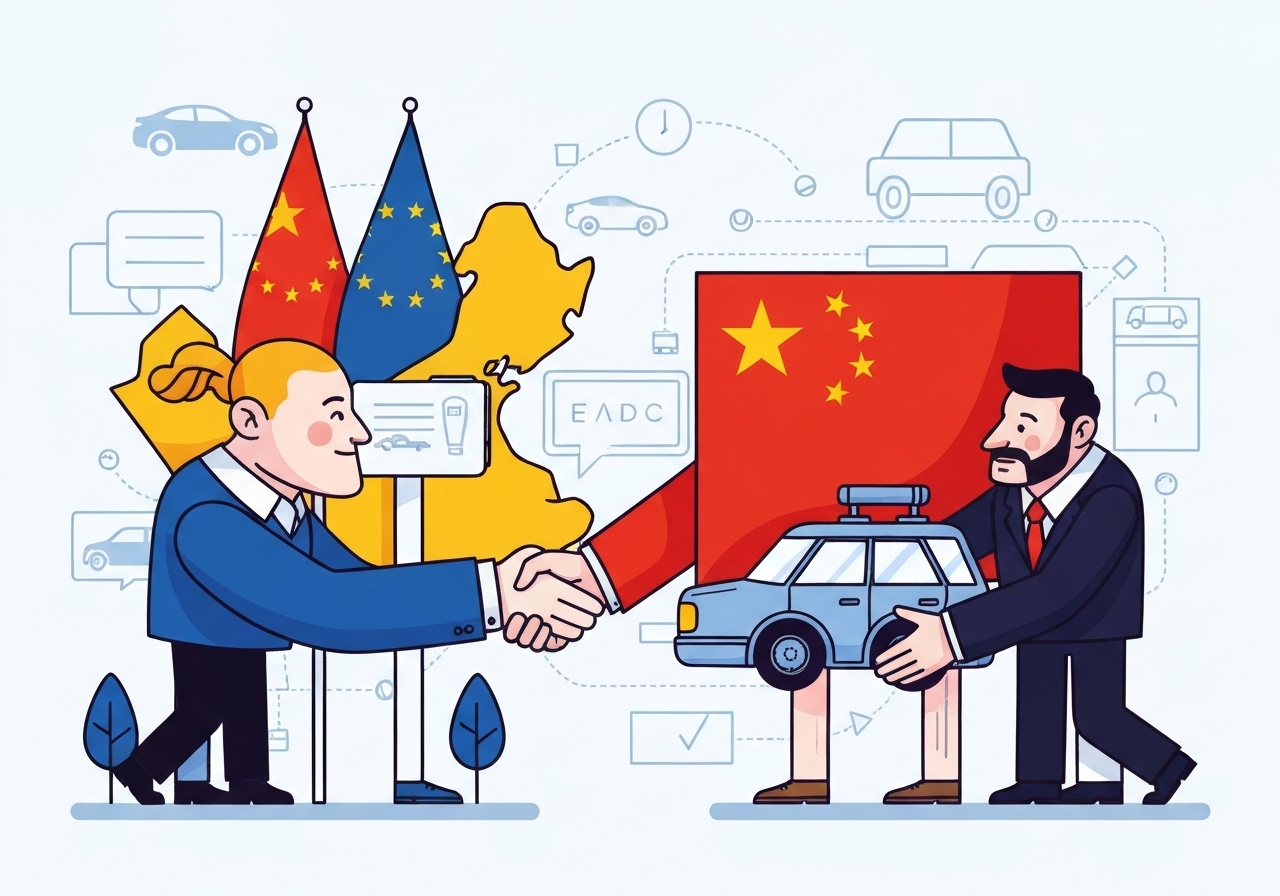
Beijing and Brussels on Monday announced a framework aimed at resolving a multi-year trade dispute over Chinese electric vehicles, marking a step toward easing tariffs imposed in 2024. The European Commission published guidance for Chinese exporters on submitting price-undertaking offers, noting proposals may include annual shipment commitments and planned EU investments. While existing countervailing duties of 7.8–35.3% over five years remain in force, the new scheme opens a pathway for minimum import prices or other remedies that could replace some duties. Both sides framed the arrangement as the product of dialogue under World Trade Organization rules and said it aims to stabilise automotive supply chains.
Key Takeaways
- The EU launched an anti-subsidy probe into Chinese EVs in October 2023 and imposed countervailing duties in October 2024 ranging from 7.8% to 35.3% for five years.
- On Monday the European Commission issued guidance allowing Chinese exporters to submit price-undertaking offers that may include annual shipment volumes and planned EU investments.
- The Commission said assessments will follow non-discrimination and WTO principles and be conducted objectively and fairly.
- Under the framework, existing tariffs remain but could be substituted with minimum import prices or negotiated commitments if offers are accepted.
- China’s Ministry of Commerce welcomed the progress as reflecting constructive dialogue and a desire to preserve global automotive supply-chain stability.
- The arrangement reduces immediate legal escalation risk but leaves substantive outcomes (investment levels, price floors, monitoring) to further negotiation and assessment.
Background
The dispute traces to the rapid rise of Chinese-made electric vehicles in European markets and concerns among EU producers about state subsidies and market distortion. In October 2023 the European Commission opened an anti-subsidy investigation focused on whether Chinese support measures gave exporters an unfair competitive edge. After a year-long probe the Commission in October 2024 imposed countervailing duties varying between 7.8% and 35.3% applied for a five-year period to address those concerns.
The tariffs represented a significant escalation in trade measures between the bloc and China, reflecting broader industrial-policy tensions over strategic sectors such as batteries and EVs. European automakers and unions had argued the tariffs were needed to protect domestic production, while Beijing consistently rejected claims that its policies amounted to unlawful subsidies. The dispute unfolded against a backdrop of EU industrial strategies seeking on-shoring and strategic autonomy and China’s push to expand outbound investment and exports.
Main Event
On Monday the European Commission published guidance for Chinese exporters wishing to submit price-undertaking offers as alternatives to the duties. The guidance specifies that offers may be strengthened by explicit annual shipment volume commitments and by detailing planned investments within the EU that would support local capacity and jobs. The Commission emphasised that each offer will be evaluated on its merits and assessed in a non-discriminatory way consistent with WTO rules.
The current duties remain legally in force while this mechanism is open, meaning importers will still face the countervailing rates unless and until an accepted offer or another remedial measure replaces them. As part of the framework the Commission indicated a possible route to minimum import prices, contingent on the sufficiency and enforceability of submitted undertakings. Enforcement, monitoring and verification mechanisms were highlighted as central requirements for any substitution of duties.
China’s Ministry of Commerce released a separate statement describing the outcome as reflecting the spirit of dialogue and consultation between the two sides, and said the progress demonstrated both parties’ willingness to resolve differences under WTO rules. Officials framed the result as supporting the stability of automotive industrial and supply chains in China, the EU and globally. The announcements stopped short of detailing quantitative investment commitments or precise timelines for replacing duties.
Analysis & Implications
The framework represents a pragmatic, negotiated pathway that reduces the immediate risk of retaliatory measures or protracted WTO litigation, while preserving the EU’s leverage through existing duties. If accepted undertakings include verifiable investment projects in the EU, the move could shift parts of the EV value chain toward local assembly, battery production or R&D hubs—altering investment flows and long-term industrial footprints.
For Chinese exporters, the option to offer shipment volumes and investment pledges provides a commercial route to regain market access or reduce duty burdens, but also creates compliance obligations and monitoring costs. Firms will need to weigh the economic trade-offs between agreeing to binding commitments (and possible penalties for breaches) versus maintaining market sales under higher tariff rates.
For EU producers and labour groups, the framework is only meaningful if undertakings deliver credible, enforceable safeguards for capacity and jobs. The effectiveness of minimum import prices or undertakings will hinge on verification regimes, penalty structures and political willingness to act on breaches—areas that will likely draw scrutiny from stakeholders and, potentially, legal challenge.
Comparison & Data
| Item | Timeline | Measure |
|---|---|---|
| Anti-subsidy probe opened | October 2023 | Investigation into alleged subsidies for Chinese EVs |
| Countervailing duties imposed | October 2024 | Tariffs of 7.8%–35.3% for five years |
| Framework announced | Monday (announcement) | Guidance for price-undertaking offers and potential minimum import prices |
The table summarises key milestones and measures. The most significant quantitative detail remains the tariff band (7.8–35.3%) and the five-year duration; all other outcomes depend on the content and enforceability of future undertakings and any minimum-price mechanism.
Reactions & Quotes
“Assessments will be objective and in line with WTO rules,”
European Commission (official statement)
The Commission emphasised procedural fairness and WTO conformity when outlining how it will review offers from Chinese exporters.
“The progress fully reflects the spirit of dialogue and the outcomes of consultations between China and the EU,”
China’s Ministry of Commerce (official statement)
China framed the agreement as a confirmation that negotiations can resolve trade differences and help stabilise global automotive supply chains.
“Any undertakings will need clear verification and enforcement to reassure European industry and workers,”
Industry analyst (independent)
Market observers warn that the deal’s practical impact depends on monitoring and the credibility of commitments submitted by exporters.
Unconfirmed
- Whether and when the EU will formally accept specific price-undertaking offers from Chinese exporters is not yet public; individual firm-level agreements remain to be seen.
- The exact quantitative commitment levels for annual shipment volumes and the monetary scale of planned EU investments have not been disclosed.
- Details on enforcement, monitoring mechanisms and penalties tied to undertakings (or minimum import-price adjustments) have not been published and remain subject to further negotiation.
Bottom Line
The announced framework is a diplomatic and procedural step that reduces the immediate confrontation between Beijing and Brussels while leaving substantive outcomes unresolved. Existing countervailing duties remain in place, but the guidance opens a pathway for negotiated solutions—potentially minimum import prices or binding undertakings—that could alter market dynamics if robustly enforced.
Success will depend on the credibility of commitments, the rigour of verification, and whether undertakings lead to tangible EU investment or capacity safeguards. Stakeholders on both sides will monitor forthcoming offers and assessments closely; the deal’s long-term effect on supply chains, prices and industrial policy will only become clear as concrete proposals and enforcement rules emerge.
Sources
- South China Morning Post (news)
- European Commission — Trade (official site) (official/agency)
- Ministry of Commerce of the People’s Republic of China (MOC) (official)