
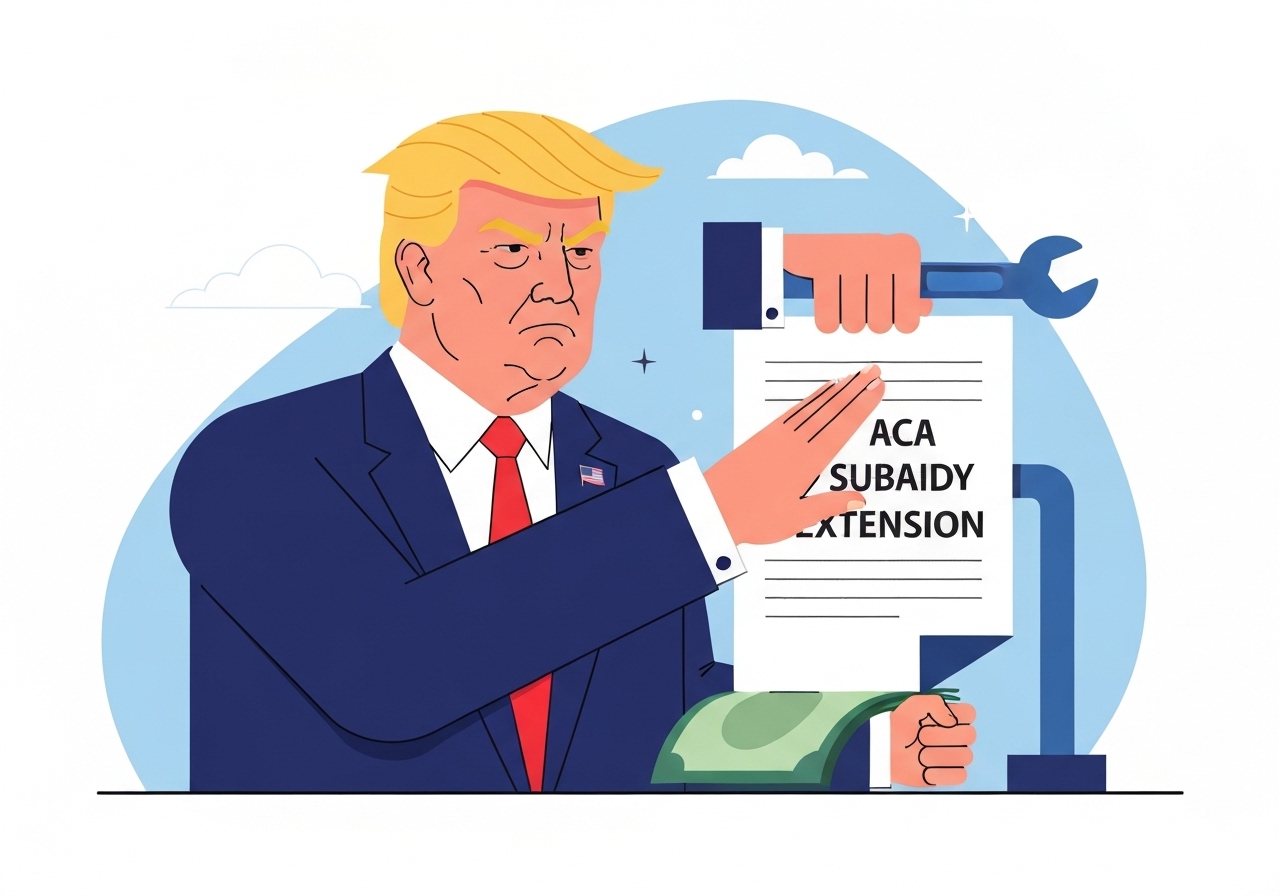
On January 12, 2026, President Donald Trump told reporters aboard Air Force One that he might veto legislation to extend Affordable Care Act (ACA) premium subsidies if Congress were to send such a bill to his desk. His comment followed a Wednesday move in the House in which nine Republicans from competitive districts joined Democrats to advance a proposal to revive expired ACA subsidies for three years. The exchange underscores a renewed early-2026 fight over health-care costs and political control of moderate lawmakers in tight districts. The immediate effect is procedural uncertainty for a measure supporters say would lower premiums for marketplace enrollees, and opponents say would expand federal spending.
Key Takeaways
- President Trump said on Jan. 12, 2026, aboard Air Force One that he may veto a bill extending ACA premium subsidies if it reaches his desk; the remark was reported at 2:14 AM UTC.
- On the prior Wednesday, nine swing-district House Republicans joined Democrats to advance legislation to restore expired ACA subsidies for a three-year period.
- The legislation under discussion is explicitly framed as a three-year revival of subsidies that had expired at the end of 2025, not a permanent program change.
- Supporters argue the extension would reduce monthly premiums for Marketplace enrollees; opponents highlight the additional federal spending and political trade-offs.
- The procedural path remains uncertain: advancement in the House does not guarantee final passage, Senate consideration, or a presidential signature.
Background
Premium tax credits under the Affordable Care Act have been a central mechanism for lowering monthly insurance costs for people who buy plans on the federal and state Marketplaces. Those credits were temporarily enhanced by prior federal actions and, according to recent reporting, certain enhancements expired at the end of 2025. Restoring or extending those payments has become a partisan flashpoint because the credits directly affect consumer premiums while also carrying a budgetary cost for federal finances.
Politically, the question intersects with the calculations of lawmakers from competitive House districts. Moderates and swing-district Republicans face pressure from constituents who see immediate effects on premiums, while party leaders weigh long-term fiscal messaging and 2026 campaign themes. Past episodes of subsidy extension have shown that cross-aisle coalitions can form when local political incentives diverge from national party strategy.
Main Event
President Trump addressed reporters on Air Force One on Jan. 12, 2026, saying he may veto any legislative package to extend ACA subsidies that reached his desk. The remark came amid news that a bipartisan group of House members had moved a bill forward that would restore those subsidies for three years. House action on Wednesday involved nine Republicans from competitive districts joining Democrats to advance the measure; that procedural step signals at least some Republican willingness to cross the aisle on the issue.
The immediate legislative mechanics remain unsettled. Advancement in the House could mean committee approval or a procedural movement toward floor consideration, but final passage still requires majority votes on the floor, possible reconciling measures with the Senate and, ultimately, the president’s signature. If the White House follows through with a veto threat, supporters would need veto-proof margins or to negotiate provisions acceptable to the administration.
Advocates for extension emphasize near-term relief for Marketplace enrollees who experienced higher premiums after the enhancements lapsed. Opponents, including officials aligned with the administration, frame the package as an unwarranted increase in federal subsidy spending that should be balanced by offsets or alternative reforms. The dispute therefore combines policy trade-offs with short-term political signaling ahead of the 2026 campaign season.
Analysis & Implications
The president’s veto threat raises the political stakes for moderate Republicans who backed the House advancement. Lawmakers in narrow districts must weigh constituent pressure to lower premiums against potential backlash from party leaders and conservative voters who prioritize spending restraint. If moderates face sustained pressure from both sides, the final outcome could hinge on negotiation over offsets, sunset dates, or targeted eligibility adjustments.
From a policy perspective, a three-year extension would restore temporarily enhanced premium assistance rather than create a permanent entitlement expansion. That limited horizon may make the proposal more palatable to some fiscal moderates but less appealing to those seeking structural ACA reforms. Insurers and state Marketplaces would welcome greater predictability for plan pricing, but temporary fixes can also complicate longer-term rate-setting and market stability.
Budgetary and market effects depend on final design and whether offsets are included. Extending subsidies increases federal outlays in the near term, an argument used by critics. Proponents counter that lower premiums can reduce uncompensated care and stabilize enrollment. Internationally and across states, the political signal is that U.S. health policy remains contestable and subject to short-term legislative fixes tied to electoral calendars.
Comparison & Data
| Item | Current Status |
|---|---|
| Proposed subsidy revival | Three-year extension |
| House movement | Advanced with support from Democrats plus 9 swing-district Republicans (Wednesday) |
| Presidential stance | Potential veto if bill reaches the president’s desk (Jan. 12, 2026) |
The table summarizes the core facts: a targeted three-year proposal advanced in the House with a small bipartisan bloc, and a veto threat from the White House. That combination creates a narrow legislative window in which negotiation, offset discussion and political maneuvering will determine whether the measure becomes law.
Reactions & Quotes
“I may veto any bill to extend Obamacare subsidies if Congress sends it to my desk.”
Donald J. Trump, President (remark to reporters on Air Force One, Jan. 12, 2026)
“Nine Republicans from competitive districts joined Democrats Wednesday to advance a three‑year revival of expired ACA subsidies.”
Bloomberg News (news report)
“Premium tax credits are designed to lower monthly premiums for Marketplace enrollees, reducing out‑of‑pocket costs for eligible households.”
U.S. Department of Health & Human Services (official guidance)
Unconfirmed
- Whether President Trump will follow through with a formal veto if the House-passed bill reaches the White House is not confirmed.
- The precise fiscal score, offsets or cost estimates for the proposed three-year extension have not been released publicly in this report and remain subject to CBO or other official scoring.
- The ultimate Senate response and whether sufficient support exists there to pass the measure as advanced in the House are unconfirmed.
Bottom Line
The Jan. 12, 2026 exchange highlights a renewed and immediate policy fight over ACA premium assistance: House movement backed by a small bipartisan group collided with a presidential veto threat, leaving the measure’s future uncertain. For consumers, the stakes are direct—subsidy restoration would reduce premiums for many Marketplace enrollees; for lawmakers, the choice is political, balancing constituent relief against fiscal and partisan messaging.
Expect negotiations in the coming weeks over scope, duration and offsets if supporters seek to blunt a veto threat. The outcome will matter for premium affordability in 2026 and for political dynamics in competitive districts ahead of the 2026 campaign cycle.
Sources
- Bloomberg News (news report)
- U.S. Department of Health & Human Services (official overview of the Affordable Care Act)