
Lead
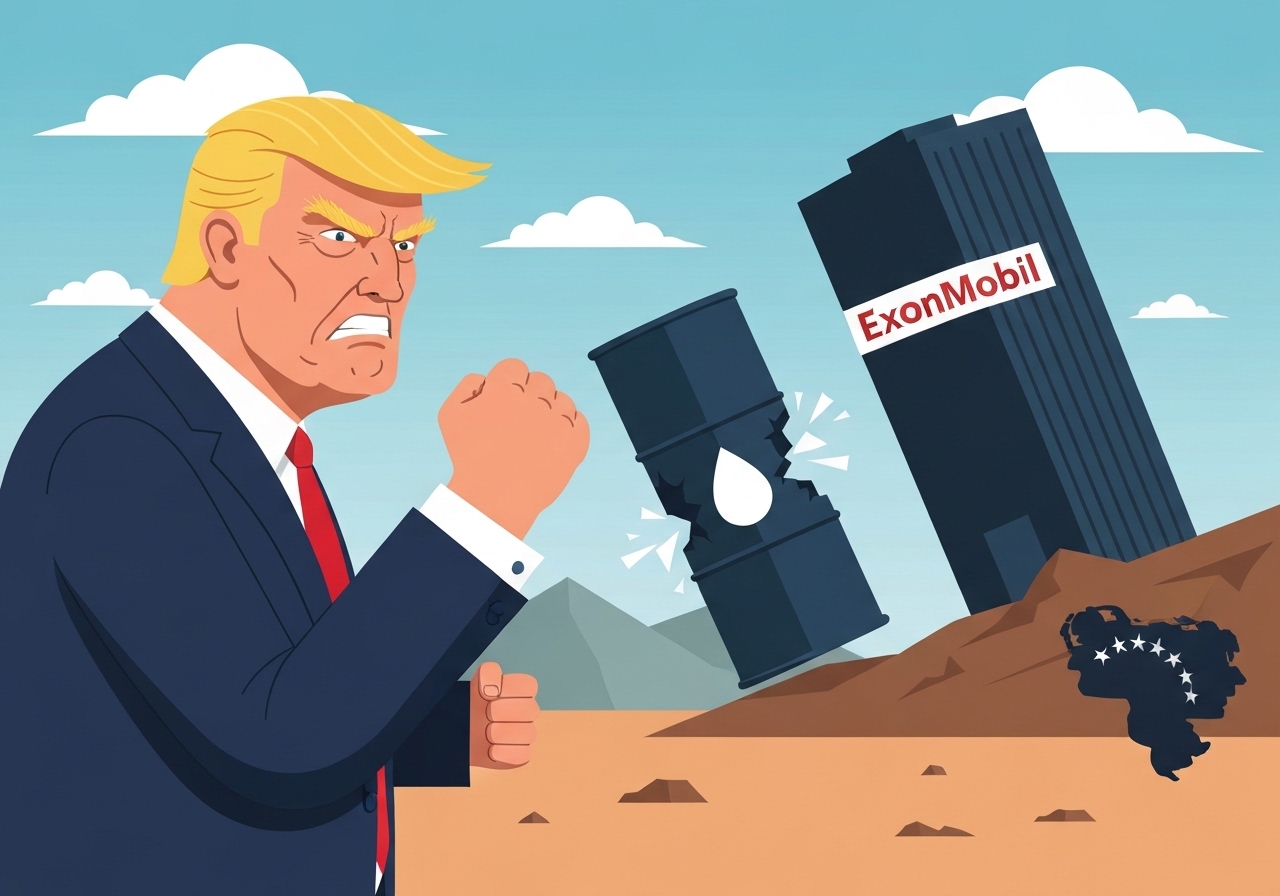
President Donald Trump said he may bar ExxonMobil from investing in Venezuela after Exxon chief executive Darren Woods described the country as “uninvestable” during a White House meeting last week. The exchange followed a high-profile session in which Mr Trump urged oil executives to commit $100 billion to rebuild Venezuela’s energy sector, less than a week after U.S. forces removed Nicolás Maduro. Mr Trump said he was displeased with Exxon’s comments and indicated his administration will decide which firms may operate in Venezuela; he also signed an executive order on Saturday to block certain creditor actions tied to Venezuelan oil revenues held in U.S. Treasury accounts.
Key Takeaways
- At a White House meeting last week, President Trump urged oil companies to invest $100 billion in Venezuela’s oil industry to revive production and infrastructure.
- ExxonMobil CEO Darren Woods told the president that, given past expropriations and current legal frameworks, Venezuela is “uninvestable” without durable protections and legal reform.
- Venezuela collectively owes over $13 billion to ConocoPhillips and Exxon following expropriations and subsequent court rulings.
- ConocoPhillips CEO Ryan Lance urged debt restructuring and a comprehensive overhaul of Venezuela’s energy institutions, including PDVSA.
- On Sunday, Mr Trump said he was inclined to “keep Exxon out” after Woods’ remarks; on Saturday he signed an executive order restricting creditor access to certain Venezuelan oil revenues in U.S. accounts.
- Exxon, Chevron and ConocoPhillips were historically major partners of Venezuela’s state oil company PDVSA, but Exxon and ConocoPhillips exited after nationalisations between 2004 and 2007.
Background
Venezuela’s oil sector was nationalised under the late president Hugo Chávez between 2004 and 2007, pushing out several foreign operators and prompting arbitration cases. ConocoPhillips and Exxon subsequently filed claims and obtained court rulings that awarded them compensation; those rulings underpin the more than $13 billion figure now cited as owed to U.S. companies. For decades before nationalisation, U.S. majors including Exxon, Chevron and ConocoPhillips were prominent partners of state oil firm PDVSA.
The recent U.S. military operation that removed Nicolás Maduro has reset political calculations about who will control Venezuela’s assets and how foreign companies might re-enter the country. That context frames the White House meeting: the administration is seeking rapid investment and reconstruction of the energy sector, while executives are weighing legal risk, previous expropriation experience and the need for enforceable investment protections.
Main Event
In the Friday meeting with at least 17 oil executives, President Trump pushed the group to consider a $100 billion reconstruction of Venezuela’s oil industry. Executives from major U.S. oil companies attended; their assessments ranged from cautious interest to blunt warnings about the current investment climate. Darren Woods told the president that Exxon had seen its assets seized in Venezuela twice and that re-entering without strong legal guarantees would be difficult.
Woods said Venezuela’s existing hydrocarbons law and legal frameworks must be reformed to attract long-term capital, that durable investment protections are required, and that the present combination of legal and commercial constructs made the country uninvestable. Trump reportedly took Woods’ comments badly; on Air Force One on Sunday he said, “I didn’t like Exxon’s response … I’ll probably be inclined to keep Exxon out. They’re playing too cute.”
ConocoPhillips CEO Ryan Lance told the president his company was the largest non-sovereign creditor in Venezuela and called for restructuring of debts and systemic reforms to PDVSA. Mr Trump responded by saying ConocoPhillips “would get a lot of its money back,” while also stating the U.S. would start with a clean slate and not fully revisit past private losses.
On Saturday, the president signed an executive order intended to block courts or creditors from seizing revenues tied to Venezuelan oil that are held in U.S. Treasury accounts. Exxon did not immediately respond to requests for comment after the meeting and subsequent public remarks.
Analysis & Implications
The immediate diplomatic and commercial consequence is heightened political control over which firms may operate in Venezuela. If the administration follows through on limiting access, it would politicise corporate entry decisions and could prompt legal challenges from affected companies claiming discrimination or breach of contract. Firms weighing re-entry will demand enforceable legal protections and clear terms on restitution for past expropriations.
Economically, the prospect of large-scale capital inflows—$100 billion, as the president proposed—depends on credible rule-of-law reforms, debt restructuring and the operational viability of PDVSA or its successor. Without those, capital commitments are likely to be smaller, staged, or routed through non-U.S. entities less constrained by U.S. political signals. The $13 billion-plus in arbitration liabilities to U.S. companies will complicate negotiations over who gets priority on future revenue streams.
Politically, the administration’s posture signals a desire to leverage control of sovereign assets and U.S.-held revenues to shape a post-Maduro settlement. That approach may accelerate short-term leverage but risks deterring long-term investors wary of political interventions. International partners and creditors will watch whether the U.S. policy is implemented as a selective commercial prerogative or as a general rule for post-conflict reconstruction.
Comparison & Data
| Company | Historic Outcome | Amount cited (approx.) |
|---|---|---|
| ConocoPhillips | Exited after nationalisation; arbitration award | Portion of >$13bn owed |
| ExxonMobil | Exited after nationalisation; arbitration award | Portion of >$13bn owed |
| Chevron | Negotiated limited continuing operations | Not the primary claimant here |
The table summarises the broad post-nationalisation positions of the three largest U.S. oil companies in Venezuela. The aggregate figure of more than $13 billion owed to ConocoPhillips and Exxon comes from court rulings tied to expropriations. Any future investment plans will need to address how those claims are handled—either through settlement, restructuring, or explicit indemnities.
Reactions & Quotes
Officials and executives offered immediate, contrasting responses at the time of the meeting and in its aftermath.
“I didn’t like Exxon’s response … I’ll probably be inclined to keep Exxon out. They’re playing too cute.”
President Donald Trump
Mr Trump spoke to reporters on Air Force One en route to Washington, framing his displeasure as a public indicator that the administration could exercise gatekeeping over which companies may enter Venezuela.
“If we look at the legal and commercial constructs and frameworks in place today in Venezuela today, it’s uninvestable.”
Darren Woods, CEO, ExxonMobil
Woods gave the White House a candid assessment of the structural constraints that, in his view, prevent immediate large-scale investment without legal and fiscal reform.
“We’re the largest non-sovereign credit holder in Venezuela; a restructuring is necessary for the energy system and PDVSA.”
Ryan Lance, CEO, ConocoPhillips
Lance framed the financial and institutional repairs he says are needed before the private sector can meaningfully participate in reconstruction.
Unconfirmed
- Whether the administration will formally bar ExxonMobil from re-entering Venezuela through a definitive, legally enforceable blacklist remains unresolved.
- Exact mechanisms and criteria the U.S. will use to select which foreign firms, if any, may operate in Venezuela have not been published.
- Precise settlement figures and timelines for the more than $13 billion owed to ConocoPhillips and Exxon have not been disclosed; future negotiations may alter liabilities.
Bottom Line
The White House’s public disagreement with ExxonMobil’s CEO adds a political layer to what is already a legally and financially complex decision for any company considering investment in Venezuela. Executives face a mix of legacy arbitration claims, demand for legal and fiscal reforms, and the new variable of U.S. political gatekeeping over market access.
For Venezuela, rapid reconstruction hinges not just on pledged capital but on credible institutions, restructured debts and enforceable protections that convince investors their assets will not be arbitrarily expropriated again. In the short term, expect intense negotiations among the U.S. government, oil companies and international creditors over who controls revenue flows and how past claims will be resolved.
Sources
- The Guardian (news media) — original reporting of the White House meeting, quotes and executive order.