
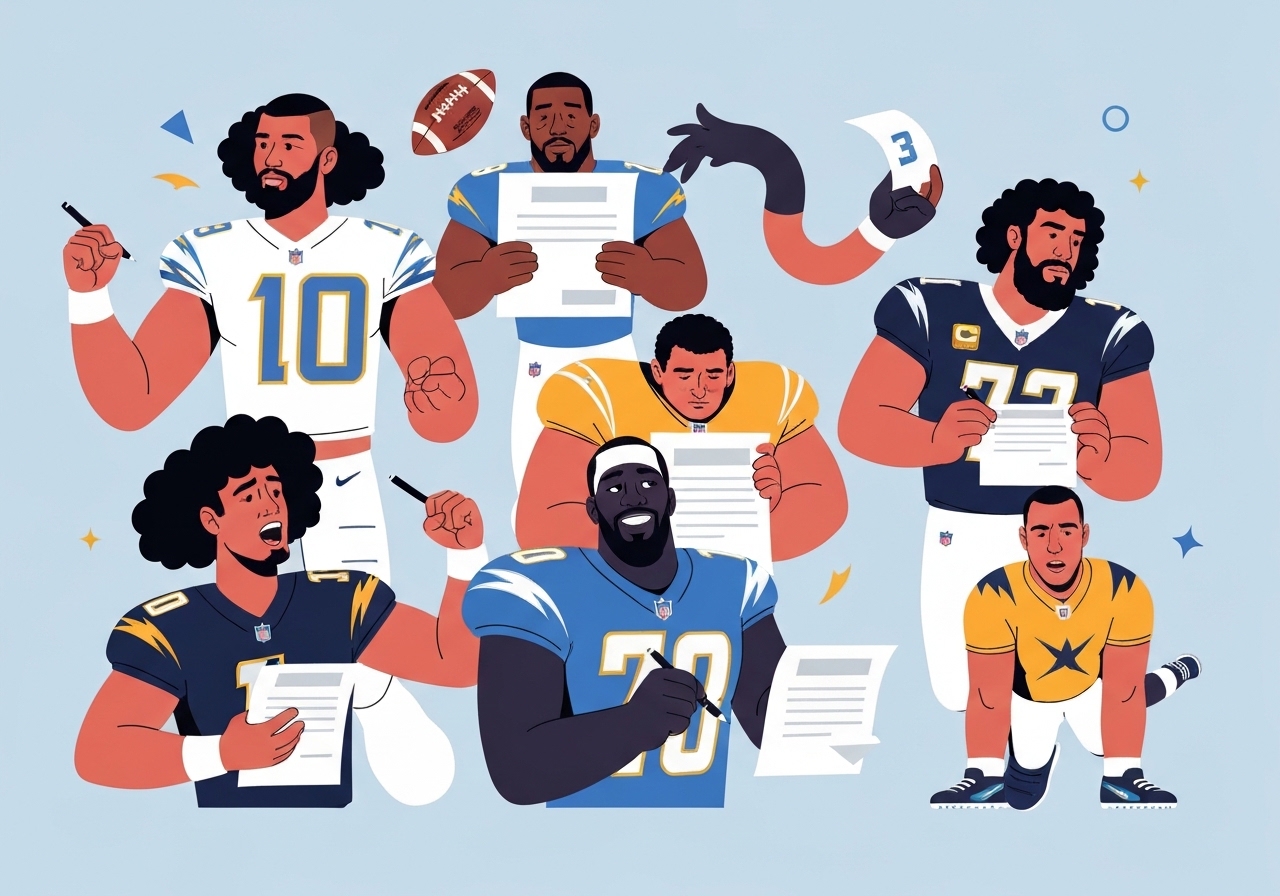
The Los Angeles Chargers announced this week that the organization signed 14 players to contracts as part of a broader set of roster moves aimed at shoring up depth and special-teams options. The signings accompany a string of activations, elevations and short-term additions to both the active roster and practice squad. Team releases and transaction posts indicate the moves address injuries, positional depth and game-day flexibility ahead of upcoming matchups. The immediate result is a larger pool of eligible players for game-day elevations and competition in practice.
Key Takeaways
- The Chargers added 14 players to contracts, according to the team announcement, increasing roster depth across multiple units.
- Recent related transactions include activations such as Tucker Fisk from Reserve/Injured and signings like Marcus Maye to the active roster.
- Several players were elevated from the practice squad in the same stretch, including Branson Taylor, Dalevon Campbell and Marcus Williams.
- The team also placed players on Reserve/Injured — for example, KeAndre Lambert-Smith and cornerback Nikko Reed — creating short-term roster openings.
- Los Angeles completed at least one trade in the same window, acquiring offensive lineman Trevor Penning from the New Orleans Saints (pending physical).
- Some signings appear to be practice-squad or depth additions (e.g., Royce Freeman, Tanner McLachlan), suggesting a mix of veteran and developmental moves.
Background
NFL clubs routinely adjust 53-man rosters, practice squads and injured-reserve lists throughout the season to respond to injuries, matchups and performance. The Chargers have been active in recent weeks with a series of announcements—activations, elevations and short-term signings—that together reflect typical in-season roster management. Practice-squad elevations allow teams to temporarily add players to the game-day roster without a long-term commitment, while signings to the active roster or to contracts more broadly can include players intended for immediate contribution or for development. General managers and coaching staffs commonly use these windows to test depth, secure special-teams options and create competition ahead of critical slate of games.
Los Angeles’s recent transaction cadence mirrors leaguewide behavior: injuries, strategic matchups and the need for special-teams specialists frequently drive midseason additions. The Chargers’ front office and coaching staff have emphasized both short-term readiness and maintaining a pipeline of developmental talent. Prior seasons show that teams that balance veteran pickups with younger signings can better absorb in-season attrition. That balance appears to be a guiding principle behind the 14 signings announced by the franchise.
Main Event
The team statement confirmed that 14 players were signed to contracts, a number that includes additions to both the active roster and practice squad pools. The announcement did not list every contract term in public detail, but it came alongside several other roster actions posted by the team: activations (for example, Tucker Fisk), elevations (such as Dalevon Campbell and Isas Waxter) and additional signings (including Marcus Maye and Jaret Patterson in separate transaction notes). Those adjacent moves provide context: some signings replace injured players placed on Reserve/Injured, while others are precautionary or strategic depth additions.
Chargers communications have routinely paired single-player headlines with separate transaction posts; in this case, the broader 14-player signing was presented as part of a sustained roster update stream. Several of the related posts indicate short-term operational decisions intended for upcoming games—elevations for game-day rosters and signings to ensure coverage at key positions. The combination of activations, elevations and signings suggests the team is prioritizing immediate readiness and special-teams reliability in the near term.
The practical effect is a deeper pool for coaches to select from on game days and more competition in practice sessions. Some signees will likely be candidates for future elevations; others may be insurance hires or developmental projects. The team’s public materials emphasize roster flexibility rather than long-term guaranteed contracts, a common pattern for midseason moves where cap exposure and roster limits constrain guaranteed investments.
Analysis & Implications
Adding 14 players in a single wave has both short-term and medium-term implications. In the short term, it gives the Chargers more options when preparing weekly game-day elevations: they can rotate players at thin positions, protect against multiple injuries in the same positional group, and add return or special-teams specialists. That flexibility can be decisive in close games where depth matters late in the season. The signings also protect the team against the risk of carrying injured players on the 53-man roster while still preserving game-day competitiveness.
From a roster-construction perspective, the mix of veterans and younger players matters. Veterans typically offer immediate reliability on special teams or in limited offensive/defensive roles, while younger signees represent developmental upside. The Chargers’ concurrent moves—elevating practice-squad players and acquiring an offensive lineman via trade—suggest management is balancing present needs with future roster building. How the coaching staff allocates snaps and elevations in the coming weeks will signal which of these 14 players are viewed as contingency depth versus developmental prospects.
Financially, most midseason signings of this type are structured to limit long-term cap commitments; practice-squad contracts and short-term active-roster deals minimize guaranteed money. That means the competitive value of signings can exceed their cap cost, especially if a player earns repeated elevations or a stable roster spot. However, the team still faces opportunity costs: 14 new contracts consume space on practice-squad lists and require coaching resources for evaluation.
Comparison & Data
| Player | Recent Transaction (from team posts) |
|---|---|
| Tucker Fisk | Activated from Reserve/Injured |
| KeAndre Lambert-Smith | Placed on Reserve/Injured |
| Dalevon Campbell | Elevated from Practice Squad |
| Isas Waxter | Elevated from Practice Squad |
| Marcus Maye | Signed to Active Roster from Practice Squad |
| Branson Taylor | Elevated from Practice Squad |
| DJ Uiagalelei | Elevated from Practice Squad |
| Jaret Patterson | Signed to Active Roster from Practice Squad |
| Royce Freeman | Signed to Practice Squad |
| Tanner McLachlan | Signed to Practice Squad |
| Trevor Penning | Acquired via Trade (pending physical) |
The table above compiles named transactions that accompanied the broader announcement; it does not claim to list all 14 signees individually because the team release summarized a bulk signing. Those transactions show a mix of activations, elevations and signings affecting both the active roster and the practice squad. This mix is consistent with a club managing in-season attrition and positional shortfalls while retaining flexibility for future moves.
Reactions & Quotes
Bolts Activate Tucker Fisk; Elevate Dalevon Campbell and Isas Waxter
Chargers.com (team transaction post)
The team used concise transaction posts to communicate specific game-day adjustments. This headline-style post signals that the organization is adjusting its active roster to meet immediate needs — in this case by returning a tight end from IR and elevating two practice-squad players for the coming game.
Los Angeles Chargers Sign Marcus Maye to Active Roster; Elevate Branson Taylor and DJ Uiagalelei
Chargers.com (team transaction post)
This related announcement illustrates the typical chain-reaction of midseason roster work: one signing to the active roster often accompanies corresponding practice-squad elevations and placements. Signing a veteran safety like Marcus Maye to the active roster indicates a need for experience in the secondary or on special teams.
Los Angeles Chargers Sign Jaret Patterson to Active Roster
Chargers.com (team transaction post)
Adding a running back to the active roster while also adding running backs to the practice squad reflects concerns around depth at the position. Game-plan needs and injury cover are common drivers for these moves, which are often short-term but can become permanent if the player performs well.
Unconfirmed
- The full public list of the 14 individual signees and their contract lengths was not included in the summary announcement and therefore remains unconfirmed in this article.
- Specific guaranteed-money details and exact cap impact for each of the 14 contracts have not been disclosed by the team.
- Which of the 14 signees will receive repeated game-day elevations or earn permanent roster spots is undecided and depends on upcoming practices and game situations.
Bottom Line
The Chargers’ decision to sign 14 players is a clear roster-management move designed to increase depth, protect against injuries and provide the coaching staff with more tactical choices on game days. The accompanying activations, elevations and trade activity underscore a broader management approach: short-term readiness coupled with selective development of younger talent. For fans and analysts, the immediate items to watch are which signees are elevated repeatedly, how special teams units are affected, and whether any of the newcomers secure a longer-term role.
Because the team’s summary did not disclose all contract specifics, follow-up updates from the organization and the NFL’s official transaction logs will be needed to confirm the complete list, financial terms and any longer-term implications. In the near term, the Chargers have widened their margins for error — the effectiveness of that strategy will become clearer over the next several games as the coaching staff deploys the new additions.