
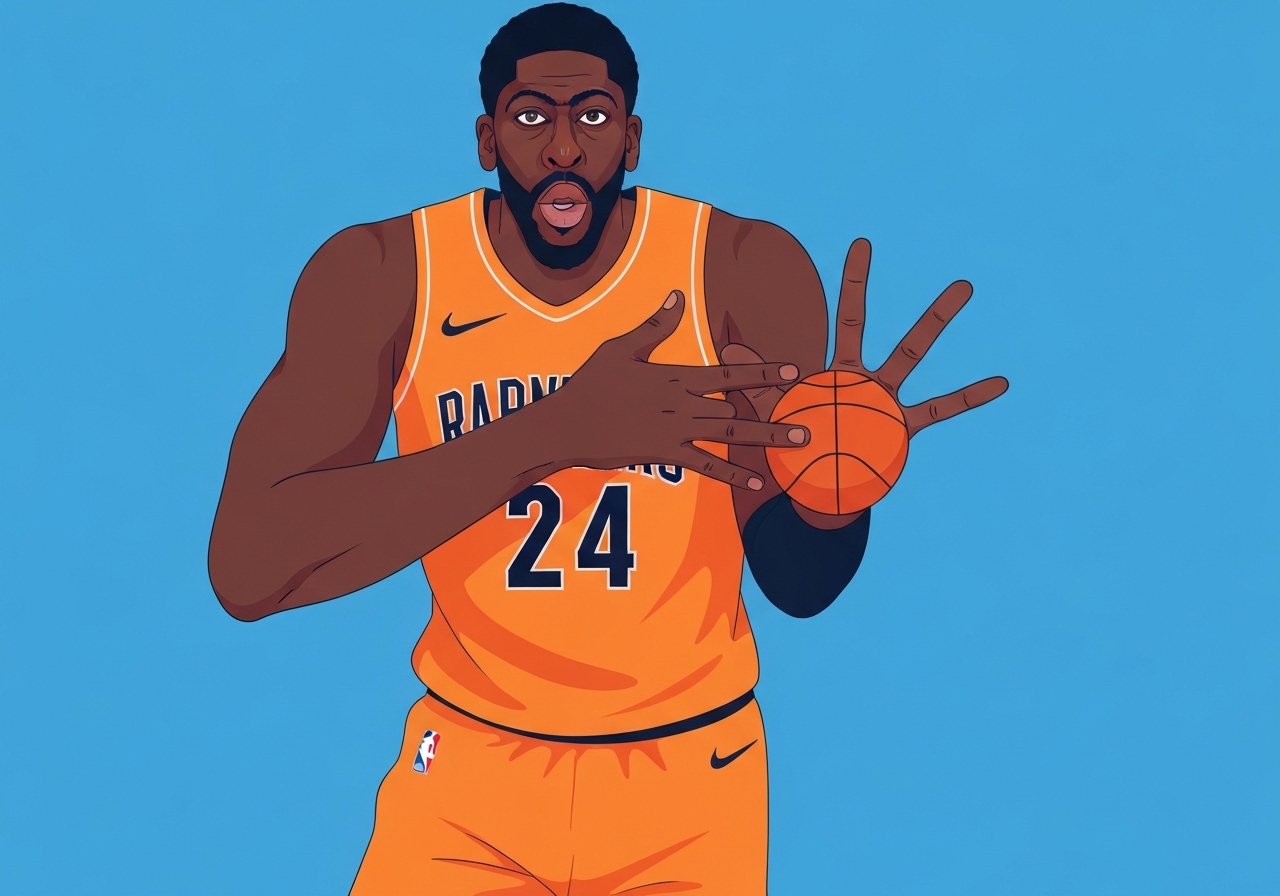
Dallas Mavericks big man Anthony Davis will miss roughly six weeks after sustaining ligament damage to his left hand late in the team’s loss to the Utah Jazz, but the club says surgery is not expected. The injury occurred while Davis was defending Lauri Markkanen in the 116-114 defeat; he left the game in visible pain and went to the locker room. A medical evaluation on Tuesday led the team to recommend non-surgical treatment and a re-evaluation in approximately six weeks. The Mavericks confirmed the timeline but emphasized that the timetable could change based on Davis’s recovery.
Key Takeaways
- Davis, 32 and a 10-time All-Star, suffered left-hand ligament damage defending Lauri Markkanen in Dallas’s recent 116-114 loss to Utah.
- The Mavericks announced after a Tuesday medical exam that surgery is not expected; Davis will be rechecked in about six weeks.
- This absence will be Davis’s second of at least a month this season; he previously missed 15 of 16 games in November with a calf strain.
- Davis has missed half of Dallas’s 40 games this season and 40 of 71 games since his Dallas debut last February.
- The timeline preserves the possibility he could recover in time to be available for a late-season push or to make himself more attractive as a trade asset.
- The development factors into Dallas’s broader roster decisions, including the timing of Kyrie Irving’s return from an ACL tear.
Background
Anthony Davis arrived in Dallas nearly a year ago in a high-profile trade that has drawn scrutiny because of Davis’s injury record since the deal. In his Dallas debut last February he re-aggravated an abdominal injury he had been managing after the trade and subsequently missed 18 games. Across his time in Dallas he has missed 40 of 71 games, reflecting a pattern of intermittent absences that complicates roster planning and on-court continuity.
This season alone Davis has missed half of the Mavericks’ first 40 games, including a 15-of-16 stretch in November when he was sidelined with a calf strain; he has also been affected at times by a groin issue. The Mavericks, who had hoped the pairing of Davis with the core pieces already in Dallas would accelerate a title push, find themselves outside the comfortable playoff picture in the crowded Western Conference. Concurrently, Kyrie Irving’s recovery from an ACL tear in his left knee—originally expected sometime after the turn of the year—remains a key factor in the club’s short-term outlook.
Main Event
The injury occurred late in Dallas’s 116-114 loss to the Utah Jazz when Davis was defending a drive by Lauri Markkanen. According to the team account, Davis went to the bench in visible pain and did not return to the game, subsequently going to the locker room for evaluation. Team doctors performed imaging and clinical exams on Tuesday, after which the club announced that surgery would not be required for the left-hand ligament damage.
The Mavericks characterized the recovery plan as conservative: non-surgical management with a period of rest, rehabilitation and a planned re-evaluation in about six weeks. That window is an estimate based on current imaging and clinical findings; the team said the timeline could shift if symptoms or exam findings change. The decision against immediate surgery typically reflects ligament injuries that are stable enough to heal with immobilization and therapy rather than operative repair.
For the Mavericks’ rotation, Davis’s absence removes a top interior defender and rim presence for approximately six weeks, forcing coach and staff adjustments to frontcourt minutes. The team has been integrating rookie Cooper Flagg and other frontcourt players; Flagg has shown promise but is a developmental option rather than a full, proven replacement for Davis’s length and defensive impact. Dallas has also had to weigh whether to pursue roster moves—short-term signings or trade options—to cover Davis’s minutes while he recovers.
Analysis & Implications
Short-term, Dallas faces the practical challenge of filling Davis’s minutes on both ends of the floor. His defensive ability to contest shots and protect the rim is not easily replicated, and the Mavericks’ record indicates they have struggled to maintain consistency when he is unavailable. If the six-week estimate holds, Davis could return late in the regular season to participate in a playoff push or to make himself available for postseason ramp-up, which would affect both Dallas’s internal plans and other teams’ evaluations.
From a roster-management standpoint, the injury complicates any trade calculus around Davis. The player’s recurring absences since joining Dallas—40 missed games of 71 since his debut—raise durability questions that prospective trade partners will weigh against his talent and championship experience. A non-surgical path that preserves a potential six-week return may boost trade market interest compared with a surgery that would carry a longer recovery and greater uncertainty.
The situation also intersects with Kyrie Irving’s timeline. If Irving returns from the ACL injury in the near future, Dallas could conceivably have both Kyrie and Davis available for a late surge; conversely, continued absences for either player would further dampen Dallas’s playoff prospects. The Mavericks remain in a crowded Western Conference where incremental availability of star players can significantly alter seeding and matchup outcomes.
Comparison & Data
| Metric | Value |
|---|---|
| Current season games (to date) | 40 |
| Games Davis missed this season | 20 (half of 40) |
| November absence | Missed 15 of 16 games (calf strain) |
| Missed since Dallas debut (Feb) | 40 of 71 games |
| Expected recovery window | ~6 weeks (re-evaluation planned) |
The table underscores the frequency of Davis’s absences since joining Dallas and the specific recent stretches he missed. Missing 20 of 40 games this season and 40 of 71 since his debut represents a substantial availability concern for a team seeking consistent playoff-level rotations. The roughly six-week recovery window for the current hand injury is short relative to major surgeries but meaningful in the context of a compressed NBA schedule.
Reactions & Quotes
Team officials framed the medical decision as one based on imaging and clinical assessment rather than a strategic roster move. The announcement prioritized a measured rehabilitation plan while leaving open the possibility of a faster or slower recovery depending on progress.
“Davis’ injury is expected to heal in about six weeks.”
Dallas Mavericks (team statement)
The league’s report of the team’s evaluation reiterated that surgery was not part of the plan after Tuesday’s exam. That language signals the team’s intent to try conservative treatment before considering any operative intervention.
“The determination to skip surgery came after a medical evaluation Tuesday.”
NBA.com report
Observers around the league noted that a non-surgical course preserves more immediate roster flexibility and could make Davis a more viable trade target if Dallas elects to pursue a deal before the trade deadline or at season’s end. Fans and analysts will watch how Davis progresses in follow-up exams and practice availability.
Unconfirmed
- Whether Davis will be fully cleared to play exactly at the six-week mark remains unconfirmed; the team said it will re-evaluate then.
- Any concrete trade interest tied specifically to this injury timeline has not been publicly reported and remains uncertain.
- Precise details of the ligament involved and the grade of the injury were not disclosed by the team and have not been independently verified.
Bottom Line
The Mavericks’ announcement that Anthony Davis likely will not require surgery and could be re-evaluated in about six weeks offers a cautiously optimistic near-term outlook. A non-surgical recovery preserves the possibility that Davis can return late in the regular season or be available to demonstrate health ahead of trade discussions, but it does not eliminate the broader durability questions that have shadowed his time in Dallas.
For Dallas, the immediate priorities are covering Davis’s minutes effectively, monitoring Kyrie Irving’s rehabilitation timeline, and deciding whether to pursue short-term roster moves. The next public updates—practice reports and the six-week re-evaluation—will be critical data points for the Mavericks and any team evaluating Davis’s on-court availability.