
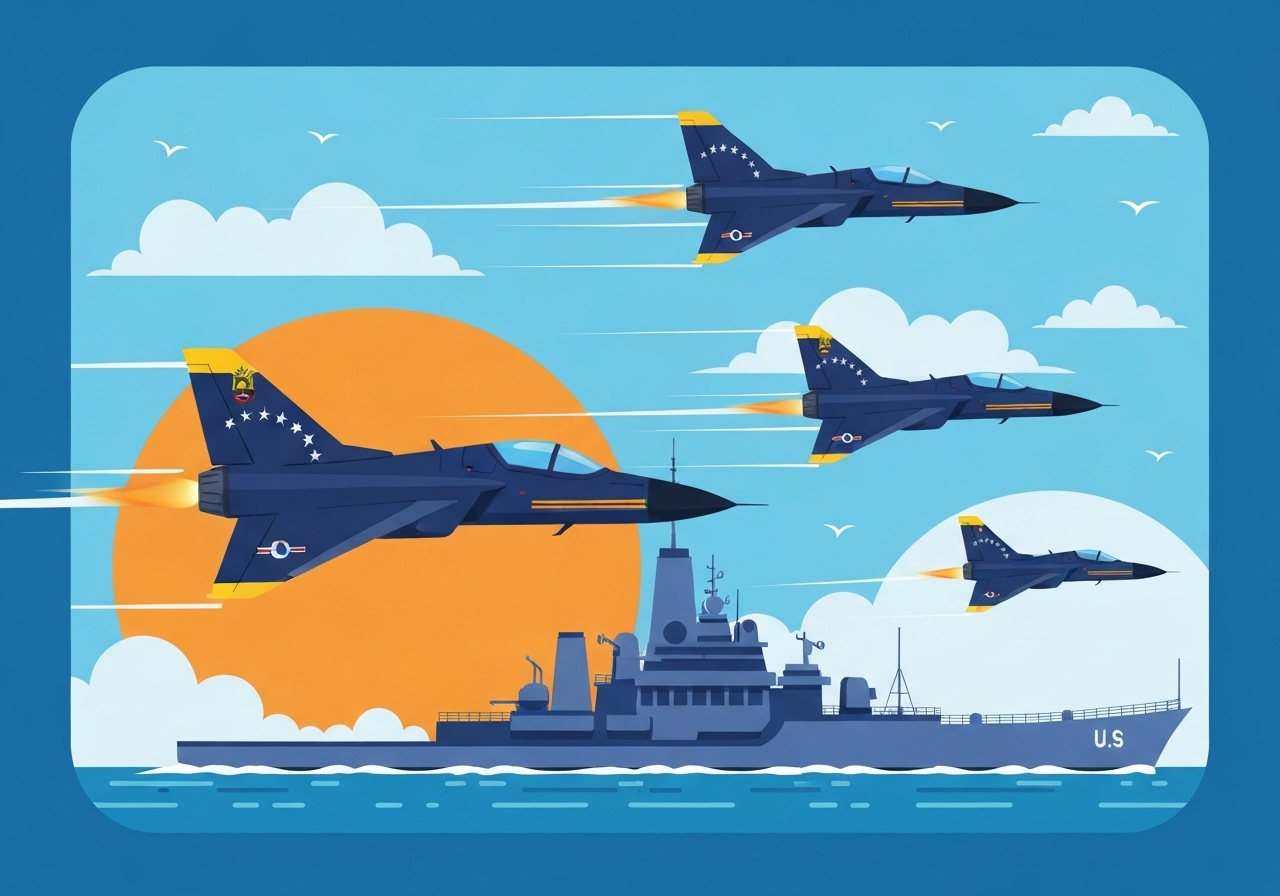
On Sept. 5, 2025, Pentagon officials told CBS News that Venezuelan military aircraft flew over the U.S. Navy guided‑missile destroyer USS Jason Dunham in international waters near South America for a second time in two days, an action U.S. officials describe as escalating tensions in the region.
Key Takeaways
- Venezuelan military aircraft, reported by one U.S. official as F‑16s, flew over USS Jason Dunham twice within 48 hours.
- The overnight Sept. 5 overflight followed an earlier pass the same day; U.S. officials said the destroyer did not fire on the aircraft.
- The Pentagon labeled the earlier incident a “highly provocative move” that interfered with counter‑narco‑terror operations.
- The U.S. recently deployed a flotilla of warships to the region to target criminal networks and narco‑terrorism.
- The White House said the U.S. carried out a strike on an alleged Venezuelan drug‑trafficking boat that killed 11 people; the administration linked the vessel to the Tren de Aragua gang.
- The U.S. is sending 10 F‑35 fighters to the Caribbean for operations focused on drug cartels.
- President Trump warned Venezuela that hostile actions could prompt a response, leaving engagement decisions to ship captains under current rules of engagement.
Verified Facts
Pentagon officials confirmed to CBS News that Venezuelan military jets flew over the USS Jason Dunham on Sept. 5, 2025, marking the second such overflight in two days. A U.S. official identified the aircraft as F‑16 fighter jets; it was not publicly confirmed whether they were armed.
The Dunham, an Aegis‑equipped guided‑missile destroyer, remained on station and did not engage the aircraft during either overflight, according to defense sources. U.S. officials characterized the earlier pass as a deliberate action aimed at disrupting U.S. counter‑narco‑terror operations.
The Jason Dunham is part of a group of U.S. warships dispatched to the region in recent weeks to interdict criminal organizations and support operations against narco‑terrorism. The Pentagon has said these deployments target illicit trafficking networks that operate in and around the Caribbean and northern South America.
On Sept. 2–5 time frame, the White House announced a U.S. strike on an alleged Venezuelan drug‑trafficking boat that President Trump said killed 11 people. The administration has identified the vessel as tied to Tren de Aragua, a gang the U.S. government has designated as a foreign terrorist organization.
Context & Impact
The repeated overflights come amid heightened U.S.–Venezuela tensions after U.S. military actions against suspected trafficking networks. U.S. naval activity in the area is framed by Washington as counter‑narco‑terrorism; Caracas portrays heightened military posture in the Caribbean as provocative.
Operationally, low‑level overflights can complicate U.S. missions by forcing vessels to alter patrol patterns and heighten alert measures. Diplomatically, such encounters risk miscalculation at sea, especially when both sides deploy combat aircraft in proximity to surface ships.
U.S. plans to forward‑deploy 10 F‑35 fighters to the Caribbean signal an expansion of aerial assets available for interdiction and deterrence. That move aims to increase detection and response options against transnational criminal networks but may also intensify regional military signaling.
Official Statements
“The earlier pass was a highly provocative move designed to interfere with our counter narco‑terror operations,”
Pentagon statement, Sept. 2025 (paraphrased)
“I would say they’re going to be in trouble… you or your captains can make the decision as to what they want to do,”
President Donald J. Trump, Sept. 5, 2025 (remarks to reporters)
Unconfirmed
- Whether the Venezuelan jets were carrying weapons during either overflight has not been publicly confirmed.
- The precise operational intent behind the flights—whether intended as a show of force, a signal to the U.S., or routine patrols—remains unclear.
- Any direct orders from Caracas authorizing aggressive action toward U.S. ships have not been confirmed.
Bottom Line
Repeated Venezuelan overflights of the USS Jason Dunham have raised U.S. concerns about interference with counter‑narco operations and the risk of unintended escalation at sea. Washington has increased regional assets, including fighter deployments, signaling both deterrence and an elevated readiness to protect U.S. missions. Analysts say careful navigation of rules of engagement and diplomatic channels will be needed to avoid a dangerous confrontation.
Sources
- CBS News (reporting and Pentagon official confirmations)
- U.S. Department of Defense (statements)
- The White House (administration remarks and announcements)