
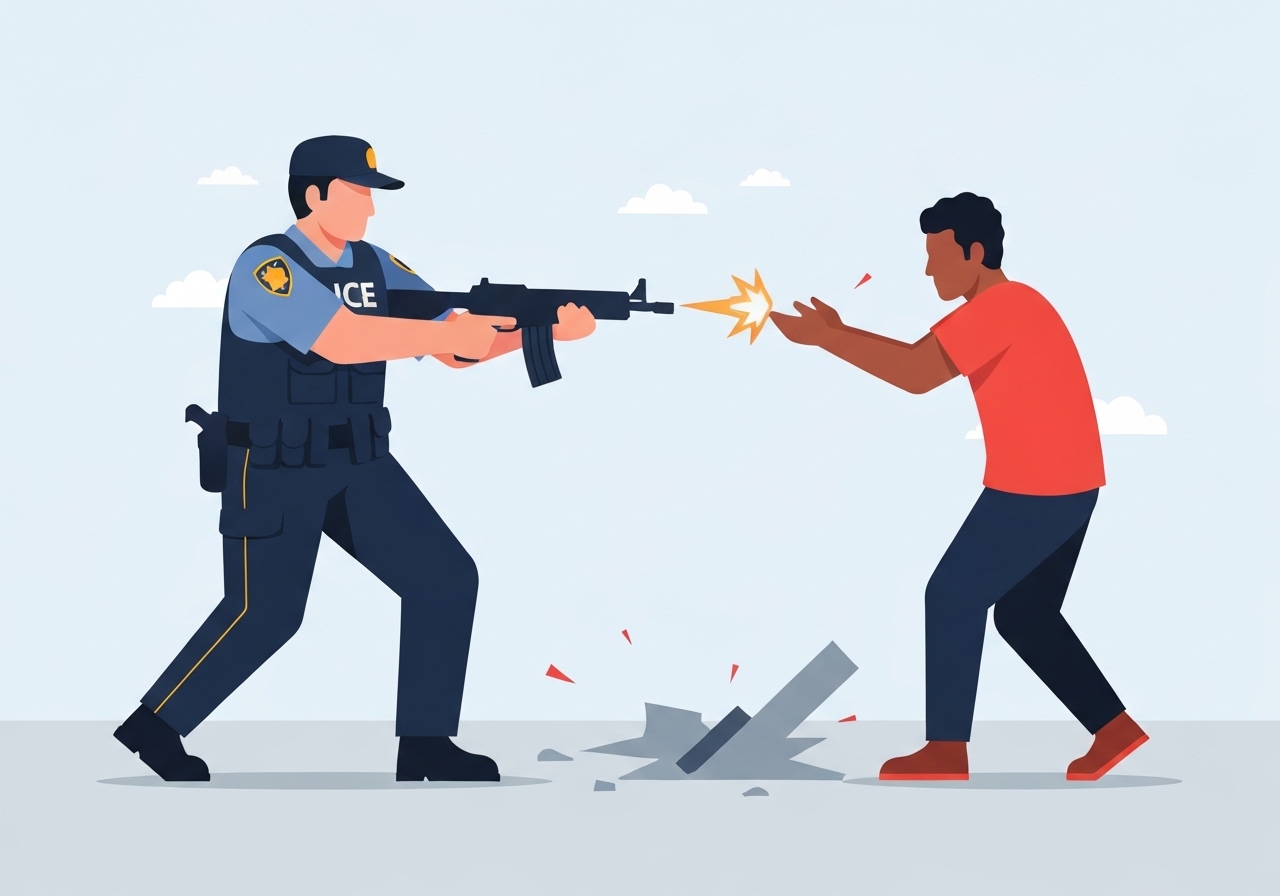
Lead: On the evening of Wednesday, January 14, 2026, an Immigration and Customs Enforcement (ICE) officer shot a Venezuelan man in the leg during a targeted Enforcement and Removal Operations (ERO) action in north Minneapolis. Officials say the man assaulted an officer with a shovel; he was transported to hospital and is expected to survive. The officer, also hospitalized after being struck, had an unclear injury status, and a large crowd later gathered, clashing with law enforcement into the early morning. The incident followed a separate, fatal ICE-related shooting in Minneapolis one week earlier and has intensified local tensions over the federal Metro Surge operation.
- Time and place: The shooting occurred around 7:00 p.m. near North Sixth Street and North 24th Avenue in north Minneapolis during a targeted ICE ERO action on January 14, 2026.
- Injuries: A Venezuelan national was shot in the leg and is expected to recover; the ICE officer who was struck with a shovel was hospitalized, with the extent of injury unconfirmed.
- Operation context: Officials say the man was a primary target of the operation; officers report he fled in a vehicle, crashed, and then continued on foot before the confrontation.
- Barricade and arrests: After being shot, the man entered a residence with three others; law enforcement later breached the home and officials believe all four were taken into custody.
- Local response and crowd dynamics: A large crowd formed; Minneapolis police reported being hit by rocks, fireworks, ice and snowballs, prompting mutual aid from state and county agencies.
- Political backdrop: The incident occurred one week after ICE officer Jonathan Ross fatally shot 37-year-old Renee Good in south Minneapolis and after a federal judge denied a temporary restraining order limiting ICE actions.
- Investigation: The Minnesota Bureau of Criminal Apprehension (BCA) announced an independent investigation; the FBI assisted with evidence collection at the scene.
- Official claims: DHS described the officer as being assaulted by multiple people and said the officer fired in self-defense while being ambushed.
Background
Federal ERO operations resumed in the Twin Cities as part of a wider initiative called Operation Metro Surge. The campaign has placed large numbers of ICE and Border Patrol personnel in Minnesota to carry out arrests of individuals suspected of serious crimes and immigration offenses, heightening an existing dispute between federal agents and local officials. Local leaders, including Governor Tim Walz and Minneapolis Mayor Jacob Frey, have publicly criticized the federal presence, calling for limits or withdrawal; federal authorities counter that the operation targets violent offenders.
Tensions escalated after a fatal encounter one week earlier when an ICE officer shot and killed 37-year-old Renee Good in south Minneapolis, fueling protests and legal challenges. A federal judge, Kate Menendez, declined to issue a temporary restraining order that would have restricted ICE activity, allowing operations to continue while litigation proceeds. Against this backdrop, law enforcement actions draw intense public scrutiny and rapid, polarized political responses at local and national levels.
Main Event
According to law enforcement sources briefed on the incident, agents were conducting a targeted ERO arrest near North Sixth Street and North 24th Avenue when the operation encountered the primary suspect, identified by officials as a Venezuelan national. Authorities say the individual fled earlier in a vehicle, crashed into a parked car, and then attempted to evade on foot. At roughly 7:00 p.m., the interaction escalated when the man allegedly struck an ICE officer with a shovel, aiming at the officer’s head.
Officials reported that, while the officer and subject were struggling on the ground, two other people emerged and allegedly joined the assault using a snow shovel and a broom handle. An ICE ERO agent then fired, striking the primary subject in the leg. After being wounded, the man ran into a nearby residence; law enforcement later determined three additional targets were inside, and all four occupants barricaded themselves.
Because of the barricade, ICE called in a specialized tactical team to assist in breaching the home. Authorities say the team entered the residence and detained the individuals believed to be involved. Both the injured man and the struck ICE officer were transported to hospitals; officials have not released details on the officer’s diagnosis or recovery timeline. The FBI assisted at the scene, collecting evidence for the ongoing inquiry.
As news spread, a large crowd gathered in the area and clashes between some demonstrators and law enforcement continued into the early morning. Minneapolis police reported officers were struck by projectiles and sought mutual aid from the Minnesota State Patrol and the Hennepin County Sheriff’s Office. There were also reports from local media and some witnesses of protestors forcing entry into ICE vehicles; police have been contacted to confirm those specific claims.
Analysis & Implications
The incident highlights the fraught intersection of federal immigration enforcement and local governance. Large-scale deployment of federal agents to cities like Minneapolis alters on-the-ground dynamics: it increases the likelihood of force encounters while straining local resources and political relationships. The mayor’s estimate—approximately 600 Minneapolis police versus about 3,000 ICE and related federal personnel in the region—illustrates the scale imbalance that local officials say complicates crowd and safety management.
Legally, the Minnesota BCA’s announced independent probe means state investigators will review use-of-force claims separate from federal internal reviews, creating parallel processes that could result in differing findings. That separation aims to bolster transparency but can also produce conflicting narratives that fuel public debate. Any criminal or administrative charges would hinge on detailed forensics, witness interviews, and body-worn camera or other video evidence.
Politically, the episode is likely to amplify national attention because it followed a high-profile fatal shooting and unfolded amid vocal statements from top officials. Federal assertions that agents acted in self-defense and local leaders’ calls for federal withdrawal set up a contest over public messaging and accountability. The short-term risk is further street-level clashes; the medium-term risk is deeper local-federal mistrust and legal challenges that could shape future operations and oversight mechanisms.
Comparison & Data
| Incident | Date | Location | Victim | Outcome |
|---|---|---|---|---|
| North Minneapolis ERO shooting | Jan 14, 2026 | North Sixth St & N 24th Ave | Venezuelan man (leg wound) | Wounded; expected to recover; 4 detained |
| South Minneapolis fatal shooting | Jan 7, 2026 | South Minneapolis | Renee Good, 37 | Fatally shot by ICE officer |
The two incidents differ in outcome—one nonfatal, one fatal—but together they have accelerated local political and legal responses. Independent investigations, public protests, and competing official narratives will shape whether operations continue and how accountability mechanisms are applied.
Reactions & Quotes
City and state leaders responded swiftly, urging calm while criticizing the federal presence and handling of operations. Law enforcement and federal agencies defended the actions of officers under attack.
“This is already a very tense situation, and we do not need this to escalate any further,”
Police Chief Brian O’Hara
Chief O’Hara framed the crowd dynamics as dangerous for officers and residents, noting reports of projectiles and calling for restraint as investigators work. Mayor Jacob Frey similarly appealed for peace and reiterated his request that ICE cease operations within the city, stressing the city’s limited police resources compared with the influx of federal agents.
“I have seen conduct from ICE that is intolerable. For anyone taking the bait tonight, stop,”
Mayor Jacob Frey
On the federal side, Department of Homeland Security officials described the officer as having been ambushed and said shots were fired in self-defense. Deputy Attorney General Todd Blanche accused state officials of encouraging violence in a forceful statement, attributing responsibility to local leaders; that characterization was rejected by city and state officials who said they were urging calm.
“Fearing for his life and safety as he was being ambushed by three individuals, the officer fired defensive shots to defend his life,”
DHS (statement)
Unconfirmed
- The full medical condition and prognosis of the ICE officer hospitalized remain unconfirmed by officials at this time.
- Reports that protesters forcibly entered ICE vehicles are described in media and witness accounts but have not been independently verified by law enforcement in public statements.
- The exact identities and criminal charges, if any, for the three other individuals taken from the residence have not been released.
- Mayor Frey’s figure of approximately 3,000 federal agents in the area is an estimate provided by city officials and has not been independently corroborated in official federal personnel rosters.
Bottom Line
The north Minneapolis shooting on January 14, 2026, underscores how federal enforcement actions can rapidly intersect with volatile local dynamics, producing street-level confrontations and renewed calls for accountability. Independent state investigation by the BCA and federal evidence collection will be central to establishing a factual record and determining whether criminal or administrative actions are warranted.
Looking ahead, the incident is likely to deepen political debate over Operation Metro Surge and the role of federal agents in municipal policing. Short-term concerns include preventing further clashes and ensuring transparent, credible investigations; longer-term outcomes may include legal challenges, policy shifts on federal-local cooperation, and changes in oversight for enforcement operations.