
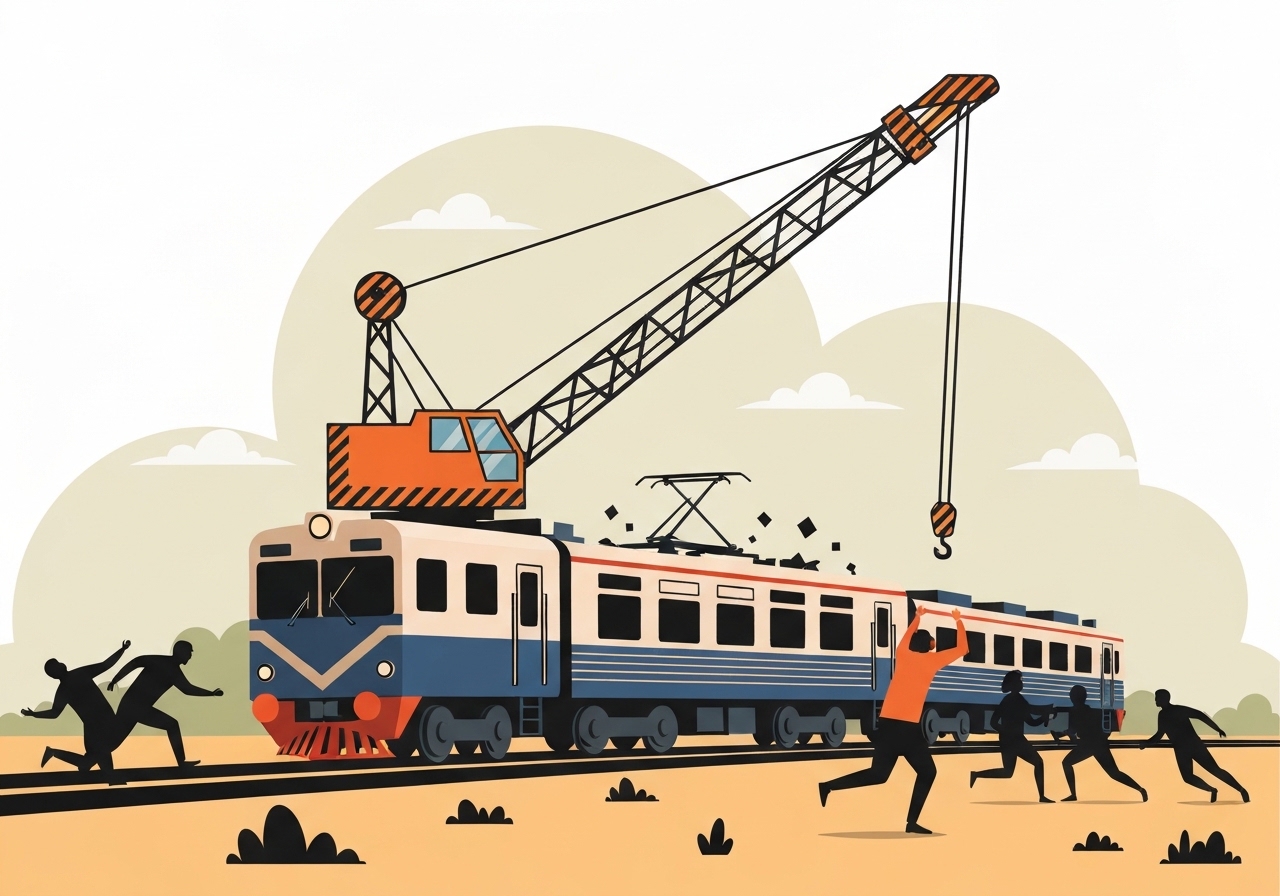
On Jan. 15, 2026, a crane reportedly collapsed onto a passenger train near Thanon Kot Village in Nakhon Ratchasima Province, northeastern Thailand, causing a derailment and a split in at least one car. Passengers and nearby residents pulled some people from wreckage, while others managed to wriggle free from crushed compartments; dozens were reported killed. Among the survivors was a 6-year-old boy who was trapped between a seat and a tray table until his grandmother, Saitee Katpia, helped extract him and led him to safety. Rescue teams and local hospitals, including Sikhio Hospital, received the injured as authorities began an investigation into the cause.
Key Takeaways
- The incident occurred on Jan. 15, 2026, in Nakhon Ratchasima Province, with the train striking or being struck by a crane that reportedly collapsed onto it.
- Dozens of people were reported killed and many more injured; official totals were still being compiled at the time of reporting.
- A 6-year-old boy was trapped and later freed by his grandmother, who required at least 10 stitches to her face at Sikhio Hospital.
- Some passengers escaped by squeezing through damaged carriage interiors; local residents also pulled trapped travelers from the wreckage.
- Emergency services and rescue workers were on site within hours, coordinating evacuations and transporting the wounded to nearby hospitals.
- Rail services in the affected corridor were suspended while investigators and cleanup crews secured the scene.
Background
Thailand has invested in expanding rail services over recent years, increasing the number of passenger routes and track-side construction projects. Heavy equipment operating close to tracks—including cranes used for maintenance or construction—can create additional safety risks if not properly secured or coordinated with rail operators. Past rail incidents in the region have prompted calls for stricter safety protocols for work adjacent to active lines, and authorities often face pressure to balance infrastructure upgrades with operational safety.
The affected area, Thanon Kot Village in Sikhio District, lies in Nakhon Ratchasima Province, a populous northeastern region that serves both commuter and long-distance routes. Local hospitals such as Sikhio Hospital frequently handle mass-casualty responses in the province, relying on a combination of provincial resources and volunteer responders. Community members near rail lines have in previous incidents been first on scene, offering immediate assistance before formal rescue teams arrive.
Main Event
The train departed the Bangkok suburbs on Wednesday morning and had been traveling east when witnesses described a loud boom and a sudden, violent jolt. Several carriages derailed and at least one car showed a longitudinal split consistent with a severe external strike or structure failure. Passengers reported chaotic conditions as people attempted to free themselves amid twisted metal and broken glass.
Some passengers escaped through gaps created when seats and interior fittings collapsed, maneuvering past trapped luggage and injured travelers. Others were extracted by nearby residents who arrived quickly after hearing the crash; reports indicate that informal rescue efforts were crucial in the first minutes after the accident. Formal rescue teams reached the site to stabilize the scene, cut into damaged car bodies where necessary, and transfer the injured to hospitals.
A grandmother identified as Saitee Katpia described briefly losing consciousness and later finding her 6-year-old grandson pinned by a chair and tray table. She forced herself to move him despite her own bleeding and pain; medical staff later treated her with at least 10 stitches. Emergency responders continued working through the day to locate survivors and clear wreckage while railway officials began documenting the scene for an investigation.
Analysis & Implications
If the crane collapse is confirmed as the proximate cause, investigators will examine coordination between construction teams and rail operations, equipment maintenance records, and any deviations from safety protocols. Cranes operating near active tracks require strict exclusion zones, load assessments, and communication with rail traffic control; failures in any of these areas can result in catastrophic outcomes. Accountability measures could include operational suspensions, fines, or criminal inquiries depending on the findings.
The human toll—dozens reported dead and many injured—underscores vulnerabilities in emergency preparedness along busy rail corridors, particularly where construction activity is present. Strengthening on-site incident response, improving public awareness of evacuation options on trains, and enforcing clearer boundaries for heavy equipment could reduce casualties in future events. For Thai rail authorities, the accident will likely renew scrutiny of contractor oversight and workplace safety practices near tracks.
Economically, the disruption may affect regional rail services and freight movement for days or weeks, depending on the extent of track and equipment damage. A prolonged suspension could ripple into commuter patterns and local supply chains, pressuring authorities to balance a thorough investigation with expedited restoration of services. Internationally, the incident may prompt foreign investors and partners involved in Thai rail projects to reassess safety clauses and project oversight mechanisms.
Comparison & Data
| Item | Reported Detail |
|---|---|
| Date | |
| Location | Thanon Kot Village, Sikhio District, Nakhon Ratchasima Province |
| Casualties | Dozens reported killed; additional injured (authorities compiling totals) |
The table above summarizes confirmed temporal and geographic facts in reporting available at publication. Exact casualty and damage tallies remained provisional as official counts were being finalized by Thai authorities and emergency services.
Reactions & Quotes
“He kept saying ‘my leg hurts, my leg hurts.'”
Saitee Katpia, survivor and grandmother of a trapped child
Ms. Katpia’s account illustrates the immediate human distress inside the damaged car and the role relatives played in extracting children and other vulnerable passengers.
“I could not help him.”
Saitee Katpia, speaking from Sikhio Hospital
Her later statement, given while receiving treatment for facial wounds, reflects both the physical limits faced by some survivors and the acute need for coordinated rescue efforts on site.
Unconfirmed
- Whether the crane operator error, mechanical failure, ground instability, or a combination of factors caused the crane to collapse is under investigation.
- The precise official death and injury totals had not been released at the time of reporting; media sources described casualties as “dozens.”
- The extent to which contractors or rail agencies will face legal or regulatory action remains unclear pending investigative findings.
Bottom Line
The Jan. 15, 2026 incident in Nakhon Ratchasima appears to have combined a severe mechanical event—a reported crane collapse—with a passenger train in service, producing a high-casualty derailment. Immediate survivor accounts highlight how informal rescues by relatives and residents complemented formal emergency response in the critical first minutes.
Investigators will need to establish the exact sequence that led to the crane’s failure and map responsibilities across contractors and rail operators. In the medium term, Thai authorities face pressure to tighten coordination between construction activities and active rail lines and to upgrade emergency-readiness measures so that future incidents produce fewer casualties.
Sources
- The New York Times (news report)