
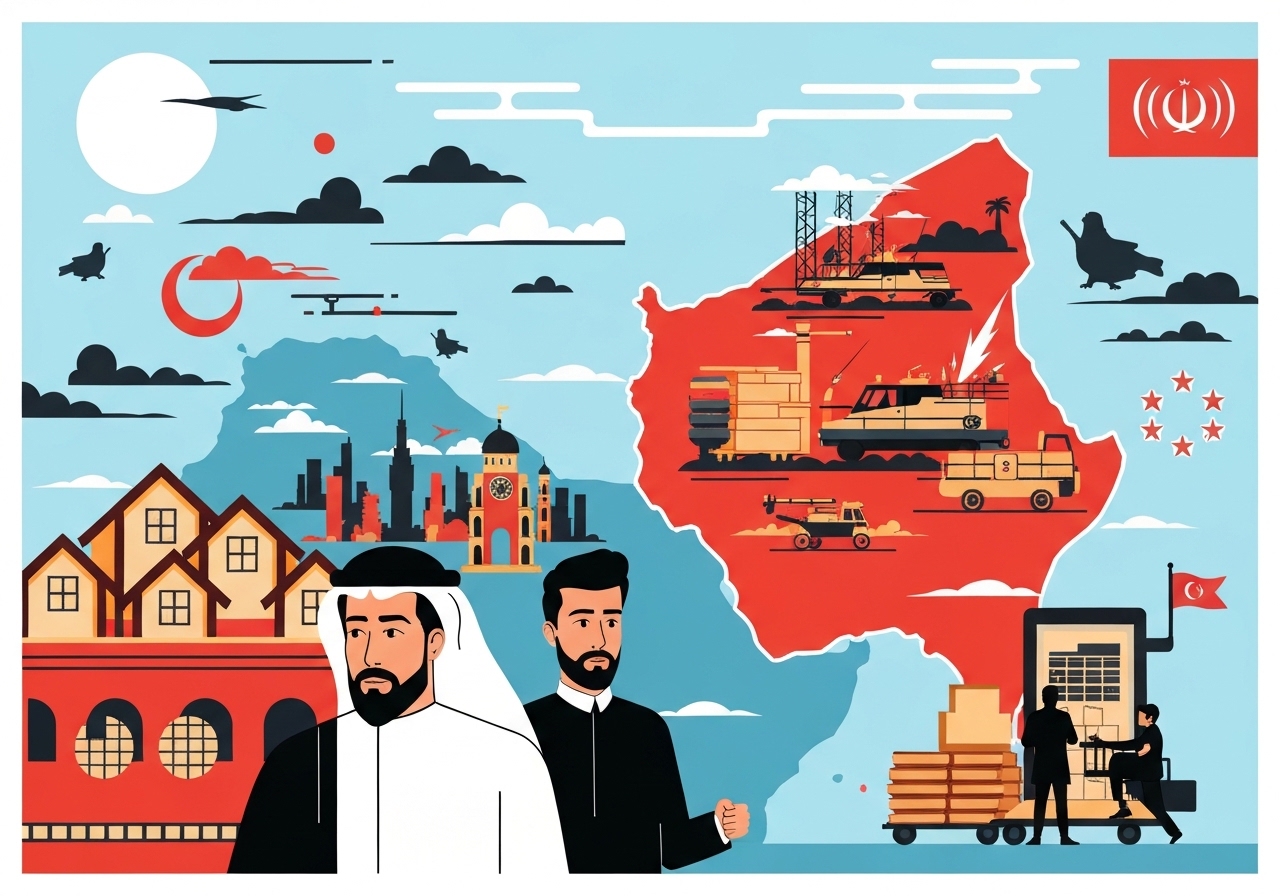
Senior Gulf governments and Turkey urged President Donald Trump on Wednesday, 14 January 2026, to refrain from airstrikes against Iran, warning that an attack would risk a broad and intractable regional conflict. Saudi Arabia, Qatar, Turkey and Oman mounted a last-minute diplomatic push that appears to have contributed to Mr Trump pausing planned strikes late on Wednesday. Riyadh also denied US aircraft access to its airspace for potential strikes, while Washington withdrew key personnel from its al-Udeid airbase in Qatar as tensions spiked. Tehran and Gulf capitals continued phone diplomacy on Thursday, underscoring the acute anxiety among regional governments about rapid escalation and disruption to Gulf maritime routes.
Key takeaways
- Saudi Arabia, Qatar, Turkey and Oman lobbied the US on 14 January 2026 to avert airstrikes on Iran, citing risks of broad regional war.
- Saudi authorities reportedly denied US use of Saudi airspace for strikes, a substantive operational constraint on any immediate campaign.
- The US withdrew key personnel from al-Udeid airbase in Qatar as tensions rose; al-Udeid is the largest US base in the region.
- Prince Faisal bin Farhan (Saudi foreign minister) held phone talks on 15 January 2026 with counterparts in Iran, Oman and Turkey to de-escalate tensions.
- Iran’s foreign minister Abbas Araghchi has increased outreach to Arab capitals, including a visit to Bahrain (first since 2010) and four visits to Cairo last year.
- Gulf states fear Iranian disruption of Gulf maritime traffic would have immediate global economic consequences if hostilities spread.
- Analysts say Iran emphasizes that Israel, not Tehran, presents a larger risk to regional stability, citing the September strike in Doha that killed five Hamas members.
Background
Relations between Iran and several Gulf monarchies have long been strained by Iran’s backing for proxy groups across Lebanon, Iraq and Yemen, commonly referred to as the “axis of resistance.” Those networks have been a primary source of concern for Gulf capitals, which view Iranian influence as destabilizing. At the same time, many Gulf states fear the precedent of an externally driven regime collapse, preferring stability over contagion that might inspire domestic unrest.
Diplomatic ties have shown signs of thaw in recent years. Saudi-Iranian relations have been on a cautious recovery path for about three years, and Iran’s foreign minister, Abbas Araghchi, has pursued active outreach across the Arab world. His visits included Bahrain, the first Iranian ministerial trip there since 2010, and multiple visits to Cairo in 2025 aimed at rebuilding channels severed in earlier years.
Main event
In a concentrated lobbying effort on Wednesday, Saudi Arabia, Qatar, Turkey and Oman warned the US administration that air operations against Iran could produce uncontrollable regional escalation. Officials in Riyadh pressed Washington on operational and political consequences, while Doha and Muscat emphasized mediation and dialogue. Reports indicate those warnings were a factor in the White House decision to hold off on strikes late that day.
Saudi officials additionally refused US requests for airspace access for potential strikes, a move that directly constrained immediate operational options. As the situation intensified, the US reduced personnel at al-Udeid airbase in Qatar, citing potential threats to forces in the region. US special envoy Steve Witkoff, who supports Qatar’s mediator role, remained engaged in shuttle diplomacy.
Tehran, for its part, engaged in phone diplomacy and public messaging portraying its actions as defensive. Iran’s foreign ministry has also worked to make the case to Arab capitals that Israel poses a more destabilizing force than Iran, a narrative made more prominent after an Israeli strike in Doha last September that killed five lower-ranking Hamas members and prompted an apology from Washington to Qatar’s emir.
Analysis & implications
The collective lobbying by Gulf states and Turkey highlights their calculation that direct US strikes on Iran would carry immediate and long-term costs. In the short term, attacks could prompt Iranian retaliatory strikes on US bases, Gulf infrastructure or shipping in the Strait of Hormuz, risking commercial disruption and energy market shocks. Gulf denial of overflight access and calls for mediation show regional actors prefer containment and dialogue over military confrontation.
Strategically, the episode underlines the limits of forward-deployed US power in the Gulf. Fixed bases and airfields designed to project force are also vulnerabilities if an adversary chooses to target them or if host governments restrict access. The withdrawal of key personnel from al-Udeid demonstrates how force posture can be retracted rapidly when political support erodes.
Politically, Iran’s outreach—high-profile visits and public diplomacy—has sought to split Gulf consensus and portray Tehran as a rational actor compared with Israeli operations that have shaken Gulf capitals. If Gulf states increasingly view Israel’s unilateral actions as destabilizing, it could complicate existing security alignments, including aspects of tacit cooperation against Tehran.
Comparison & data
| Actor | Recent action | Date/Note |
|---|---|---|
| Saudi Arabia | Denied US airspace for strikes | Reported 14 Jan 2026 |
| Qatar | Hosted al-Udeid; saw withdrawal of key US personnel | 14–15 Jan 2026 |
| Turkey | Called for dialogue | Public statements, Jan 2026 |
| Oman | Engaged in diplomatic outreach | Part of Gulf lobbying, Jan 2026 |
The table summarizes immediate diplomatic and operational moves. These actions reflect divergence from previous episodes where Gulf airspace and bases were more readily available for coalition operations, underscoring a more cautious regional posture in 2026.
Reactions & quotes
Qatar framed the situation as requiring collective negotiation rather than unilateral military steps. The statement came amid Doha’s long-standing role as a mediator and host to key diplomatic channels.
The big challenges in the region…require all of us to return to the negotiating table.
Majed al-Ansari, Qatar foreign ministry spokesperson
Turkey emphasized mediation and direct dialogue as preferable mechanisms, signaling Ankara’s interest in preventing a wider conflict that would affect trade and regional security.
Hopefully, the United States and Iran will resolve this issue among themselves—whether through mediators, other actors, or direct dialogue. We are closely following these developments.
Hakan Fidan, Turkish foreign minister
Unconfirmed
- Some reports assert the September strike in Doha was intended to kill senior Hamas negotiators; the precise intent and full targeting chain have not been independently verified.
- Claims that the US ordered Israel to end a 12-day assault on Iran-linked targets after a particular Iranian strike are reported in some accounts but lack full confirmation from official US or Israeli sources.
- Attribution of any future maritime disruptions to specific Iranian units or proxies would require corroborating open-source or official intelligence beyond the current public record.
Bottom line
The lobbying by Gulf states and Turkey on 14–15 January 2026 illustrates how regional capitals can shape US decision-making by emphasizing the broader costs of military action. Denial of airspace by Saudi Arabia and operational caution at al-Udeid signal tangible limits to rapid escalation plans. Policymakers in Washington, Riyadh, Doha, Ankara and Tehran now face a choice between renewed diplomacy or a campaign that could entangle multiple states and proxy networks.
For observers, the episode underscores that military options are inseparable from regional politics: host-nation consent, maritime security, and the positions of proximate states materially affect how any confrontation would unfold. The coming days will be critical to see whether sustained dialogue reduces risks or whether further incidents push parties toward a more dangerous trajectory.
Sources
- The Guardian — UK national newspaper reporting on Gulf and Turkish lobbying and regional reactions (news).