
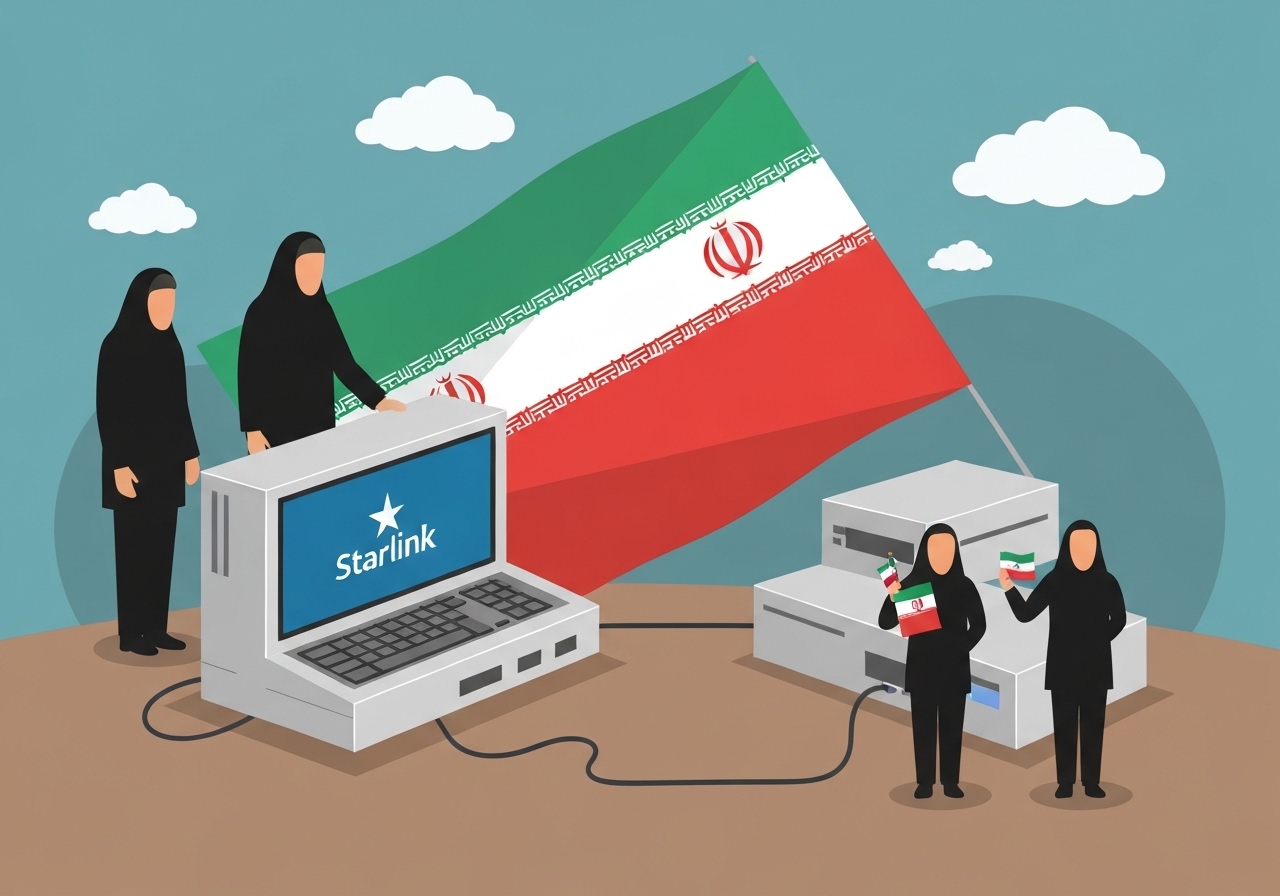
Lead: In mid-January 2026, as Iran enacted a sweeping communications blackout, networks for internet and mobile services were taken offline nationwide, crippling banking and messaging. A network of activists, engineers and developers who had quietly imported Starlink satellite terminals used the systems to restore connectivity and share images from protests and clashes. Their actions, activists say, prompted authorities to deploy military-grade GPS jamming equipment to disrupt Starlink receivers. The episode underscores how satellite internet is changing the dynamics of state-enforced shutdowns.
Key Takeaways
- Activists and civil society groups say roughly 50,000 Starlink terminals are now operating inside Iran, an estimate based on field reporting and group networks.
- The nationwide blackout in January 2026 interrupted online banking, e-commerce and SMS services, complicating daily life and protest reporting.
- Organizers had prepared since 2022, smuggling hardware and training users to maintain connectivity during shutdowns.
- Officials responded by using high-powered GPS-disruption technology, a tactic activists say is more commonly seen in battlefield settings such as Ukraine.
- The availability of satellite internet — aided by a U.S. sanctions exemption for certain communications tools — has made large-scale digital censorship harder to enforce.
- Experts warn this escalates a technology-versus-control cycle, likely prompting new regulations, countermeasures and clandestine distribution networks.
Background
National internet shutdowns have become a familiar tool for states aiming to blunt protests and control information flows. Governments in countries including India, Myanmar and Uganda have used network interruptions to disrupt organizing and limit reporting during moments of unrest. These blackouts typically rely on control over terrestrial infrastructure — switches, mobile operators and last-mile networks — which can be ordered offline by regulators or security agencies.
Since 2022, Iranian activists and diaspora groups have prepared for such contingencies by acquiring satellite terminals and building discreet distribution channels. A U.S. government exemption allowing certain communications services to be offered in Iran eased commercial access to satellite devices, according to people familiar with the matter. Iran responded legislatively last year by passing a law banning unlicensed satellite systems, while enforcement has been uneven and often reactive.
Main Event
On Jan. 15, 2026, authorities shut down major internet and cellular services across Iran, according to local observers and users. Within hours, a patchwork of Starlink receivers assembled by activists began carrying traffic for journalists, families searching for missing relatives and organizers documenting clashes. Photos and short videos showing troops on city streets and civilians wounded circulated through these satellite links to social platforms and messaging apps.
As those flows accelerated, Iranian forces sought to interrupt the satellite-based connections. Activists and technical monitors reported the use of spectrum- and GPS-disruption tools designed to deny Starlink terminals the positioning signals they rely on. The effect was to intermittently degrade or disable terminals in targeted areas, complicating but not wholly stopping the networks.
The confrontation exposed supply routes and logistical work by civic groups who had imported devices, hidden them in homes and community centers, and trained users to swap equipment when signals were jammed. While enforcement actions included seizures and arrests in some localities, the broader network persisted because terminals were widely dispersed and operated autonomously from central infrastructure.
Analysis & Implications
The Iranian episode marks a turning point in how states and nonstate actors contest control over connectivity. Satellite internet reduces the leverage a government gains from controlling physical network chokepoints, forcing security services to adopt costly electronic warfare tools or to target users directly. Those responses raise the operational bar for repression and broaden the toolkit for both sides of the conflict.
For technology providers and suppliers, the trend creates complex legal and reputational choices. Companies that supply satellite hardware or services may face pressure from host governments, sanctions regimes and human-rights advocates simultaneously. The U.S. exemption that allowed some communications tools into Iran illustrates how policy decisions can have rapid downstream effects on information access in closed societies.
Economically, intermittent connectivity alters commerce and humanitarian response. Restored satellite links enabled online banking workarounds and humanitarian coordination during the blackout, but also introduced fraud and security risks when routing was improvised. In the long term, firms and civil-society groups will need resilience plans that balance usability, safety and legal exposure.
Comparison & Data
| Context | Typical Method | Resilience Observed |
|---|---|---|
| Traditional shutdowns (recent years) | Terrestrial network cutoffs ordered to ISPs and mobile carriers | High short-term impact; low immediate bypass options |
| Iran (Jan 2026) | Terrestrial cutoff + satellite terminals in use (~50,000 estimated) | Partial restoration via Starlink; targeted GPS jamming reduced effectiveness |
The table contrasts the classic model of nationwide cutoffs with the emerging pattern in Iran, where satellite terminals provided partial resilience. While a precise inventory of devices is hard to verify, activists’ estimate of about 50,000 terminals suggests a scale sufficient to sustain significant information flows despite targeted interference.
Reactions & Quotes
Local and international actors reacted quickly, framing the clash as both a human-rights and a technical confrontation.
“You need to plan to have that infrastructure in place.”
Fereidoon Bashar, Executive Director, ASL19 (digital-rights NGO)
“The use of GPS and spectrum disruption in a domestic context represents an escalation more commonly associated with warfare.”
Independent digital-rights researcher
“People used the terminals to document what was happening and to connect families during days of silence.”
Anonymous activist involved in distribution networks
Unconfirmed
- The activists’ figure of about 50,000 terminals reflects group estimates and field reports; it has not been independently verified by a neutral third party.
- Some reports of the exact models and origins of the jamming equipment used by authorities remain unconfirmed publicly and lack manufacturer-level attribution.
- Details about specific smuggling routes and the identities of organizers involved in device distribution are still subject to investigation and verification.
Bottom Line
The events in Iran show that satellite internet can blunt state attempts to silence large populations, but it does not render repression impossible. Authorities can respond with electronic countermeasures, legal bans and targeted arrests, producing a costly escalation for both sides. Civil-society groups will likely double down on dispersal, redundancy and training to keep information flowing.
Policymakers and providers face hard choices: regulators must weigh the humanitarian benefits of resilient communications against risks that equipment will be used in ways that violate local laws or international norms. For observers, the key takeaway is that connectivity campaigning and technical preparedness are now central components of modern protest ecosystems, and that state responses will continue to evolve in kind.
Sources
- The New York Times (news report)
- ASL19 (digital-rights NGO)
- Starlink / SpaceX (company information)