
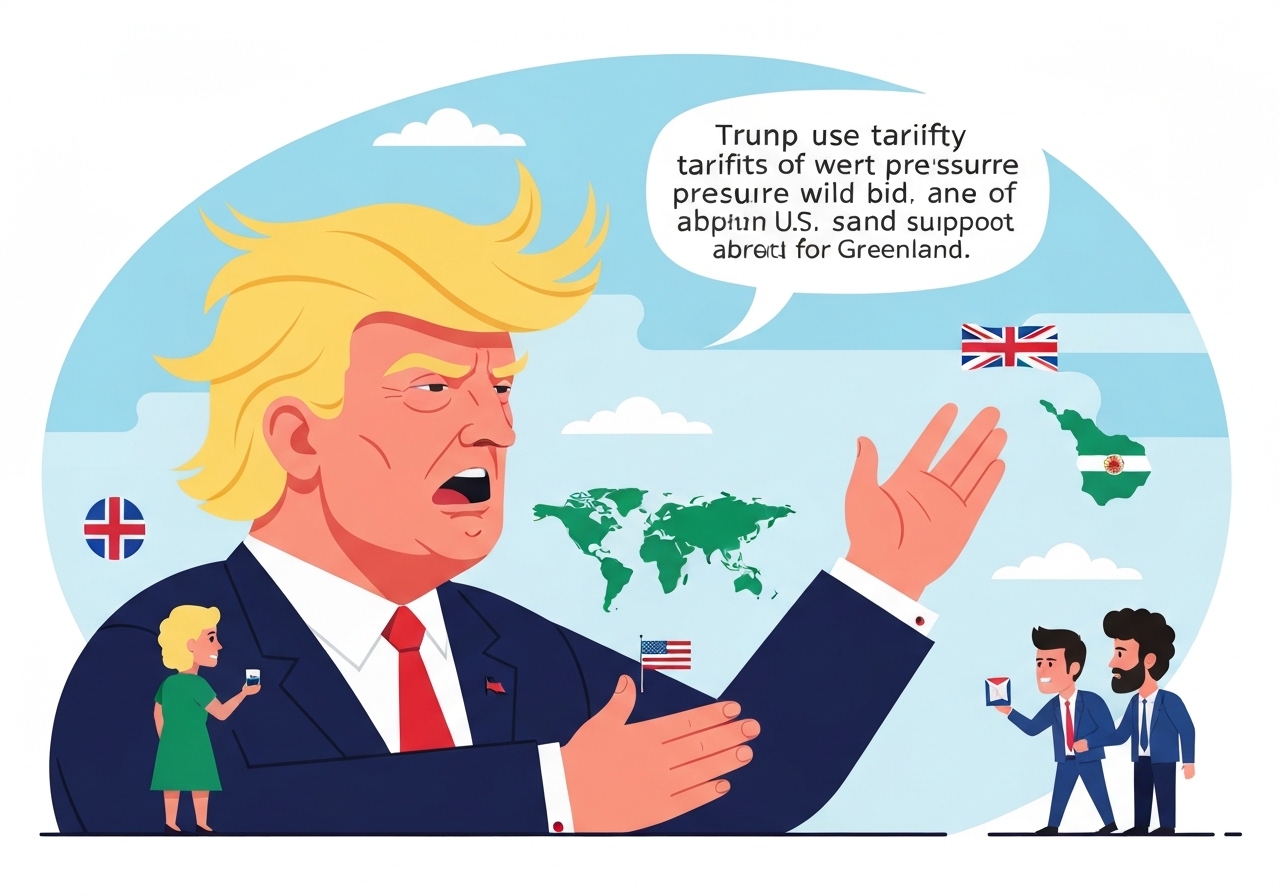
Lead: U.S. President Donald Trump said on Friday he might impose tariffs on countries that do not support U.S. efforts to take control of Greenland, remarks that coincided with a bipartisan congressional delegation visiting Copenhagen to ease tensions. The comment, delivered during a White House event on rural health care, revived a months-long White House push for American control of the semiautonomous Arctic territory of Denmark. Danish and Greenlandic officials, along with visiting U.S. lawmakers, emphasized diplomacy and partnership while Copenhagen signaled a bolstering of its military presence on the island. The episode deepens a transatlantic dispute over sovereignty, resources and security in the Arctic.
Key Takeaways
- President Trump said Friday he might place tariffs on countries that do not back U.S. control of Greenland; he framed the move as necessary for national security.
- A bipartisan congressional delegation met Danish and Greenlandic leaders in Copenhagen to lower tensions and underscore long-standing alliance ties, citing 225 years of U.S.-Denmark partnership.
- In Washington earlier this week, U.S. Vice President J.D. Vance and Secretary of State Marco Rubio met with Denmark and Greenland’s foreign ministers and agreed to set up a working group, though public accounts of its purpose diverged.
- Denmark announced it is increasing its military presence in Greenland and insists decisions about the territory remain a matter for Denmark and Greenland to decide.
- Sen. Lisa Murkowski cited polling showing roughly 75% of Americans oppose acquiring Greenland and co-sponsored bipartisan legislation to bar use of Defense or State funds to seize a NATO ally’s sovereign territory.
- The Inuit Circumpolar Council, representing about 180,000 Inuit across four countries, criticized White House rhetoric as revealing worrying attitudes toward Indigenous peoples and small populations.
Background
Greenland is a semiautonomous territory within the Kingdom of Denmark, home to a small population and large untapped deposits of critical minerals. For months President Trump has publicly argued the United States should control Greenland, citing strategic and resource concerns and warning about potential interest from China and Russia. Denmark, a NATO ally, has repeatedly said the island’s future is a matter for Denmark and Greenland to decide together and rejected the idea of a transfer of sovereignty. Earlier meetings in Washington this week involved U.S. Vice President J.D. Vance and Secretary of State Marco Rubio and resulted in an agreement to create a working group, though U.S. and Danish statements afterward described different expectations for its mandate.
Historically, Greenland has been sensitive territory: its 20th-century relationship with Denmark includes periods of colonial rule and a post‑World War II strategic role for Allied militaries. The island’s geographic position in the Arctic and its mineral potential have made it a focus for security planners as climate change opens new access to polar resources. Greenlandic political leaders and Indigenous organizations have emphasized self-determination and warned against treating the population as an asset to be traded between great powers.
Main Event
On Friday, at a White House gathering focused on rural health care, Mr. Trump recounted prior threats to impose tariffs on European allies and said he might employ the same leverage over Greenland-related disputes: “I may put a tariff on countries if they don’t go along with Greenland,” he said, adding that the island is important for U.S. national security. That marked the first time the president publicly raised tariffs as a tool to compel other countries to accept a U.S. claim or control over Greenland.
Meanwhile in Copenhagen, a bipartisan U.S. delegation of senators and representatives met Danish Prime Minister Mette Frederiksen, Greenlandic lawmakers and Danish parliamentarians in an effort to steady relations. Delegation leader Sen. Chris Coons thanked hosts for “225 years of being a good and trusted ally,” while Sen. Lisa Murkowski stressed Greenland should be treated as an ally — not an asset — and highlighted congressional oversight of spending and constituent views on sovereignty.
The U.S.-Danish discussions followed separate talks in Washington between U.S. officials and the foreign ministers of Denmark and Greenland. Those conversations did not bridge the deep differences, but participants agreed to establish a working group. Denmark has publicly described a coordinated increase in its military presence on Greenland alongside partners, and Greenlandic leaders have reiterated their preference for continued ties with Denmark and NATO.
Analysis & Implications
Using tariffs to extract diplomatic concessions would be an unusual and provocative use of U.S. trade tools, particularly against allied countries. Trade measures tied to sovereignty disputes risk reciprocal economic retaliation and could erode trust in NATO-coupled security arrangements that depend on predictable allied cooperation. If exercised, tariffs intended to coerce backing for territorial control would raise questions about the United States’ respect for allied sovereignty and international norms.
Domestically, the president’s remarks put him at odds with members of his own party and a bipartisan group of lawmakers who favor a diplomatic and rights-respecting approach. Senators such as Lisa Murkowski and Jeanne Shaheen have introduced legislation to block Defense and State funds from being used to annex or seize a NATO ally’s territory without consent, signaling congressional resistance to unilateral action. Public polling cited by lawmakers indicates a majority of Americans oppose acquiring Greenland, complicating political support for any forced acquisition.
For Greenland and Indigenous communities, the episode underscores longstanding anxieties about external powers treating the island’s resources and people as commodities. Calls from Greenlandic leaders to prioritize ties with Denmark, NATO and the EU reflect a preference for established multilateral frameworks and local self-determination over transactional power politics. Internationally, heightened U.S. pressure could open space for other actors to question U.S. leadership in the Arctic and accelerate regional militarization.
Comparison & Data
| Actor | Public Position | Notable Figure/Action |
|---|---|---|
| White House | Advance U.S. role in Greenland; President mentioned tariffs | Tariff threat (President Trump) |
| U.S. Congress (bipartisan) | Favor diplomacy; block funds for annexation | Legislation by Sen. Murkowski and Sen. Shaheen |
| Denmark | Asserts sovereignty; increasing military presence | Government coordination with allies |
| Greenlandic leaders | Favor ties with Denmark/NATO; reject colonization | Statements preferring Denmark |
| Inuit Circumpolar Council | Criticizes U.S. rhetoric as dismissive of Indigenous peoples | Represents ~180,000 Inuit |
The table summarizes publicly stated positions and concrete actions reported this week. While the White House emphasizes strategic motives, Denmark and Greenland emphasize sovereign decision‑making and partnerships. Congressional measures aim to constrain executive options, and Indigenous organizations emphasize rights and dignity in any discussion about Greenland’s future.
Reactions & Quotes
Officials in Copenhagen sought to calm rhetoric and reiterate alliance ties while pressing for respect for sovereign processes. Delegation leader Sen. Chris Coons framed the visit as an exercise in sustaining long-term cooperation and respectful dialogue.
“225 years of being a good and trusted ally and partner,”
Sen. Chris Coons
President Trump framed tariffs as leverage tied to national security, linking economic pressure to territorial aims in a public forum. His comments marked a novel invocation of trade policy as a tool to influence third-party support on territorial questions.
“I may put a tariff on countries if they don’t go along with Greenland, because we need Greenland for national security,”
President Donald Trump
Greenlandic and Indigenous voices warned that public talk of acquisition reflects troubling attitudes toward small, Indigenous populations and stressed the desire for self-determination over renewed colonization.
“How one of the biggest powers in the world views other peoples that are less powerful … is really concerning,”
Sara Olsvig, Inuit Circumpolar Council
Unconfirmed
- Whether the White House will follow through with tariff measures specifically tied to Greenland remains unconfirmed; the president stated the possibility but took no final action Friday.
- Claims that China or Russia have definitive plans to seize strategic footholds in Greenland are asserted by the White House but have not been substantiated in public, independently verified intelligence made available to reporters.
Bottom Line
The president’s suggestion to use tariffs to compel support for U.S. control of Greenland escalates tensions with allies and runs counter to diplomatic norms that many in Congress and NATO leaders favor. Copenhagen and Greenlandic officials, supported by Indigenous organizations, emphasize sovereignty, partnership and self-determination rather than transactional bargaining over territory.
Practical steps now underway — U.S.-Danish working-group talks, Denmark’s military posture changes, and bipartisan congressional measures — indicate multiple levers are in play: diplomatic engagement, legislative constraints, and alliance management. The coming weeks will show whether rhetoric translates into policy action and how allies, Congress and Indigenous leaders shape the outcome.
Sources
- Associated Press — news report on White House remarks and Copenhagen meetings (media)
- Inuit Circumpolar Council — Indigenous organization representing Inuit in Alaska, Canada, Greenland and Russia (organization)