
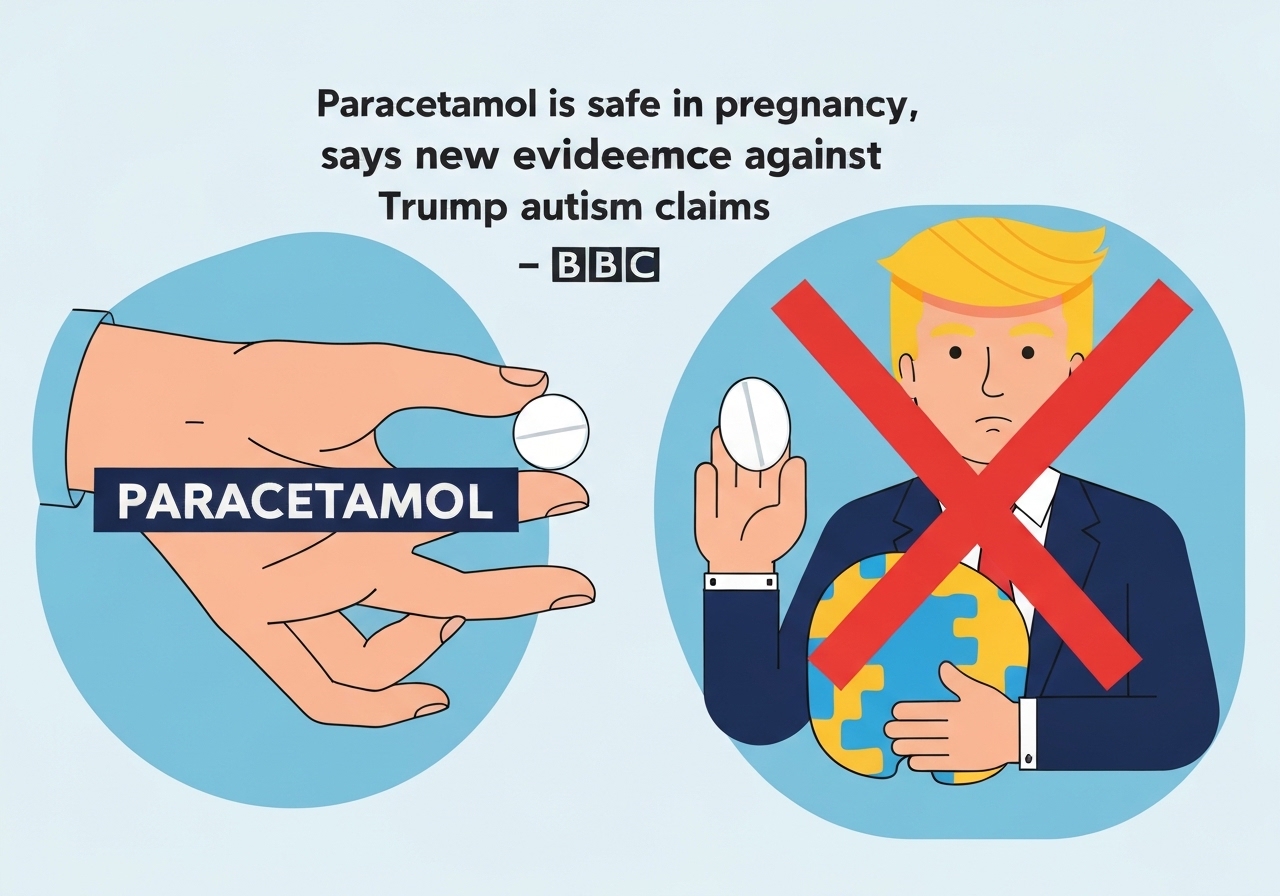
Paracetamol is safe in pregnancy, says new evidence against Trump autism claims
Lead: A large, peer-reviewed review published in The Lancet journal finds no evidence that taking paracetamol during pregnancy increases the risk of autism, ADHD or other developmental disorders in children. The analysis examined 43 high-quality studies involving hundreds of thousands of pregnancies and used sibling-comparison methods to reduce confounding. Its authors and external experts say the findings contradict high-profile claims made by US President Donald Trump in September 2025 and should reassure pregnant women and clinicians. US health officials continue to urge careful prescribing in some cases, but the review reinforces existing guidance that paracetamol is the first-line option for pain and fever in pregnancy.
Key takeaways
- The review analyzed 43 of the most robust studies on prenatal paracetamol use, covering hundreds of thousands of pregnancies across multiple cohorts.
- Authors prioritized sibling-comparison designs and low-bias studies and included investigations that followed children for more than five years.
- Lead author Professor Asma Khalil and co-authors report no association between maternal paracetamol use and increased risk of autism, ADHD or intellectual disability.
- The findings align with guidance from major medical bodies in the UK, US and Europe that recommend paracetamol as the preferred analgesic and antipyretic during pregnancy.
- Experts warn that untreated high fever or severe pain in pregnancy can raise risks such as miscarriage, preterm birth and developmental harm, so avoiding paracetamol without clinical reason can be dangerous.
- Some recent studies flagged possible links with heavy or prolonged acetaminophen use; the new review judges those signals likely reflect confounding rather than causation.
- US officials and some researchers continue to recommend cautious use in specific contexts, preserving the need for further targeted research into dosage and timing.
Background
Concerns about a possible link between prenatal paracetamol (known as acetaminophen in the US) and neurodevelopmental disorders gained public attention after policy statements and a September 2025 Oval Office speech by President Donald Trump advising pregnant women to avoid the medication. That intervention intensified debate among clinicians, researchers and expectant parents, and followed a series of observational studies suggesting small associations in some cohorts.
Medical regulators including the US Food and Drug Administration (FDA) responded by urging clinicians to weigh benefits and risks and to be cautious about prolonged or high-dose use; however, official guidance has continued to describe a causal relationship as unestablished. In parallel, academic work has produced mixed signals—some individual papers reported possible links, while others found no effect once family-level factors were accounted for.
Main event
The new analysis, published in The Lancet Obstetrics, Gynaecology & Women’s Health, systematically reviewed 43 high-quality studies. The team focused on designs that can better separate drug effects from family-level confounders, especially sibling-comparison studies that compare outcomes between siblings discordant for exposure.
Researchers restricted inclusion to studies with low risk of bias and those that provided long-term follow-up, aiming to capture neurodevelopmental outcomes that may emerge beyond early childhood. Across the assembled evidence, the meta-analysis found no consistent increase in autism, ADHD or intellectual disability tied to paracetamol taken during pregnancy.
Professor Asma Khalil, consultant obstetrician and lead author, told the BBC the analysis found “no links” and that the message is clear: when used as directed, paracetamol remains a safe option in pregnancy. The study team emphasized that earlier associations are likely explained by confounding factors such as maternal illness, genetics and family environment rather than a direct pharmacological effect.
Analysis & implications
For clinicians and public-health agencies, the review reduces uncertainty about routine paracetamol use in pregnancy. Because paracetamol is the recommended first-line treatment for fever and pain in pregnant women, the absence of a demonstrated causal link supports continuing that advice while clinicians counsel patients on appropriate dosing and duration.
For expectant parents, the practical implication is reassurance: occasional, guideline-directed use for headache, pain or fever is not supported by current evidence as a driver of autism or ADHD. At the same time, the review underscores the importance of treating high fever and disabling pain in pregnancy, since those conditions themselves carry risks to fetal development.
Policy implications differ by jurisdiction. In the US, where some officials have highlighted lingering concerns, the review may prompt reassessments of precautionary letters and clinical advisories; regulators will weigh the aggregate evidence and outstanding questions about heavy or prolonged exposure. Globally, the study may reduce public confusion triggered by political statements and conflicting headlines.
Comparison & data
| Metric | Value |
|---|---|
| Number of studies reviewed | 43 |
| Participants | Hundreds of thousands of pregnancies (combined cohorts) |
| Designs prioritized | Sibling-comparison, low-bias longitudinal studies |
| Follow-up | Several studies >5 years |
The table highlights the review’s emphasis on study design that reduces confounding. By comparing outcomes among siblings with different exposure histories, investigators can better control for shared genetic and household factors that often bias observational research.
Reactions & quotes
“When we did this analysis, we found no links — there was no association,”
Prof Asma Khalil, lead study author (City St George’s, University of London)
The lead author’s statement framed the review as providing clarity after public confusion. Her team emphasized methodological rigour, noting that sibling designs and long follow-up strengthen confidence in the null finding.
“Expectant mothers do not need the stress of questioning whether medicine most commonly used for a headache could have far reaching effects on their child’s health,”
Prof Grainne McAlonnan, King’s College London (independent expert)
Independent experts said the study should reduce anxiety in pregnant women and among clinicians advising them. Other academics praised the exclusion of lower-quality work that failed to account for key confounders.
“The study provides strong evidence that use of paracetamol during pregnancy does not increase risk of autism, ADHD or intellectual disability,”
Prof Jan Haavik, University of Bergen (molecular neuroscientist and clinician)
Experts cautioned, however, that continued research is warranted into dosage, timing and patterns of prolonged use that some earlier studies flagged as potentially important.
Unconfirmed
- Whether very heavy or prolonged paracetamol use during pregnancy carries small risks remains debated; some researchers have reported signals that warrant targeted investigation but causation is unproven.
- It is not fully resolved whether specific windows of exposure (for example, particular trimesters) or interactions with other maternal conditions could alter risk; further subgroup analyses are needed.
Bottom line
The best available, peer-reviewed synthesis of high-quality studies finds no evidence that guideline-directed paracetamol use in pregnancy increases the risk of autism, ADHD or intellectual disability in children. The review’s emphasis on sibling-comparison and long follow-up strengthens confidence that previously reported associations were likely confounded.
Clinicians should continue to recommend paracetamol as the first-line analgesic and antipyretic for pregnant women, while advising patients to avoid unnecessary prolonged or high-dose use and to seek medical care for persistent fever or severe pain. Policymakers and regulators will likely incorporate this synthesis into guidance, but continued, targeted research on exposure level and timing is appropriate.
Sources
- BBC News (news report summarizing the review and expert reaction)
- The Lancet (publisher / peer-reviewed journal platform where the review appears)
- US Food and Drug Administration (FDA) (official regulator statements and clinical advisories)