
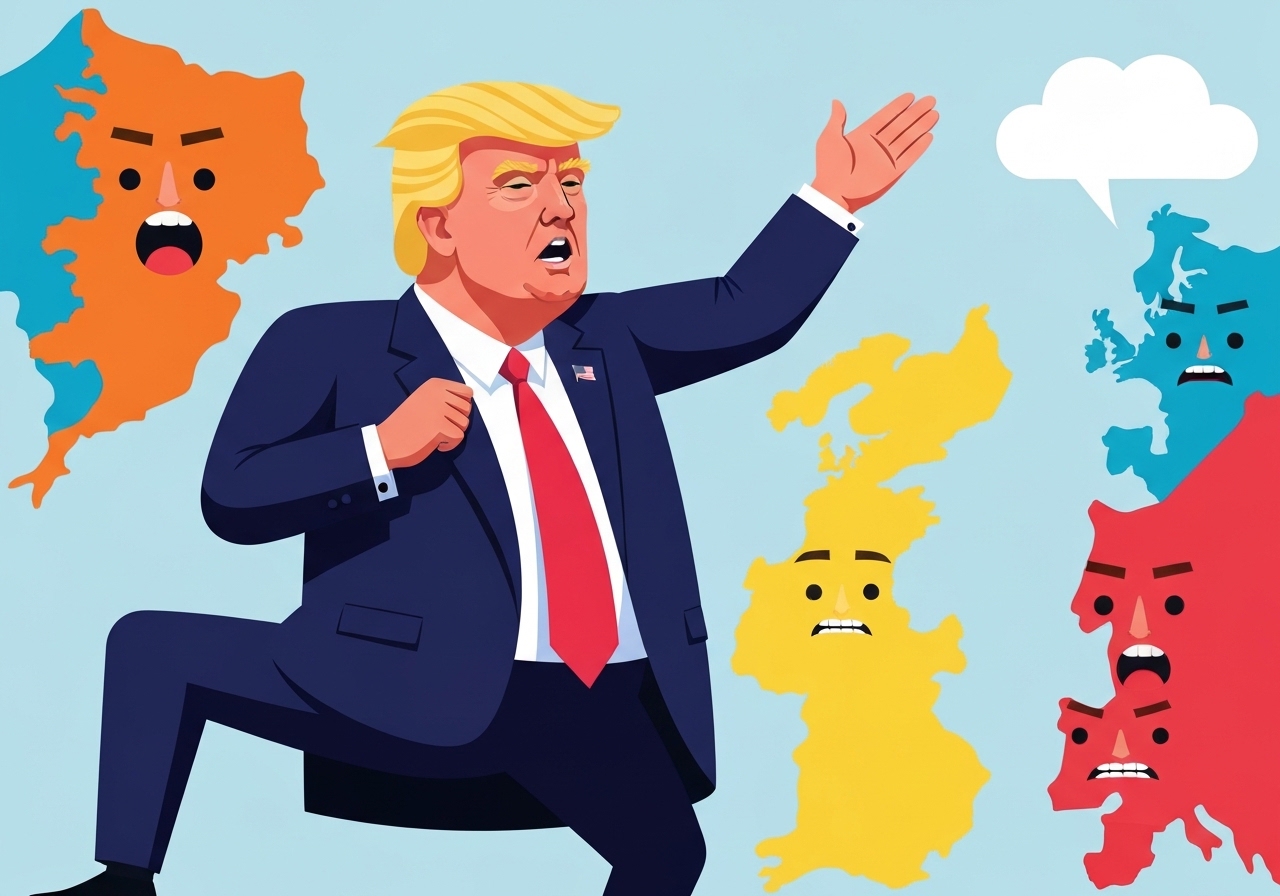
President Donald Trump announced on social media that the United States will impose tariffs on a group of European exporters over disputes tied to Greenland. The measure, posted on Truth Social, names Denmark, Norway, Sweden, France, Germany, the United Kingdom, the Netherlands and Finland and sets an initial 10% import duty from 1 February, rising to 25% on 1 June. Mr. Trump framed the move as leverage to secure a “Complete and Total purchase of Greenland,” and said the duties will remain until a deal is reached. The announcement immediately raised concerns in London and Copenhagen about diplomatic fallout and trade disruption.
Key Takeaways
- The US will apply a 10% tariff on goods from Denmark, Norway, Sweden, France, Germany, the UK, the Netherlands and Finland starting 1 February; the rate will rise to 25% on 1 June.
- President Trump said the tariffs will stay in place until the US secures a purchase agreement for Greenland; he posted the claim on Truth Social.
- Trump characterized long-standing trade arrangements as subsidising those countries; he singled out Denmark and called for it to “give back.”
- The president asserted security concerns about foreign interest in Greenland, explicitly referencing China as a potential rival in the region.
- British officials say a tariff move would damage Downing Street’s strategy of cultivating a constructive relationship with the US; urgent diplomatic discussions were expected.
- Tariffs are a tax on imports and may raise costs for exporters, US importers and ultimately consumers if companies pass on the added charge.
- Legal and trade responses — including potential WTO complaints — are likely but will depend on how and when the measures are implemented.
Background
Greenland is an autonomous territory within the Kingdom of Denmark with a strategic position in the Arctic. Interest in Greenland has grown in recent years among major powers because of natural resources, new shipping routes as sea ice recedes, and military positioning. In 2019 then‑President Trump publicly expressed interest in buying Greenland; the idea was rejected by Danish and Greenlandic officials and was widely seen as a diplomatic misstep.
Trade policy has become a tool of geopolitical signalling in recent US administrations. Tariffs can be imposed for domestic economic reasons, but they are also used to exert pressure in disputes. The countries named by the president are major European exporters to the US with broad economic ties and layered diplomatic partnerships, including NATO commitments and longstanding bilateral cooperation.
Main Event
The president’s post said the 10% duty will take effect on 1 February and increase to 25% on 1 June, and that the measures will be rescinded only after a negotiated transfer of Greenland to US ownership. The announcement came via Truth Social and did not include a formal White House policy paper or an immediate implementing proclamation from federal trade authorities at the time of publication.
In his social post, Mr. Trump framed the tariffs as corrective: he said the US had been subsidising the named nations by not imposing duties and argued the measures would counter what he described as foreign encroachment in Greenland. He also made contested and colorful claims about Greenland’s defence and foreign visits, remarks that prompted immediate questions from diplomats and analysts.
Officials in London and Copenhagen said the move — if enforced — would have swift economic and political consequences. UK government sources told reporters that a new tariff on British exports would be a significant shock and that officials were preparing to open urgent lines of communication with Washington to seek clarification and possible exemptions.
Analysis & Implications
Economically, a 10% tariff rising to 25% would increase costs for European exporters and US importers across many sectors. For goods with thin margins, exporters could see orders fall as American buyers look for alternatives, and some price increases could be passed on to US consumers. Supply‑chain effects could ripple through manufacturing sectors that rely on intermediate components from the affected countries.
Legally, unilateral US tariffs can run into World Trade Organization rules if they are not justified under specific national security exceptions or countervailing measures. Any affected government could pursue dispute settlement at the WTO, but that process is slow. Shorter‑term responses might include reciprocal duties, targeted exemptions, or coordinated diplomatic pressure seeking a rapid reversal.
Politically, the move risks straining the so‑called “special relationship” between the US and the UK as well as NATO cohesion if allies perceive economic coercion tied to a bilateral territorial demand. For Denmark and Greenland, the announcement sharpens an ongoing debate about autonomy, security partnerships and investment in Arctic infrastructure. Internationally, it highlights the growing strategic competition in the Arctic, particularly concerns about Chinese activity in the region.
Comparison & Data
| Effective date | Tariff rate (announced) | Scope |
|---|---|---|
| 1 February | 10% | All goods from listed European countries |
| 1 June | 25% | All goods from listed European countries |
To illustrate: a $10 imported widget subject to a 10% tariff would carry an additional $1 charge at import; at 25% the same item would incur an extra $2.50. These simple examples understate downstream effects such as changed purchasing decisions, altered supply‑chain routing and potential retaliatory measures that could amplify economic disruption.
Reactions & Quotes
UK political sources described the announcement as an unwelcome escalation. The BBC’s political correspondent framed the tariffs as a potential setback for the UK government’s approach to the Trump administration and noted fast-moving efforts to clarify Washington’s intentions.
“These tariffs would be a real blow for Downing Street’s strategy—if they come into force.”
Nick Eardley / BBC (political correspondent)
The president’s social‑media post tied the measures directly to strategic goals and made stark claims about Greenland’s security environment. His language prompted immediate diplomatic concern.
“It’s time for Denmark to give back,”
Donald Trump (Truth Social)
Business groups and trade bodies warned privately that even announced tariffs can unsettle markets, and exporters urged swift clarification on enforcement and exemption procedures to limit commercial harm.
Unconfirmed
- It was not independently confirmed at the time of the announcement that federal agencies had issued implementing orders to effect the tariff schedule on 1 February.
- Claims that Greenland is protected “only by two dogsleds” and details about foreign military posture in Greenland are assertions from the president and were not corroborated here.
- The president’s statement that tariffs will stay until a purchase deal is reached is his stated condition; whether any administration would follow that course through formal treaty processes or other mechanisms remains unconfirmed.
Bottom Line
The president’s tariff announcement ties trade policy to an extraordinary geopolitical demand and, if implemented, would impose economically significant duties on several close European partners. Immediate consequences would likely include higher costs for affected exporters and importers, accelerated diplomatic engagement, and potential legal challenges in trade fora.
For readers and policymakers, the key items to watch are: whether the administration issues formal implementing instructions, how affected governments respond diplomatically or through the WTO, and whether businesses receive exemptions or face broad enforcement. The episode highlights how trade measures can be used as leverage in strategic disputes, with broad implications for alliances, commerce and Arctic geopolitics.