
Lead
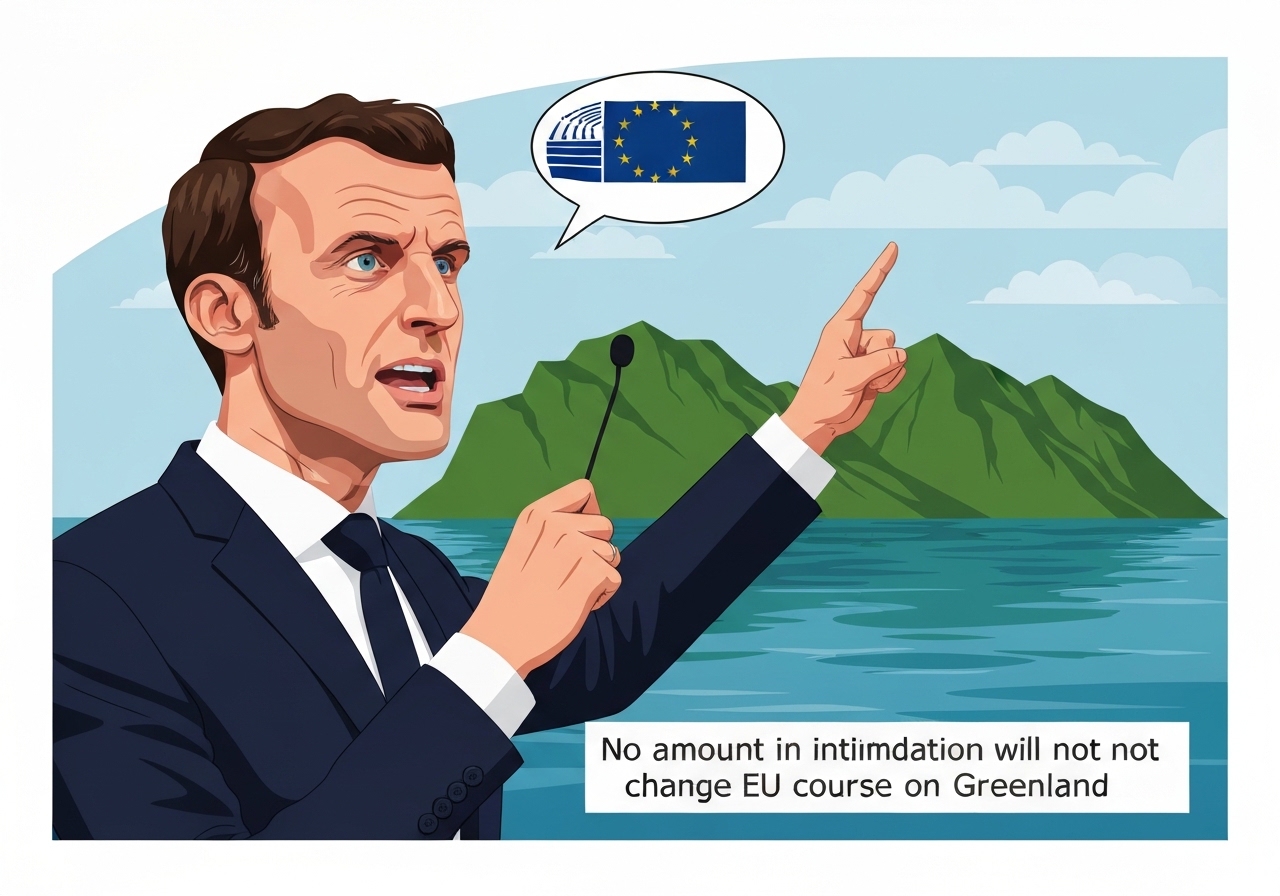
French president Emmanuel Macron on Saturday rejected US threats of tariffs tied to President Donald Trump’s comments about buying Greenland, saying no intimidation will alter European decisions. Trump announced a 10% tariff on eight European countries effective 1 February and a further 25% from 1 June; the move followed sharp opposition from several EU capitals to US plans concerning Greenland. EU leaders meeting in Paraguay — where they were due to sign a Mercosur trade pact — called the tariff threats damaging to transatlantic ties and announced coordinated diplomatic responses. European institutions and MEPs signalled they could pause ratification of a US trade agreement in response.
Key takeaways
- Trump announced 10% tariffs on Denmark, Norway, Sweden, France, Germany, the UK, the Netherlands and Finland from 1 February, rising to 25% from 1 June.
- Those eight countries are the ones most vocal in opposing US overtures on Greenland; the announcement followed EU leaders travelling to Paraguay for a Mercosur trade signing.
- Macron called the tariff threat “unacceptable” and insisted intimidation would not change France’s stance; he tied the response to broader defence and international-law principles.
- EU leaders including António Costa and Ursula von der Leyen warned tariffs would undermine transatlantic relations and risk a downward spiral.
- MEPs and major parliamentary groups, including the EPP and Socialists & Democrats, indicated they may pause the ratification of a pending EU-US trade deal.
- Denmark said it was pursuing constructive talks with US interlocutors while coordinating with NATO partners on Arctic security.
- Analysts described the tariff announcement as a negotiating tactic that matches the countries that have deployed troops or personnel to Greenland.
Background
The flashpoint began after public reporting that the US president expressed interest in purchasing Greenland, prompting political backlash in Copenhagen and across Europe. Greenland is part of the Kingdom of Denmark and has strategic significance in the Arctic; several European states have heightened security and scientific activity in the region in recent years. Tensions over Arctic access and bases intersect with broader postures on NATO burden-sharing and rival great-power activity in the high north.
Diplomatically, the row landed while EU leaders were in Paraguay to sign the EU-Mercosur trade agreement, amplifying the surprise and disrupting plans for a smooth summit. The US and EU had an earlier tariff understanding reached last August, but that arrangement was not fully ratified by the European Parliament. Domestic politics on both sides of the Atlantic — from Capitol Hill to EU party groups — shape how trade and security measures translate into policy moves.
Main event
On Saturday, the US president posted a message on his social platform announcing that tariffs of 10% would apply to eight European countries from 1 February, and that rate would rise to 25% from 1 June unless a deal was struck for the “complete and total purchase of Greenland.” The announcement explicitly targeted the countries seen as opposing US approaches to Greenland. The wording and timetable immediately alarmed EU officials and diplomats.
French president Emmanuel Macron responded promptly, calling the threats unacceptable and saying they had no place when Europe and its partners are working to defend Greenland and uphold international law. Sweden’s prime minister Ulf Kristersson said the EU would not be blackmailed, while Norway’s Jonas Gahr Støre said threats are inappropriate among allies. The coordinated European response emphasized unity and respect for sovereignty.
EU institutions moved quickly: EU ambassadors were expected to convene an emergency session and senior EU figures publicly warned that tariffs would damage transatlantic relations. In Brussels and Strasbourg, MEPs and party leaders discussed pausing the ratification process for the pending EU-US trade agreement as leverage and as a matter of principle given the threats.
Denmark sought to calm the diplomatic temperature by highlighting ongoing, constructive contacts with US officials and emphasising transparent cooperation with NATO partners on Arctic security. Danish officials framed their Arctic deployments as defensive and coordinated, and called for dialogue rather than coercive measures.
Analysis & implications
The episode illustrates how transactional trade measures can be used as instruments of statecraft and domestic messaging, raising the prospect of tit-for-tat escalation that could harm long-standing alliances. A tariff imposition tied to a political dispute about sovereignty is rare among NATO members and risks undermining the alliance’s cohesion on strategic priorities, including deterrence and Northern European security.
Suspending ratification of an EU-US trade agreement would be a consequential step. Parliamentary hold-ups in the European Parliament could delay tariff reductions on US goods and complicate transatlantic cooperation on standards, digital trade and other regulatory issues. That in turn would reduce the economic upside both sides have cited for concluding broader commercial arrangements.
Economically, the threatened additional 10% would be layered on top of the 15% tariffs announced last August, raising costs for exporters and potentially prompting reciprocal measures. Even if imposed as a negotiating lever rather than a permanent policy, short-term market uncertainty and disrupted supply-chain planning would affect exporters in multiple sectors, from agriculture to manufacturing.
Politically, the backlash shows European leaders prepared to present a unified front when core principles—sovereignty, alliance norms, and international law—appear at stake. How Washington responds in the coming days will determine whether this becomes a brief diplomatic flare-up or a longer rupture that shifts bargaining dynamics in NATO and trade forums.
Comparison & data
| Item | Detail |
|---|---|
| New threatened tariffs | 10% from 1 Feb; 25% from 1 Jun (targeting 8 EU states) |
| Earlier US tariffs | 15% on some EU exports announced last August |
| Affected countries | Denmark, Norway, Sweden, France, Germany, UK, Netherlands, Finland |
| EU response | Emergency ambassador meeting; warning from EU leaders; potential MEP pause on trade deal ratification |
The numbers above show layered tariff risks: an additional 10% would compound existing tariff burdens, and a later 25% would represent a major barrier to trade. The list of eight countries corresponds closely to those most publicly engaged in Arctic deployments or diplomatic pushback, which analysts say explains the selection. Even short-term implementation would raise compliance and customs costs for companies and could shift supply chains over time.
Reactions & quotes
European capitals issued immediate pushback and framed their responses within alliance commitments and legal principles. Officials emphasised the need for diplomacy and warned against coercive economic measures among allies.
No intimidation or threats will influence us when faced with such situations.
Emmanuel Macron, President of France
Macron used his statement to link the Greenland dispute to broader commitments: defending sovereignty, supporting the UN charter, and the rationale for France’s participation in Arctic security initiatives alongside Denmark.
We will not allow ourselves to be blackmailed. Only Denmark and Greenland decide on those issues.
Ulf Kristersson, Prime Minister of Sweden
Kristersson underlined national decision-making for Denmark and Greenland and framed Sweden’s stance as solidarity with Nordic partners rather than a direct escalation toward Washington.
Threats have no place among allies.
Jonas Gahr Støre, Prime Minister of Norway
Norway’s leader stressed that allied relationships should be governed by consultation and shared norms, not unilateral punitive measures.
Unconfirmed
- Whether the tariff schedule will be implemented exactly as announced on 1 February and 1 June remains unclear pending formal US executive actions or Commerce rulings.
- Claims that the tariff targets precisely the countries that sent troops to Greenland are an analyst interpretation and have not been officially confirmed by a US government rationale document.
- The prospect of an outright sale or “complete and total purchase of Greenland” remains a political statement without any published negotiation documents or formal offer on the public record.
Bottom line
The spat over Greenland has moved quickly from a political provocation into a live transatlantic dispute with potential trade, diplomatic and security consequences. European leaders have signalled unity and the willingness to use parliamentary and diplomatic levers, while Denmark seeks to de-escalate through dialogue and NATO coordination. The coming days will show whether the episode is contained by negotiations or evolves into a broader rupture that affects ratification of trade agreements and alliance cooperation.
For stakeholders — governments, exporters and defence planners — the key watchpoints are whether the United States carries out the tariff timetable, how the European Parliament and member-state governments respond procedurally, and whether informal channels can produce a face-saving diplomatic path forward. Absent swift clarification, uncertainty alone will raise costs and complicate cooperation in the Arctic and beyond.
Sources
- The Guardian (news report)
- European Council / EU leaders joint statements (official EU statements and press releases)
- European Parliament (institutional communications on trade ratification)
- Danish Institute for International Studies (research institute commentaries)