
Lead
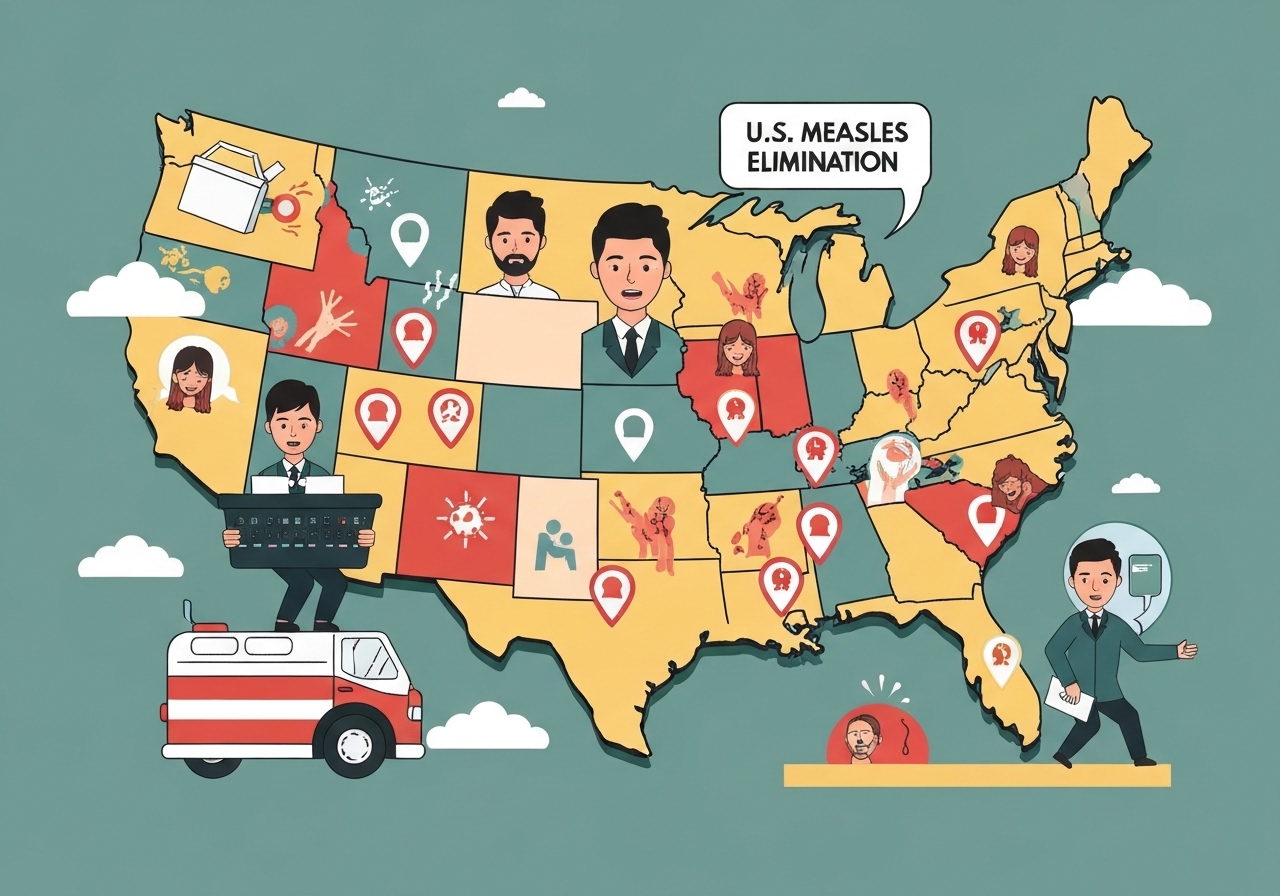
International health authorities will meet on April 13 to decide whether the United States has lost its measles-free designation after outbreaks that began in West Texas a year ago. The Centers for Disease Control and Prevention confirmed 2,144 cases across 44 states in 2025, the highest total since 1991. Public health officials are investigating whether transmission chains in Texas, Utah, Arizona and South Carolina form a single uninterrupted chain of at least 12 months. Although the review is largely procedural, experts say it reflects deeper gaps in vaccination coverage and public health capacity.
Key Takeaways
- The CDC confirmed 2,144 measles cases across 44 states in 2025, the largest U.S. total since 1991.
- Texas reported 762 cases tied to the West Texas cluster, with two children confirmed dead and many likely uncounted.
- National MMR coverage is about 92.5%, below the ~95% community protection threshold needed to stop spread.
- More than 800 cases have been reported across Utah, Arizona and South Carolina since late summer 2025.
- Mexico has reported roughly 6,000 cases and 21 deaths in Chihuahua state; investigators link its outbreak to the Texas chain.
- PAHO will decide on April 13 whether U.S. transmission has been uninterrupted for 12 months, a technical criterion for elimination.
- Contact tracing and case confirmation gaps—such as 182 unconfirmed potential cases in Gaines County in March 2025—complicate efforts to determine continuity.
Background
Measles was certified eliminated in the United States in 2000, meaning there was no continuous indigenous transmission for 12 months. Elimination is a technical, epidemiological achievement that depends on both sustained vaccination coverage and effective surveillance. Measles is highly contagious—about nine in ten susceptible people exposed will become infected—so public health guidance aims for roughly 95% two-dose coverage to maintain herd protection. Over the past decade many U.S. communities have fallen below that threshold because of vaccine hesitancy, access barriers, and exemptions that lower local coverage.
Investment in local public health infrastructure has declined in many jurisdictions, leaving departments with less capacity for rapid testing, contact tracing and outreach. Experts also note that disinformation and changing federal rhetoric about vaccines have eroded public confidence in some areas. Those social and policy factors set the stage for large, prolonged outbreaks once the virus is reintroduced from regions where it remains common. The Pan American Health Organization (PAHO) applies a strict 12-month continuity test when reviewing elimination status, a definition that can hinge on the quality of surveillance and genetic data.
Main Event
The first known U.S. case in the recent cascade developed a measles rash on Jan. 20, 2025, in West Texas, and the outbreak expanded rapidly in rural Gaines County. Official reporting ties 762 cases to the Texas cluster and notes two child fatalities; local officials also reported 182 potential but unconfirmed pediatric cases in Gaines County in March 2025, suggesting undercounting. From Texas the same viral strain has been detected by sequencing in New Mexico, Utah, Arizona, South Carolina and in cases abroad, including Mexico and Canada.
Across the U.S. other outbreaks emerged in 2025: New Mexico recorded about 100 cases with one adult death; Kansas experienced nearly 90 cases spanning 10 counties and requiring a seven-month response; Ohio confirmed 40 cases; Montana, North Dakota and Wisconsin each reported 36. Public health teams say the scale of simultaneous outbreaks strained local contact tracing and laboratory capacity, increasing the chance that transmission chains were not fully documented.
PAHO and national officials are now assessing whether one continuous chain of transmission persisted for at least 12 months in the Americas. PAHO spokespersons have indicated a conservative approach—cases of unknown origin in a country with ongoing local spread are likely to be considered part of existing transmission. HHS told reporters that as of the department’s most recent review it did not have evidence that a single U.S. chain had continued for a full year.
Analysis & Implications
Losing formal elimination status is primarily symbolic: it does not change the biology of measles or the immediate clinical care for patients. Yet the designation matters for public confidence, international reputation and public health funding priorities. A loss would underscore measurable failures in vaccination coverage and surveillance, and could prompt renewed investment in outbreak control, school-entry immunization enforcement and community outreach.
The apparent spread of a single viral strain across multiple states and into neighboring countries highlights the permeability of modern travel and the limits of local containment when vaccination gaps exist. If PAHO classifies recent cases as continuous transmission, it may also influence neighboring countries’ assessments and regional control strategies. For Mexico—where officials report about 6,000 cases since late 2024—the cross-border pattern illustrates how outbreaks can leap national boundaries and then be reimported.
Operationally, the situation exposes a tension in international standards: the 12-month continuity rule depends on robust surveillance and sequencing to prove interruption. Where public health systems are under-resourced, the absence of definitive evidence of continuity could reflect data gaps rather than true interruption. That reality could drive calls for standardized genomic surveillance and increased support for local public health laboratories and workforce.
Comparison & Data
| Location | Cases (2025) | Reported deaths |
|---|---|---|
| United States (total) | 2,144 | At least 2 |
| Texas (Gaines County cluster) | 762 | 2 |
| Utah + Arizona + South Carolina | >800 (combined) | — |
| New Mexico | 100 | 1 |
| Mexico (Chihuahua and national) | ~6,000 | 21 |
The table aggregates confirmed figures reported by state and national health authorities and PAHO through late 2025. Jurisdictional counts differ in timeliness and in case-definition application; the Texas cluster alone includes a March 2025 report of 182 potential but unconfirmed pediatric cases in Gaines County that would raise the local case total if validated. Genetic sequencing has matched the same strain across several U.S. states and neighboring countries, but the measles virus mutates slowly, so identical sequences are necessary but not always sufficient to prove direct transmission chains.
Reactions & Quotes
Health professionals and officials offered terse assessments while noting larger systemic problems.
“It is really a question of semantics.”
Dr. Jonathan Temte, Wisconsin family physician who helped certify U.S. elimination in 2000
Temte used the phrase to stress that whether PAHO calls the pattern continuous transmission or not, the underlying conditions—suboptimal vaccination and weakened surveillance—allow large outbreaks to occur. He warned the decision will not change the practical need to raise immunization rates.
“The most important thing that we can do is to make sure the people who aren’t vaccinated get vaccinated.”
Jennifer Nuzzo, director, Brown University Pandemic Center
Nuzzo reiterated that clear, sustained messaging and targeted outreach are central to stopping measles. Public health officials noted that vaccination campaigns and school-entry enforcement remain the fastest path to reducing spread.
“CDC data are among the best, but our investment in public health has changed, so we’re less able to do the case tracking we used to do.”
Noel Brewer, behavioral scientist and chair of the U.S. committee finalizing data for PAHO
Brewer emphasized that weakened local capacity for contact tracing and testing increases uncertainty about whether transmission truly stopped in any one place.
Unconfirmed
- Whether the Texas outbreak continued as a single uninterrupted chain into other U.S. outbreaks for a full 12 months remains under review and is not yet definitively established.
- The precise size of undercounted cases in Gaines County and other communities is uncertain because many probable cases went untested or unreported.
- The degree to which specific federal policy decisions directly caused lower vaccination coverage in particular communities is plausible but not fully proven in peer-reviewed analyses.
Bottom Line
The April 13 PAHO decision on whether the United States has lost measles-elimination status is primarily a technical determination, but it will carry symbolic weight and practical consequences. If PAHO rules that transmission was continuous, the loss would underscore persistent vulnerabilities: suboptimal vaccination coverage in many communities, uneven surveillance capacity and public mistrust driven by misinformation.
Regardless of the formal designation, public health experts say the immediate priorities remain the same: accelerate vaccination for unprotected people, shore up local testing and contact tracing, and fund sustained community outreach. The outcome of the PAHO review should prompt policymakers to consider targeted investments that reduce the chance of similarly large outbreaks in the near future.
Sources
- The Associated Press — (news organization; original reporting)
- Pan American Health Organization (PAHO) — (regional public health agency)
- Centers for Disease Control and Prevention (CDC) — (U.S. federal public health agency; surveillance data)
- U.S. Department of Health and Human Services (HHS) — (federal agency; statements on response)
- Texas Department of State Health Services — (state public health agency; outbreak reports)
- Brown University Pandemic Center — (academic research and public-health commentary)