
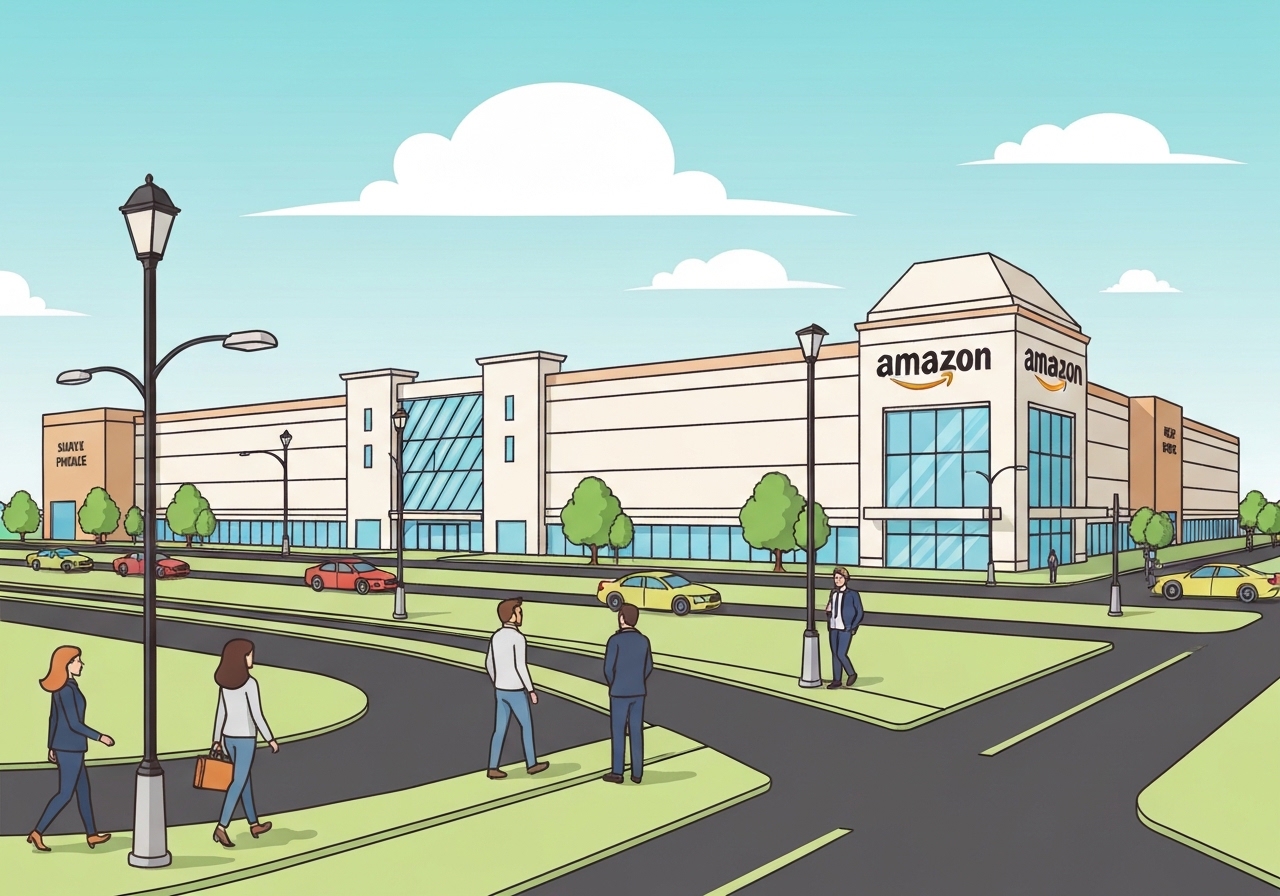
Orland Park’s village board granted final approval on Monday night for Amazon to construct a new, 230,000-square-foot retail concept at 9600 159th St., a project the company calls “first-of-its-kind.” The development will sit on 35 acres, include about 800 parking spaces and create roughly 500 jobs—about half full-time—plus 200 temporary construction positions. Amazon said the space will blend general merchandise, household items and groceries, will not require Prime membership to shop, and is expected to open in late 2027 at the earliest. The board’s vote followed a two-week review that included public comment and some residents’ objections about process speed and future traffic.
- The approved building is estimated at 230,000 square feet on 35 acres at 9600 159th St.; site plans reserve roughly 800 parking spaces.
- Amazon projects about 500 permanent jobs (about 50% full-time) and roughly 200 temporary construction jobs during build-out.
- The village approved construction after a Plan Commission 6–1 vote on Jan. 6 and a board vote the following Monday night; the proposal was first announced publicly on Jan. 3.
- Amazon expects the concept to open in late 2027 at the earliest and says more than half the building will house back-of-house operations, not a fulfillment center.
- A traffic study prepared for the project projects 10,060 new daily vehicle trips and a 5–6% traffic increase by 2033, with mitigation measures planned.
- Amazon plans seven loading docks at the site (nearby Walmart has six); company attorneys say about 27 trucks will serve the location daily, scheduled during off-peak hours.
- Some residents pushed to delay final approval; an online petition to pause the vote had 533 signatures as of the Monday vote.
Background
Orland Park announced on Jan. 3 that Amazon had proposed development at the southwest corner of 159th Street and LaGrange Road, replacing a vacant parcel that includes the closed Petey’s II restaurant, which shuttered in 2024. The property has been vacant for years and attracted private-sector interest because of its size and location on a busy retail corridor that already includes Costco, Target, Walmart Supercenter and Best Buy. Local leaders framed the project as an opportunity to revitalize the corridor and expand sales tax revenue that can underwrite public improvements.
The village’s formal review unfolded quickly: the Plan Commission held a Jan. 6 meeting where it voted 6–1 to approve the development, sending it to the Committee of the Whole and then to the Board of Trustees for a final vote the next Monday night. Officials said the process complied with public-notice rules; critics said the timeline—from initial public notice to final approval—felt unusually brief for a project of this scale. Village staff and Amazon representatives provided engineering and traffic studies and held public Q&A sessions in advance of the vote.
Main Event
At the final meeting, trustees discussed traffic mitigation, site design and the project’s fiscal benefits before voting to approve the zoning and development agreements. The approved plan calls for sidewalks around the site, new turn lanes, an extension of Ravinia Avenue to 161st Street and a traffic signal already planned by the village. Officials emphasized that sales and property tax revenue from the development would help fund those long-awaited traffic improvements.
Residents who spoke at the public session raised concerns about the pace of the approval, the aesthetics of a large concrete structure at the corridor’s entrance and the potential for increased congestion. Of 11 public commenters, five urged a delay. An online petition organized by a resident had gathered 533 signatures by the evening of the vote. Village attorneys and trustees said public notice requirements were met and that multiple public meetings had been held.
Amazon representatives said the site is designed primarily as a retail and back-of-house operations center rather than a fulfillment warehouse for e-commerce. They also explained logistics plans that limit truck deliveries to off-peak hours; an updated figure given by Amazon’s counsel put daily truck visits at about 27, not the earlier estimate of 10. The approved design includes seven loading docks and multiple pickup areas to integrate online orders with in-store pickup.
Analysis & Implications
Economically, the project promises a notable boost to local revenue streams. Village officials highlighted potential sales and property tax receipts that could fund infrastructure and public services; such receipts are often a central rationale for approving large retail projects. For Orland Park, additional revenue sources could accelerate traffic and safety projects that have been on hold for years. The scale of the approved building—230,000 square feet on 35 acres—also signals Amazon’s intent to test hybrid retail and logistics formats outside its traditional fulfillment model.
For traffic and land-use planners, the numbers matter: the Amazon-conducted study projects about 10,060 new daily vehicle trips and a 5–6% rise in area traffic by 2033. Planners will need to monitor whether the planned turn lanes, Ravinia Avenue extension, and the planned signal sufficiently absorb that growth. The village and Amazon both noted additions like turn lanes and scheduled delivery windows as mitigation; enforcement and long-term monitoring will determine whether the measures match modeled outcomes.
The retail landscape could also shift: Amazon’s presence adjacent to major chains such as Costco and Walmart may change shopping patterns and competitive dynamics in the immediate trade area. While Amazon says the space is not a fulfillment center, the building’s substantial back-of-house footprint raises questions about how much the location will serve local shoppers versus company logistics. Locally, the promise of 500 jobs—about half full-time—was a key selling point, but the nature of those roles and their wage levels will shape public perception over time.
Comparison & Data
| Metric | Planned / Projected |
|---|---|
| Building size | 230,000 sq ft |
| Site area | 35 acres |
| Parking spaces | ~800 |
| Permanent jobs | ~500 (≈50% full-time) |
| Construction jobs | ~200 (temporary) |
| Projected daily vehicle trips | ~10,060 (increase 5–6% by 2033) |
| Daily trucks | ~27 (scheduled off-peak) |
| Loading docks | 7 (Walmart nearby: 6) |
The table groups the proposal’s principal measurements so stakeholders can compare them to nearby uses and prior expectations. The compare-to-Walmart note gives a local reference for scale; the truck and trip estimates are taken from Amazon-supplied traffic materials and presentations made during the village review process.
Reactions & Quotes
Residents and officials offered sharply different frames during the review. Supporters emphasized economic gains and the opportunity to fund infrastructure projects, while opponents focused on process speed and quality-of-life impacts like congestion and visual character.
“The timeline from initial public awareness to potential board approval feels unusually fast for a project of this size and permanence,”
Michael Sipple, resident
Sipple spoke during the public comment period, saying residents received significant project materials only hours before the vote and that the compressed schedule limited public review time. His remarks typified procedural concerns expressed by several speakers.
“How does a 230,000-square-foot industrial concrete structure serve as a welcoming entrance to our community?”
Joe Solek, resident
Solek, who helped circulate a petition to delay the vote, argued the building’s scale and appearance are out of step with what some residents want at a neighborhood gateway. The petition had 533 signatures as of Monday night.
“Projects like this have the potential to generate substantial sales tax revenue that directly benefits residents while strengthening one of our most important corridors,”
Mayor Jim Dodge (statement)
Mayor Dodge and other trustees framed the development as a private investment that will produce local tax receipts and allow traffic mitigation projects to move forward. Trustees who supported approval said the site had been underutilized and that the project represents a pragmatic reuse.
Unconfirmed
- Exact opening date: Amazon cites “late 2027 at the earliest,” but a formal opening timeline and permitting milestones remain to be confirmed.
- Project name and final store format: Amazon has not announced an official name for the concept and the detailed mix of in-store services is not finalized publicly.
- Net tax revenue estimates: the village has not published a precise forecast of expected sales or property tax proceeds tied to the development.
- Long-term truck scheduling enforcement: the village and Amazon have committed to off-peak deliveries, but monitoring and penalties for noncompliance have not been detailed.
Bottom Line
The Orland Park approval marks a major local commitment to a large, hybrid Amazon retail format that blends shopping and logistics on a prominent corridor. It promises jobs and new local revenue that could fund infrastructure upgrades, but it also raises long-term questions about traffic, land use and how the format will interact with nearby retailers. The village’s quick review and divided public reaction suggest implementation, monitoring and community engagement over the next two years will determine whether local benefits outweigh the trade-offs.
Watch for three near-term indicators: (1) details in Amazon’s final permits and construction schedule, (2) the village’s traffic-improvement timetable and funding plan, and (3) operational commitments on truck delivery windows and parking/traffic management as the project moves through permitting and construction toward a potential late-2027 opening.
Sources
- Chicago Sun-Times (local news report on village vote and project details)
- Village of Orland Park (official municipal site and public notices)
- Amazon Newsroom (company statements and descriptions of retail concepts)