
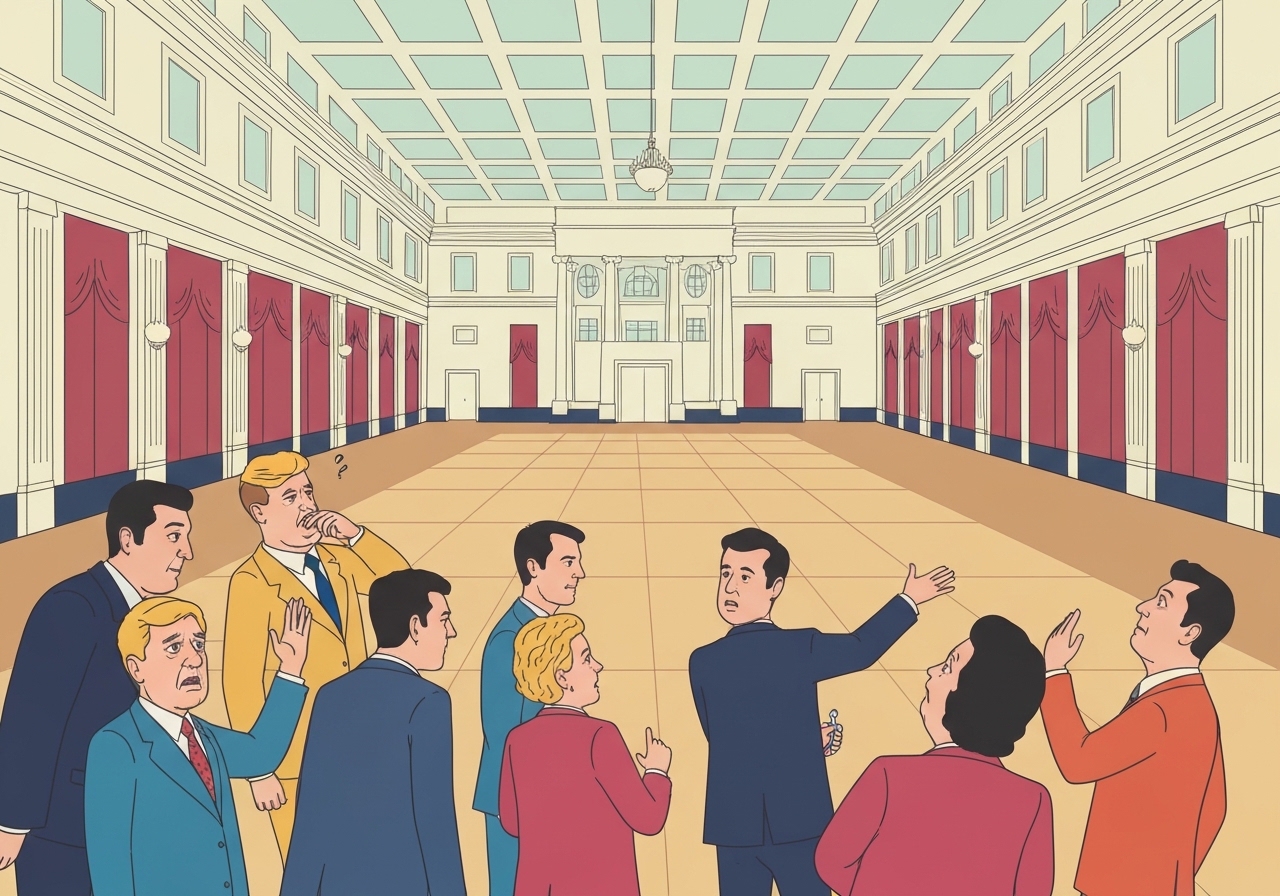
At a Thursday online hearing, members of the Commission on Fine Arts — several of whom were appointed by President Donald Trump — raised questions about the size and visual impact of the administration’s proposed White House ballroom while generally endorsing the president’s intent to expand. Commissioners asked the project team for an in-person follow-up with three-dimensional scale models to better judge how the addition would sit alongside the White House and neighboring federal buildings. The discussion came as preservation groups seek a federal injunction to halt work after the East Wing was demolished to make way for plans that would more than double the mansion’s former square footage. A judge said he expects to rule next month on whether the project should be paused pending litigation.
Key Takeaways
- Commission on Fine Arts members requested 3D scale models showing the proposed addition, the U.S. Treasury building and the Eisenhower Executive Office Building to assess context and scale.
- Lead architect Shalom Baranes confirmed the proposed addition would total nearly 90,000 square feet, of which about 22,000 square feet would be the ballroom itself.
- The White House complex measured roughly 55,000 square feet before the East Wing (built 1902, expanded in the 1940s) was demolished to clear the site for the expansion.
- Public comments filed before the hearing were described by the commission’s executive director as “almost all” negative, citing concerns about design, process and scale.
- The project’s estimated price tag is $400 million, and historic preservationists have asked U.S. District Judge Richard Leon for a preliminary injunction to suspend construction.
- Administrations prior to Mr. Trump have complained about hosting large official events in temporary structures, a point cited by the commission chair in support of finding a permanent solution.
- Architects presented a proposal for a two-story east colonnade to link the main house to the ballroom addition and discussed — as a concept only — adding a second story to the West Wing to address symmetry.
Background
President Trump approved demolition of the East Wing and unveiled renderings for an ambitious addition intended to expand the White House’s event and hospitality capacity. The plan would more than double the building’s footprint compared with its pre-demolition size, moving the complex toward a total of nearly 90,000 square feet. The administration frames the project as a modernization and a remedy to the recurring need for temporary tents and facilities for state dinners and major official events.
Historic preservationists and advocacy groups view the project differently, arguing that such a large alteration to the executive mansion requires broader review and possibly congressional input. Those groups have brought litigation seeking to halt work, contending that the demolition and construction process may have skipped required approvals or failed to fully account for historic values. The dispute has produced competing legal and public-relations arguments about stewardship, statutory authority and institutional norms.
Main Event
The Commission on Fine Arts convened an online meeting Thursday where architect Shalom Baranes presented renderings of the proposed ballroom addition. Commissioners probed the design’s massing, sightlines and how new volumes would relate to Pennsylvania Avenue and the South Lawn. Several members said the renderings suggested the new mass was large enough to dominate views from some approaches, prompting the request for physical scale models that include adjacent federal buildings.
Baranes told the panel the plan sets the north boundary of the addition back from the North Portico and keeps the top of the new structure flush with the primary White House facade to preserve the Pennsylvania Avenue perspective. He described a new east-side, two-story colonnade linking the mansion to the addition and said architects had considered a matching two-story treatment on the West Wing as a symmetry exercise, though no structural analysis has been completed to confirm feasibility.
Commission chair Rodney Mims Cook Jr. acknowledged the administration’s goal to replace temporary event tents with permanent space but repeatedly raised the question of whether the proposed elements could be reduced or refined so the historic character of the White House remains intact. The commission’s executive director, Thomas Luebke, read a summary of public feedback filed online, noting that most comments criticized either the proposal’s scale, the process that produced it, or both.
Analysis & Implications
The review highlights a collision between presidential prerogative and preservation practice: the White House is both a working residence and a national symbol, and large alterations invite scrutiny from historic advocates, architects and the courts. If the judiciary grants the National Trust’s request for a preliminary injunction, construction could be halted, delaying an administration priority and potentially raising costs. A suspension could also become a political flashpoint, reinforcing broader debates over executive authority and stewardship of public heritage.
From a design standpoint, commissioners’ insistence on physical models reflects the difficulty of judging mass and context from digital renderings alone. Views from Pennsylvania Avenue and the South Lawn are especially sensitive; small changes in depth or height can change perceived proportions. The proposal’s two-story colonnade and multistory southern porch drew particular attention for resembling neighboring federal architectures rather than historic White House elements, raising questions about stylistic coherence.
Legally, the conflict may turn on whether the president needed additional approvals or congressional authorization before such a large, costly alteration. Government counsel argued that statutory authority and executive discretion permit the modifications and that halting work mid-project would create security and operational problems. Plaintiffs counter that longstanding stewardship responsibilities limit unilateral action and that public process and preservation law must be respected.
Comparison & Data
| Metric | Existing / Before East Wing | Proposed Addition |
|---|---|---|
| Total square footage | ~55,000 sq ft | ~90,000 sq ft (total after addition) |
| Ballroom size | — | ~22,000 sq ft |
| Estimated project cost | — | $400 million |
The numbers show the proposed project would substantially increase the White House complex’s footprint, more than doubling space compared with the estate’s pre-demolition area. The ballroom alone would be roughly 40% of the mansion’s former total square footage, highlighting why commissioners and preservationists alike are focused on visual balance and civic symbolism as much as raw programmatic needs.
Reactions & Quotes
Commission chair Rodney Mims Cook Jr. framed the project as a national priority while urging careful stewardship to keep the building’s character intact.
“This is an important thing to the president. It’s an important thing to the nation.”
Rodney Mims Cook Jr., Commission on Fine Arts chair
White House spokespeople defended the project as consistent with the president’s goals for the executive residence and its official functions.
“President Trump is working 24/7 to Make America Great Again, including his historic beautification of the White House.”
Davis Ingle, West Wing spokesman
Litigants challenging the project argued in court that the president lacks unilateral authority to undertake changes of this scale without broader approval and described the White House as a public trust.
“He is a steward.”
Thad Heuer, attorney for preservation plaintiffs
Unconfirmed
- Whether a structural analysis would show the West Wing can safely support a second story remains uncompleted and therefore unresolved.
- The precise timing and scope of any appeal if Judge Richard Leon issues a ruling next month are uncertain and would depend on the court’s order.
- Details about final materials, façade treatments and landscaping for the south-facing porch and colonnade have not been finalized and remain subject to revision.
Bottom Line
The Fine Arts commission’s request for physical models underscores the project’s high-stakes blend of architecture, symbolism and politics. The numbers — a near-90,000-square-foot expansion and a 22,000-square-foot ballroom at an estimated $400 million — make this one of the most consequential changes to the executive mansion in decades.
How regulators, courts and the public respond will determine whether the administration proceeds, modifies the design, or faces a prolonged legal fight. Watch for the forthcoming court decision, any formal findings from in-person model reviews, and whether Congress or additional agencies weigh in on the project’s statutory footing.
Sources
- Associated Press (news report)
- Commission on Fine Arts (official federal advisory body)
- National Trust for Historic Preservation (historic preservation advocacy)