
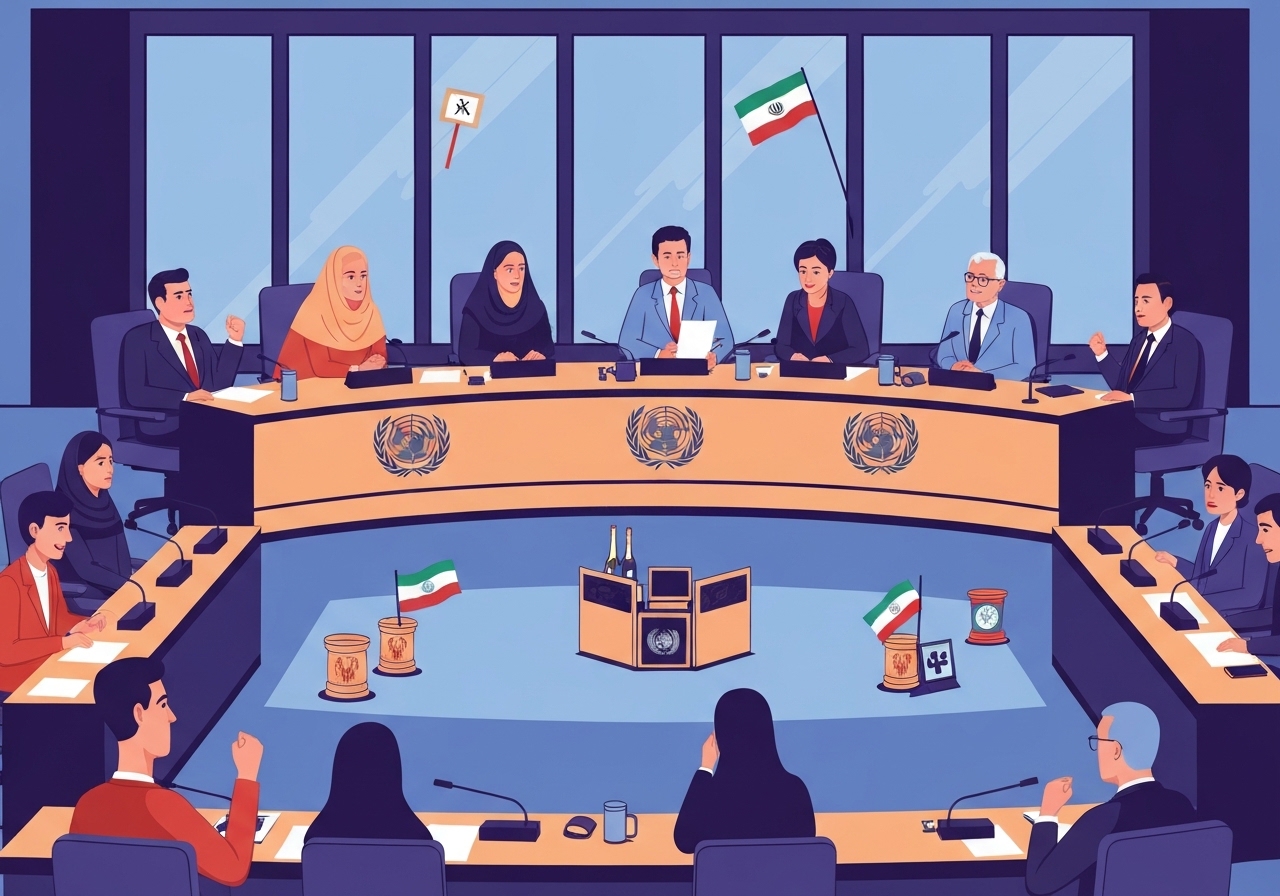
Lead: On 23 January 2026 the UN Human Rights Council held an emergency session in Geneva to examine allegations of widespread rights violations by Iranian security forces during recent nationwide protests. The Iran Fact-Finding Mission chair, Sara Hossain, presented witness testimony and digital evidence alleging torture, sexual violence and forced televised confessions. Iran’s delegation rejected the session’s legitimacy and reiterated a 3,117 death toll it attributes largely to “terrorist operations.” Delegates debated a proposal to extend the UN investigation mandate by two years and open an urgent probe into crimes tied to the latest unrest.
Key Takeaways
- The special session took place at the Palais des Nations in Geneva on 23 January 2026 following weeks of repression and internet shutdowns across Iran.
- Iran’s Fact-Finding Mission chair cited testimonial and digital evidence alleging torture, sexual violence and forced confessions aired on state television.
- The Iranian government acknowledged 3,117 deaths during the unrest and attributes 2,427 of those to “terrorist operations,” a claim disputed by rights groups.
- The UN proposal on the table seeks a two-year extension of the 2022 investigation mandate and an urgent inquiry into possible crimes for future legal proceedings.
- Several states — including China, Egypt and Qatar — argued Iran should handle investigations internally, while others urged international mechanisms for accountability.
- UN experts warned that a nationwide internet blackout has impeded documentation, delayed family verification and obstructed outside monitoring of abuses.
- Human rights organizations and former prosecutors warned of large-scale and systematic violations that could require transitional justice mechanisms.
Background
The current UN scrutiny traces back to protests that flared after the 2022 killing of Mahsa Amini, which prompted the creation of the UN fact-finding mandate. That mission has since gathered testimonies, forensic materials and digital recordings alleging a pattern of violent suppression. Iran’s internal security posture and rules on information flow have repeatedly complicated independent verification of on-the-ground events.
Iranian authorities have a history of contesting external scrutiny and emphasizing domestic remedies. Several states aligned with Tehran, along with some non-aligned countries, have opposed international intervention citing sovereignty and the need for internal investigation. The geopolitical backdrop — including tensions tied to regional conflicts and accusations of double standards at UN bodies — shaped both the timing and tone of the Geneva session.
Main Event
The special session opened with a presentation by Sara Hossain, chair of the Iran Fact-Finding Mission, who summarized witness statements and digital materials alleging severe abuses including torture, sexual violence and coerced televised confessions. Hossain also warned that medical facilities in some cities were overwhelmed after security forces fired metal pellets into crowds, producing mass casualties and a spike in eye injuries.
Iran’s UN representative rejected the council’s authority to judge Tehran’s response, repeating the government’s figure of 3,117 deaths and asserting that 2,427 deaths were the result of ‘‘terrorist operations.’’ Tehran urged states to respect its sovereignty and blamed foreign interference and armed provocateurs for the escalation.
Several delegations pressed for an immediate extension of the fact-finding mandate and the initiation of an urgent inquiry into crimes that might warrant future prosecutions. Others — including China, Egypt and Qatar — argued that Iran’s state institutions should lead any investigation and warned against what they called politicization of human rights discussions.
Analysis & Implications
The session underscores a central dilemma in international human rights work: when domestic mechanisms are viewed as insufficient, states and civil society push for multilateral investigative tools, but political divisions at the UN complicate consensus. Iran’s insistence on internal remedies, and support for that stance from a bloc of states, reduces the likelihood of an immediate Security Council referral because of likely vetoes.
Extending the fact-finding mandate would preserve evidence-gathering and keep investigative channels open for possible prosecutions or truth-seeking processes. Legal experts warn that preserving chain-of-custody for digital material and witness protection will be essential if future transitional justice or international criminal proceedings are to proceed credibly.
Economically and politically, prolonged unrest and an internet blackout deepen humanitarian and information crises. Restrictions on communications not only impede documentation of abuses but also worsen family separations and obstruct humanitarian coordination. Regionally, the debate feeds larger contestations about how the UN responds when member states accuse each other of selective attention to crises.
Comparison & Data
| Source | Reported Fatalities | Notes |
|---|---|---|
| Iranian authorities (Supreme Council) | 3,117 | Official figure acknowledged by Tehran; attributes many deaths to “terrorist operations”. |
| Rights groups / independent reports | Higher / ongoing counts | Several NGOs report additional deaths beyond the official toll; figures remain being documented amid internet shutdowns. |
The table contrasts Tehran’s official tally with higher, still-evolving counts reported by various rights groups and media. The internet blackout and restricted access make rapid reconciliation of figures difficult; investigators emphasize corroborated forensic evidence, medical records and multiple witness statements when building casualty estimates.
Reactions & Quotes
UN officials and rights experts urged immediate steps to prevent further abuses and to restore communications.
“I call on the Iranian authorities to reconsider, to pull back, and to end their brutal repression,”
Volker Türk, UN High Commissioner for Human Rights
Legal and advocacy voices framed the situation in terms of accountability and possible future prosecutions.
“We are trying to set the stage for transitional justice in Iran, for the country’s Nuremberg moment, should that come to pass,”
Payam Akhavan, former UN prosecutor
Critics of the Council’s timetable contrasted the speed of response to other conflicts with the weeks it took to convene on Iran.
“The council is always immediately ready to act, yet it took weeks for the council to even hold a session,”
Anne Herzberg, human rights lawyer and UN representative for NGO Monitor
Unconfirmed
- The Iranian claim that 2,427 of the deaths were solely the result of “terrorist operations” has not been independently verified by UN investigators and remains contested by rights groups.
- Precise nationwide casualty figures beyond the official 3,117 remain under verification due to restricted access, ongoing unrest and communications blackouts.
- Allegations that specific foreign states coordinated or supported protests have been asserted in political statements but lack corroborated public evidence at this stage.
Bottom Line
The Geneva session reflects growing international alarm over reported brutality during Iran’s protests and a split among UN members over how to respond. Extending the fact-finding mandate would keep investigative tools active and help preserve evidence that could underpin accountability, but geopolitical divisions will shape whether those tools translate into tangible legal action.
For observers and policymakers, the immediate priorities are restoring communications, ensuring medical access, protecting witnesses, and securing forensic material. Over the medium term, credible, transparent investigations — whether domestic or international — will determine whether there is accountability for alleged large-scale abuses and how the international community might assist victims and families.
Sources
- The Jerusalem Post (media) — original reporting on the UN session and statements by mission chair and delegates.
- Reuters (news agency) — contributed reporting on expert comments and context cited during the session.
- Office of the UN High Commissioner for Human Rights (UN / official) — statements and mandate information from OHCHR and UN officials.