
Lead
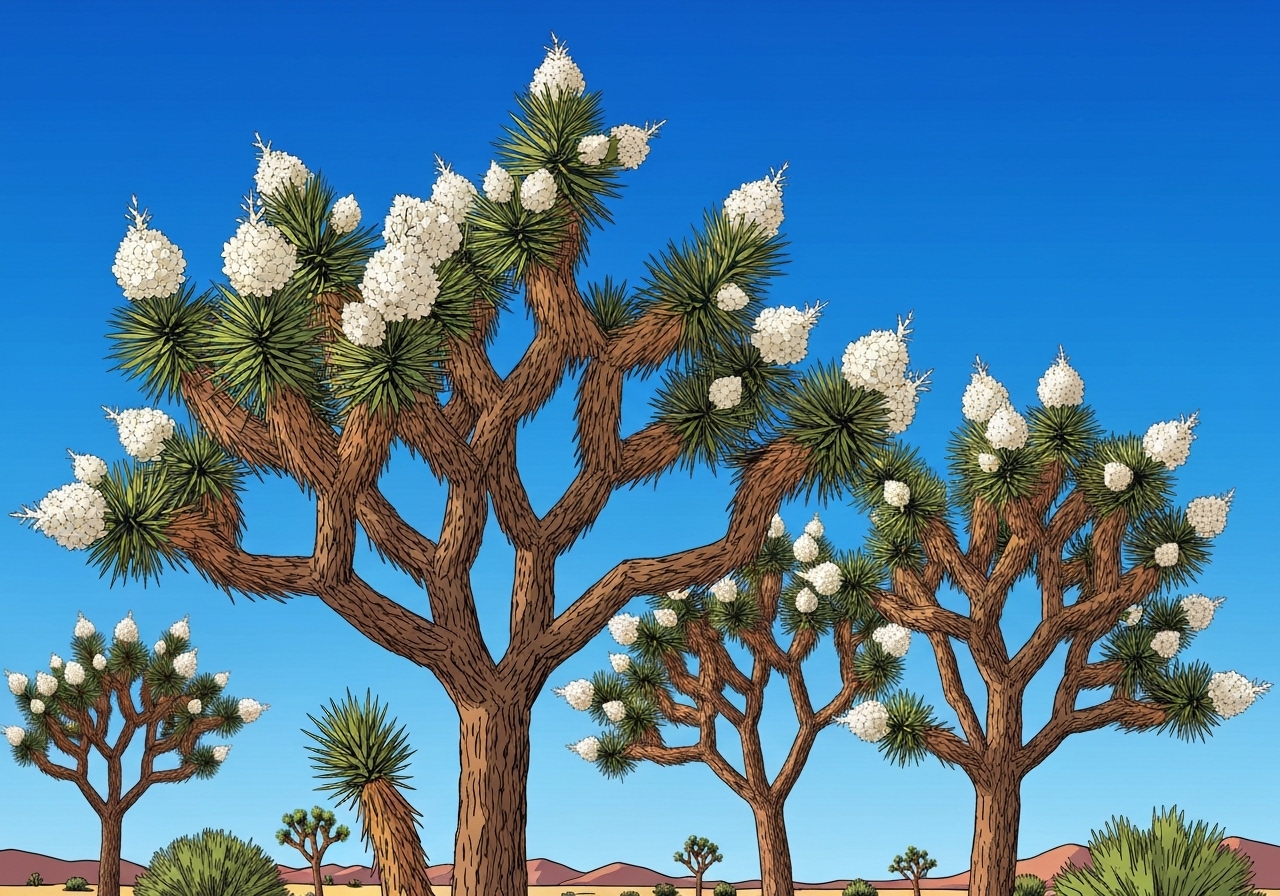
Across Southern California, Joshua trees began producing large clusters of blooms well before their normal season in 2025–26, raising concerns about disrupted timing for their sole pollinator and the trees’ capacity to set seed. Observations of flowering as early as late October and November contrast with the species’ usual bloom window from February to April. Scientists led by Jeremy Yoder at California State University, Northridge are uncertain what triggered the out-of-season flowering and are asking the public to submit photos to iNaturalist to help track whether early blooms result in fruit. The outcome matters for a species already stressed by climate change, wildfires and other threats.
Key Takeaways
- Joshua trees, native to the Mojave Desert, typically flower between February and April; this year many produced blooms as early as late October–November.
- The yucca moth is the Joshua tree’s only effective pollinator; its life cycle is tightly synchronized with the tree’s normal bloom period.
- Scientists report fewer moth observations so far, creating uncertainty whether early flowers will be pollinated and produce viable fruit.
- Researchers suspect unusual early-season rainfall as one possible trigger, but the exact environmental cues for flowering remain unknown.
- Citizen scientists are asked to upload repeat photos of individual trees to iNaturalist to document bloom timing and potential fruit set.
- An earlier, localized off-season bloom occurred in 2018 centered on Joshua Tree National Park; this 2025–26 event appears more widespread across the tree’s range.
- If early flowering becomes more frequent without matched moth emergence, trees could expend reproductive energy without producing seeds, potentially reducing resilience.
Background
Joshua trees (Yucca brevifolia) are keystone species of the Mojave Desert and depend on a tightly co-evolved relationship with the yucca moth. The moth is the tree’s exclusive pollinator, and its reproductive cycle is synchronized with the tree’s flowering so adult moths emerge and lay eggs in the open blooms. Larvae then develop within the fruit, consume some seeds, and the next generation pupates in the soil for months or sometimes years before emerging again.
Historically, Joshua tree flowering occurs primarily between February and April, a pattern used by researchers to time surveys, seed-collection and conservation actions. The trees also reproduce clonally in some locations, which can sustain local stands but does not create genetic diversity or extend range. The species faces mounting pressures from hotter temperatures, altered precipitation patterns, and more frequent wildfires — all linked to climate change — which complicate projections for its future distribution and reproduction.
Main Event
Beginning in late 2025 and extending into early 2026, observers across Southern California reported clusters of white-yellow blossoms on Joshua trees outside the usual bloom window. Photographs uploaded to the citizen science platform iNaturalist documented blooms observed as early as late October and November 2025. Field researchers and volunteers noted that whole stands, not just isolated trees in the southern range, were producing flowers.
Jeremy Yoder, an associate professor of biology at California State University, Northridge and principal investigator at the Yoder Lab, said the mismatch between bloom timing and expected moth emergence is the most immediate concern. Early-season rains are one hypothesis for triggering the bloom, since water availability can influence flowering in arid landscapes, but Yoder emphasized that the precise environmental cues for Joshua tree flowering are not yet established.
Researchers are monitoring whether the early flowers persist long enough for moths to find them and whether fruit develops and drops to the ground for rodents to disperse seeds. If moths do not appear, or appear in reduced numbers, early flowers could fail to yield seed despite the trees’ investment of resources. The Yoder Lab is combining iNaturalist observations with weather-pattern models to identify conditions associated with flowering events.
Analysis & Implications
The reproductive partnership between Joshua trees and yucca moths is obligate: the moth provides the sole pollination service, and the tree provides essential breeding habitat. A temporal mismatch — flowers opening before adult moths are active — can reduce pollination success and seed production. Over multiple years, repeated mismatches could lower recruitment of new individuals and weaken population resilience, particularly in marginal or fragmented stands.
Early flowering could also carry energetic costs. Flower and fruit production consumes carbohydrates and water; when blooms fail to yield seed, that investment offers no reproductive return and may reduce the tree’s ability to survive other stressors such as drought, heatwaves or fire. For populations already challenged by warming climates and habitat loss, wasted reproductive effort may accelerate decline in some areas.
On the other hand, if moth emergence is plastic enough to track anomalous flowering in some years, the system could tolerate occasional mismatches. The moth’s pupal dormancy — with cocoons that can remain dormant for months or years — suggests built-in flexibility, but researchers do not yet know how often and under what conditions moths break dormancy early. The broader implication is that understanding phenological flexibility in both partners is critical to predicting long-term persistence under climate variability.
Comparison & Data
| Typical bloom window | Observed early blooms (2025) |
|---|---|
| February–April | Late October–November (first reports), continuing into winter |
This simple comparison highlights the shift in timing rather than precise numeric change in bloom magnitude. Researchers plan to quantify extent and frequency of out-of-season flowering by aggregating time-stamped photos from iNaturalist and comparing them with historical observation records (including 2018 data). That will allow statistical models to link blooms with weather variables such as rainfall timing, temperature anomalies and soil moisture.
Reactions & Quotes
Yoder and his team stressed the urgency of public reporting to fill observation gaps across the species’ range. They are particularly interested in repeat photographs of the same individuals to determine whether early blooms proceed to fruit.
The moths are totally dependent on the trees. The trees have no other pollinators because the moths are so good at their job.
Jeremy Yoder, Associate Professor of Biology, California State University, Northridge (Yoder Lab)
The Yoder Lab also directly appealed to citizen scientists to contribute to an observational dataset that can be linked with climate data.
We’re looking for as many folks out there as possible to help observe this phenomenon; repeat images of the same tree are especially helpful.
Jeremy Yoder, Yoder Lab (citizen-science request)
Unconfirmed
- Whether early blooms in 2025–26 will result in significant fruit set across the population remains unknown; current reports have not yet confirmed widespread successful pollination.
- Early-season rainfall is a leading hypothesis for the trigger, but causation has not been established and other environmental cues may contribute.
- The extent to which yucca moth emergence will shift in response to early flowering is uncertain; preliminary observations suggest fewer moths so far, but systematic surveys are incomplete.
Bottom Line
The out-of-season flowering of Joshua trees across Southern California in late 2025 represents a potentially important phenological shift with direct implications for reproduction and resilience. Because the yucca moth is the tree’s exclusive pollinator, mismatches in timing can reduce seed production and, over time, weaken population recovery, particularly under the combined pressures of climate change and habitat disturbance.
Immediate priorities are systematic documentation and analysis: researchers need time-stamped, repeat photos and coordinated field surveys to determine whether early blooms yield fruit and whether moth emergence responds. Public contributions via iNaturalist, combined with targeted ecological monitoring and weather-data modeling, will help scientists assess whether this event is an anomaly or an indicator of a longer-term trend that conservation managers must plan for.