
Lead
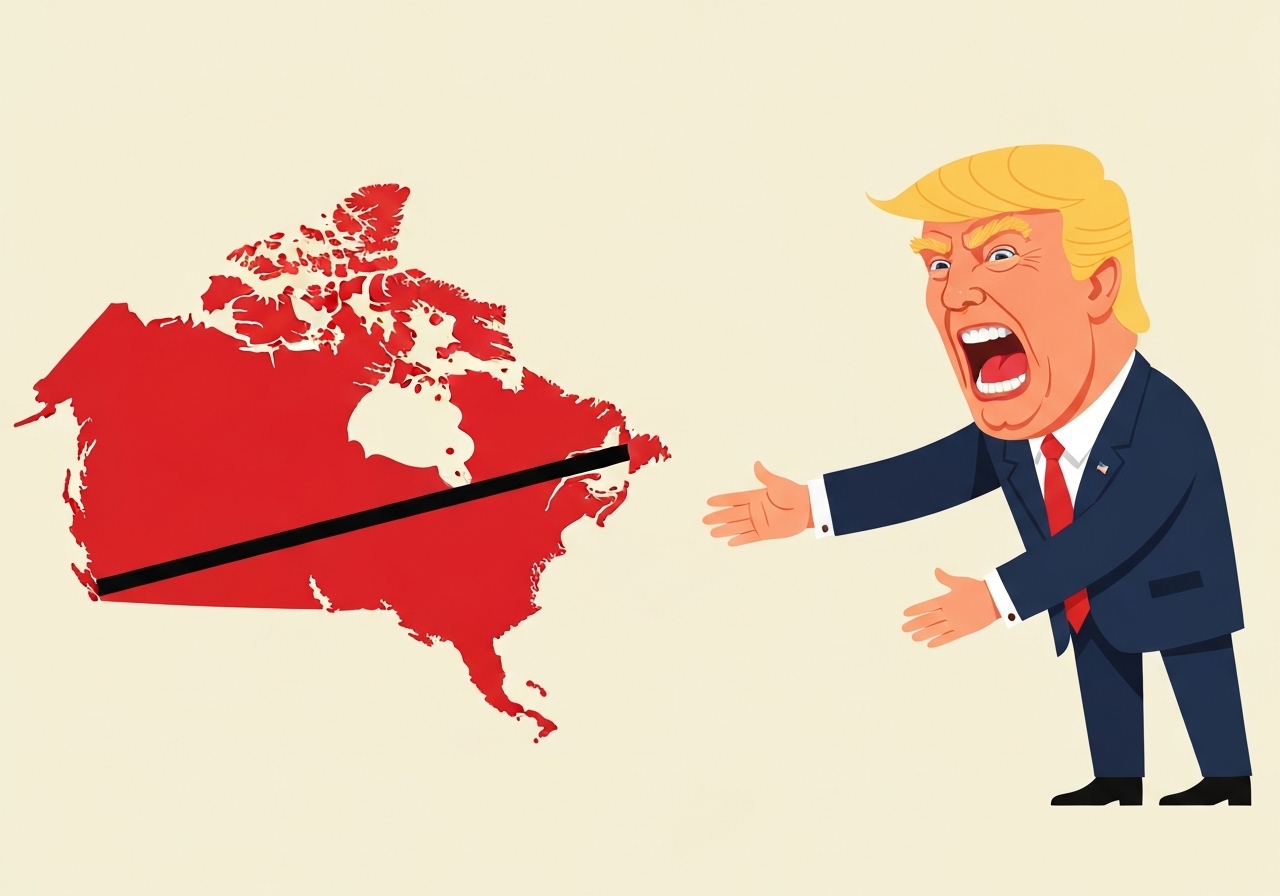
President Donald Trump warned on Jan. 24, 2026 that the United States would impose a 100% tariff on Canadian imports if Canada “makes a deal with China,” a blunt statement made on his Truth Social platform after his return from the World Economic Forum in Davos. The threat followed Canadian Prime Minister Mark Carney’s high-profile Davos speech criticizing the weaponization of economic tools and a modest Canada–China trade reset agreed during Carney’s recent state visit to Beijing. Trump initially praised aspects of that visit but then criticized Carney by referring to him as “Governor Carney,” intensifying tensions between the two countries. There is no public evidence that Canada and China are negotiating a comprehensive trade pact that would trigger the threatened U.S. response.
Key Takeaways
- On Jan. 24, 2026 President Trump posted that a “100% Tariff” would be imposed on all Canadian goods if Canada strikes a deal with China.
- Mark Carney delivered a Davos speech warning that tariffs and other economic tools are being used as coercion; his speech did not name the United States directly.
- Carney visited China last week and reached a limited agreement to lower some tariffs on Chinese electric vehicles in exchange for reduced Chinese duties on selected Canadian agricultural products.
- A senior Canadian official said Jamieson Greer, the U.S. Trade Representative, received a detailed preview of the Canada–China agreement before it was finalized.
- There is currently no independent confirmation that Canada and China are negotiating a broader or comprehensive trade deal that would justify the 100% tariff scenario described by Mr. Trump.
- The exchange marks a rare escalation between Ottawa and Washington after a public policy disagreement at the World Economic Forum in Davos, Switzerland.
Background
The spat traces to Mark Carney’s trip to Beijing and his appearance at the World Economic Forum in Davos earlier this week. In China, Carney negotiated a narrowly scoped trade arrangement aimed at easing duties on certain electric vehicles and reciprocal reductions on select Canadian agricultural exports; Canadian officials described the deal as modest rather than comprehensive. At Davos, Carney framed the global economic landscape as fractured and urged middle powers — including Canada — to coordinate responses to a new era of economic coercion.
The United States and Canada have a long, interdependent trade relationship; past U.S. administrations have imposed tariffs in disputes, most notably the 2018 U.S. tariffs on steel (25%) and aluminum (10%) that affected Canada among other trading partners. Trade tensions between allies raise the prospect of escalation that would disrupt integrated supply chains across the continent and affect industries from agriculture to automotive manufacturing. Ottawa and Washington maintain regular diplomatic and trade channels — including the office of the U.S. Trade Representative — but public rhetoric can complicate private negotiation.
Main Event
After returning from Davos on Jan. 24, 2026, President Trump published a post on Truth Social saying, “If Canada makes a deal with China, it will immediately be hit with a 100% Tariff against all Canadian goods and products coming into the U.S.A.” That message followed initial public remarks in which Mr. Trump said of Carney’s China visit, “Good for him,” but then shifted tone after Carney’s Davos speech criticized the use of tariffs as a coercive tool.
Canadian officials have said the China visit was meant to reset relations and that the resulting trade measures were limited in scope; a senior Canadian official speaking on condition of anonymity told reporters that Jamieson Greer, the U.S. Trade Representative, was given a detailed preview of the agreement before signing. The official framed the exchange with Washington as part of routine diplomatic courtesy rather than a secretive maneuver.
The episode quickly drew reactions in Ottawa and Washington. In Canada, government spokespeople emphasized the modesty of the China deal and the importance of maintaining stable relations with the U.S. In Washington, some advisers cautioned that publicly threatened tariffs of the magnitude Trump described would be unprecedented and disruptive, even if presented as a deterrent.
Analysis & Implications
Trump’s 100% tariff threat is rhetorically stark and risks creating market uncertainty. A tariff at that level would effectively halt most bilateral trade flows by doubling import prices at the border and invite retaliatory measures or lengthy legal challenges under World Trade Organization rules. Even as a threat, such rhetoric can influence investor sentiment, currency movements and cross-border supply-chain decisions.
Politically, the exchange reflects widening divergence between the two leaders on trade strategy and global economic governance. Carney’s Davos address — urging middle powers to cooperate against the weaponization of economic ties — represents a direct critique of practices that use trade measures as geopolitical leverage. That framing challenges a U.S. posture that has at times used tariffs and sanctions as tools of statecraft.
For Canada, the immediate policy calculus will focus on damage control: clarifying the scope of its China arrangements, stressing continued cooperation with the U.S., and shielding sectors most exposed to a tariff shock, including agriculture and automotive supply chains. For the U.S., publicly announcing such an extreme tariff could complicate relations with other allies and global trade partners who might fear similar measures.
Comparison & Data
| Measure | Typical Past U.S. Rate | Trump’s Threat |
|---|---|---|
| Steel tariff (2018 example) | 25% | — |
| Aluminum tariff (2018 example) | 10% | — |
| Threatened Canada-wide tariff (Jan. 24, 2026) | — | 100% (all Canadian goods) |
The table juxtaposes the 100% tariff threat with earlier U.S. tariff actions that affected allies in 2018 — 25% on steel and 10% on aluminum — to show the scale difference. While past tariffs were significant and disruptive, a blanket 100% duty would be far more severe in economic impact and political consequence. Analysts caution that legal, economic and diplomatic constraints make the realization of such a sweeping tariff uncertain.
Reactions & Quotes
Public statements and social posts have been terse and pointed from both sides. Below are representative short quotes placed in context.
“If Canada makes a deal with China, it will immediately be hit with a 100% Tariff against all Canadian goods and products coming into the U.S.A.”
President Donald J. Trump — Truth Social post, Jan. 24, 2026
Trump’s message framed the tariff as an automatic punitive measure; advisors later described the post as intended to deter a closer Canada–China trade alignment.
“Good for him.”
President Donald J. Trump — initial reaction to Carney’s China visit
This short remark shows the initial, more conciliatory tone taken by Trump after Ottawa announced elements of the China agreements before his sharp reversal following Davos.
“More recently, great powers have begun using economic integration as weapons, tariffs as leverage, financial infrastructure as coercion, supply chains as vulnerabilities to be exploited.”
Mark Carney — Davos speech, World Economic Forum, Jan. 2026
Carney’s Davos remarks formed the immediate backdrop to the dispute, articulating a broader concern about the geopolitical use of economic policy.
Unconfirmed
- There is no independent confirmation that Canada and China are negotiating a broad, comprehensive trade deal that would trigger a U.S. response as described by President Trump.
- The assertion that the U.S. Trade Representative received a full preview of the Canada–China agreement comes from a senior Canadian official who spoke on the condition of anonymity and has not been publicly substantiated by an official U.S. release.
- It is unclear whether Mr. Trump’s post reflects a formal U.S. policy decision, a negotiating posture, or a strategic attempt to influence domestic political audiences.
Bottom Line
The Jan. 24 exchange highlights a volatile moment in Canada–U.S. ties: a modest Canada–China trade adjustment and a forceful U.S. warning about the use of economic relationships as geopolitical tools. While the 100% tariff threat is dramatic, implementing such a sweeping measure would face legal, economic and diplomatic obstacles; nevertheless, the rhetoric alone raises the stakes for industries and policymakers on both sides of the border.
For observers, the key questions are whether the dispute will be contained through quiet diplomacy, whether Ottawa will further clarify the scope of its China agreements, and whether U.S. policymakers move from public threats to formal action. In the near term, markets and supply-chain planners should expect heightened uncertainty while officials in Washington and Ottawa manage both public messaging and behind-the-scenes consultations.