
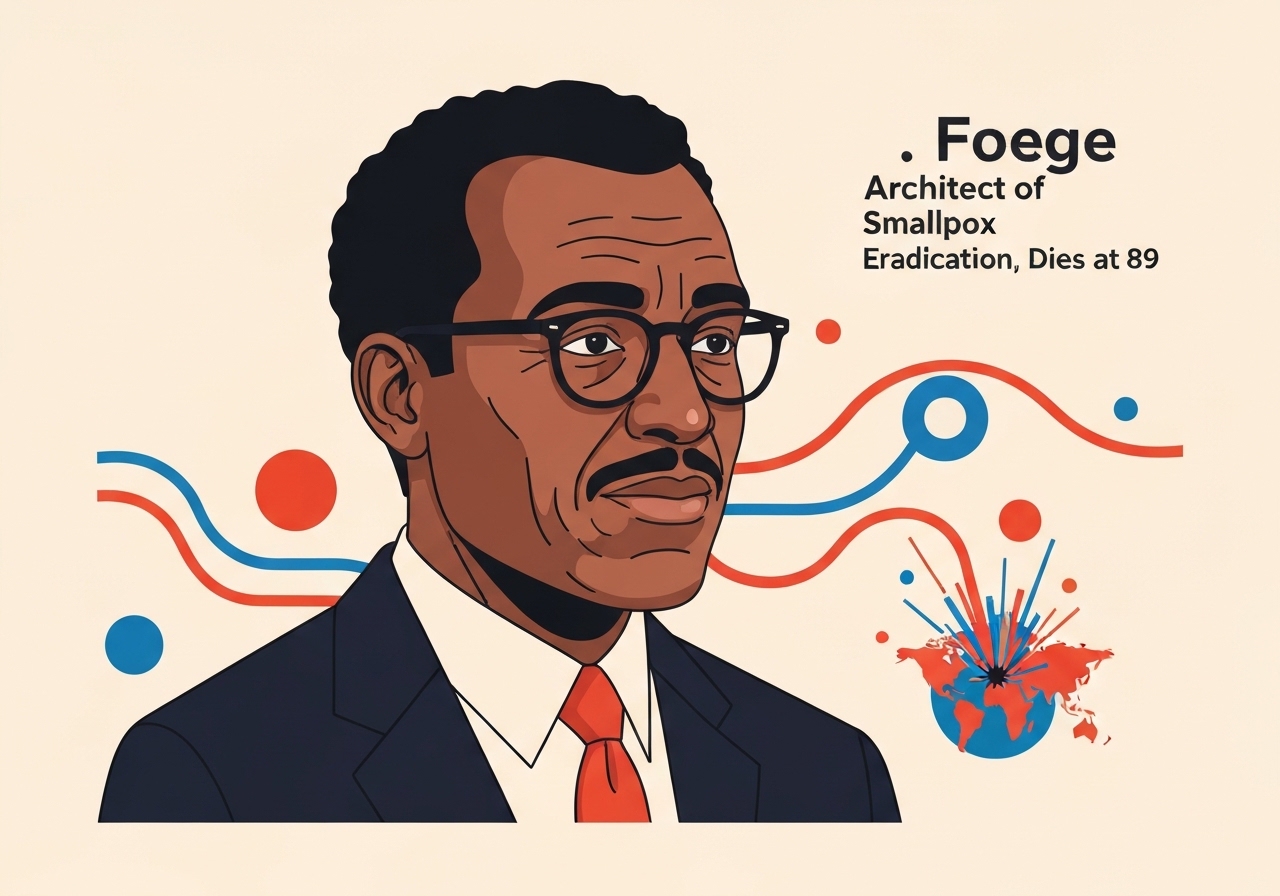
William H. Foege, the epidemiologist credited with devising the targeted vaccination approach that helped end smallpox and a former director of the Centers for Disease Control and Prevention, died at his home in Atlanta on Saturday night. He was 89. Dr. Mark Rosenberg, a longtime colleague, said the cause was congestive heart failure. Foege’s work in the 1960s and 1970s — including leadership roles at the C.D.C. and major global immunization efforts after 1983 — shaped modern public health practice worldwide.
Key Takeaways
- William H. Foege died at 89 in Atlanta on Jan. 24, 2026; cause reported as congestive heart failure by Dr. Mark Rosenberg.
- In the late 1960s and 1970s he developed and championed a targeted “ring vaccination” strategy that was central to the World Health Organization’s smallpox eradication effort.
- He served as C.D.C. director under Presidents Jimmy Carter and Ronald Reagan and left the agency in 1983 to focus on global immunization programs.
- Under his post-C.D.C. leadership, childhood vaccination rates rose sharply in many low- and middle-income countries through coordinated delivery and financing initiatives.
- He received the Presidential Medal of Freedom in 2012 for lifetime achievements in public health.
- Foege’s career linked field epidemiology, public health leadership, and advocacy on issues beyond infectious disease, including injury prevention and gun violence.
Background
Smallpox was a centuries-old scourge; by the mid-20th century it remained endemic in parts of Africa and Asia and killed millions across decades. In 1966 the World Health Organization launched an intensified global eradication program, mobilizing resources and personnel to interrupt transmission. Traditional mass-vaccination campaigns were costly and logistically difficult in some settings; Foege, then working as a missionary physician in Africa and later with field teams, helped refine a different approach.
Foege advocated identifying cases quickly and vaccinating the immediate contacts and surrounding community — a focused strategy that conserved vaccine and manpower while stopping chains of transmission. That method, often called ring vaccination, was implemented across challenging conditions in West and Central Africa and became a central tactic of the W.H.O. effort. The program’s momentum culminated in the last known naturally occurring smallpox case in 1977 and formal certification of eradication by the W.H.O. in 1980.
Main Event
The immediate news is Foege’s death in Atlanta on Jan. 24, 2026; colleagues described him as a towering figure physically and professionally. Tall and soft-spoken, he combined field experience from Africa with administrative leadership at the C.D.C., where he broadened the agency’s focus to include major causes of preventable death beyond infectious disease. During his tenure he pushed the C.D.C. toward injury prevention and research on violence, positions that at times put the agency at odds with political and interest groups.
After leaving the C.D.C. in 1983, Foege turned his energies to expanding routine childhood immunization worldwide, helping design programs that increased vaccine coverage in low-resource countries. His work bridged donors, national ministries of health, nongovernmental organizations and technical agencies to build delivery systems rather than only supply vaccines. The result was sustained improvements in immunization levels in many regions over subsequent decades.
Foege also played an early U.S. public health role during the emergence of AIDS, guiding agency responses and offering veteran judgment amid a rapidly changing epidemic. Public health leaders across administrations continued to seek his counsel; in 2012 President Barack Obama awarded him the Presidential Medal of Freedom in recognition of his lifetime contributions to population health. Colleagues say his combination of fieldcraft, humility and strategic thinking is rare in the discipline.
Analysis & Implications
Foege’s principal methodological legacy — targeted, ring-based vaccination and rapid case containment — demonstrates how adaptive strategies can succeed where broad, resource-intensive approaches might falter. That lesson remains relevant for contemporary outbreak control, including responses to diseases where vaccines are limited or logistics are difficult. The smallpox campaign showed that strong surveillance, rapid response teams and community engagement are as important as the vaccine itself.
Institutionally, Foege helped model a public health agency that combines science, program delivery and policy advocacy. His push to address injuries and violence expanded the C.D.C.’s remit beyond infectious disease and established precedent for the agency to study politically sensitive issues when evidence suggested large public health burdens. That posture, however, also exposed the agency to political pressure — a tension current and future C.D.C. leaders still navigate.
Globally, Foege’s post-1983 work demonstrated that technical fixes must be embedded in financing, logistics and governance. Increasing childhood immunization coverage required not only vaccines but cold chains, trained workers, predictable financing and local political commitment. His approach — marrying technical design with system building — remains a blueprint for scaling other interventions such as routine noncommunicable disease screening and new vaccine introductions.
Comparison & Data
| Year | Event | Note |
|---|---|---|
| 1966 | W.H.O. launches intensified smallpox eradication program | Program prioritized surveillance and targeted vaccination in endemic areas. |
| 1977 | Last known naturally occurring smallpox case (Somalia) | Marked the practical end of endemic transmission. |
| 1980 | W.H.O. certifies global eradication of smallpox | Smallpox became the first disease eradicated by human effort. |
The table highlights the condensed timeline from program launch to global certification. Those milestones reflect decades of fieldwork, evolving tactics such as ring vaccination, and international coordination. Foege’s contributions fit into this sequence as a practical innovation that improved efficiency and feasibility in difficult settings.
Reactions & Quotes
“Basically, he was the ‘Babe Ruth of public health’ — a once-in-a-generation figure whose fieldwork and judgment set a standard.”
Dr. Thomas R. Frieden (former C.D.C. director)
Dr. Frieden’s remark underscores how peers viewed Foege’s outsized influence on the practice of public health, comparing him to an iconic figure in another field to convey rarity and impact.
“His passing removes a steady hand from the field; he combined field experience with administrative clarity,”
Dr. Mark Rosenberg (colleague)
Rosenberg provided the immediate cause-of-death information and emphasized Foege’s long-term role advising public health leaders across administrations.
“The smallpox program showed what surveillance and targeted vaccination can achieve when paired with political will and community trust,”
Public health official (statement)
This reaction reflects institutional recognition that Foege’s tactical innovations worked because they were implemented within coordinated programs and local engagement, not solely because of a single technique.
Unconfirmed
- Reports that Foege alone convinced all national programs to adopt ring vaccination are oversimplified; multiple field teams and national authorities also shaped implementation.
- Details about private internal discussions at the C.D.C. during policy disputes with Congress over gun violence remain incompletely documented in public sources.
- Attributions that credit any single individual with the entire rise in global childhood vaccination rates after 1983 overlook the contributions of ministries of health, donors and other agencies.
Bottom Line
William H. Foege’s death closes a chapter in public health history defined by practical innovation, programmatic scaling and sustained advocacy. His ring-vaccination approach directly contributed to a rare global success: the eradication of smallpox, certified in 1980, and his subsequent work helped broaden access to routine immunization in many countries.
Beyond the technical wins, Foege’s career illustrates enduring lessons: the importance of connecting field methods to systems, the need for evidence-driven advocacy inside public institutions, and the political fragility of public health gains. For policymakers and practitioners, his legacy is both a proof of concept and a mandate to invest in surveillance, delivery systems and global cooperation.
Sources
- The New York Times (Press report on his death and career)
- World Health Organization (Official background on the smallpox eradication program)
- Centers for Disease Control and Prevention (CDC) (U.S. federal public health agency; institutional context and historical records)
- White House Archives (Official record of Presidential Medal of Freedom awards)