
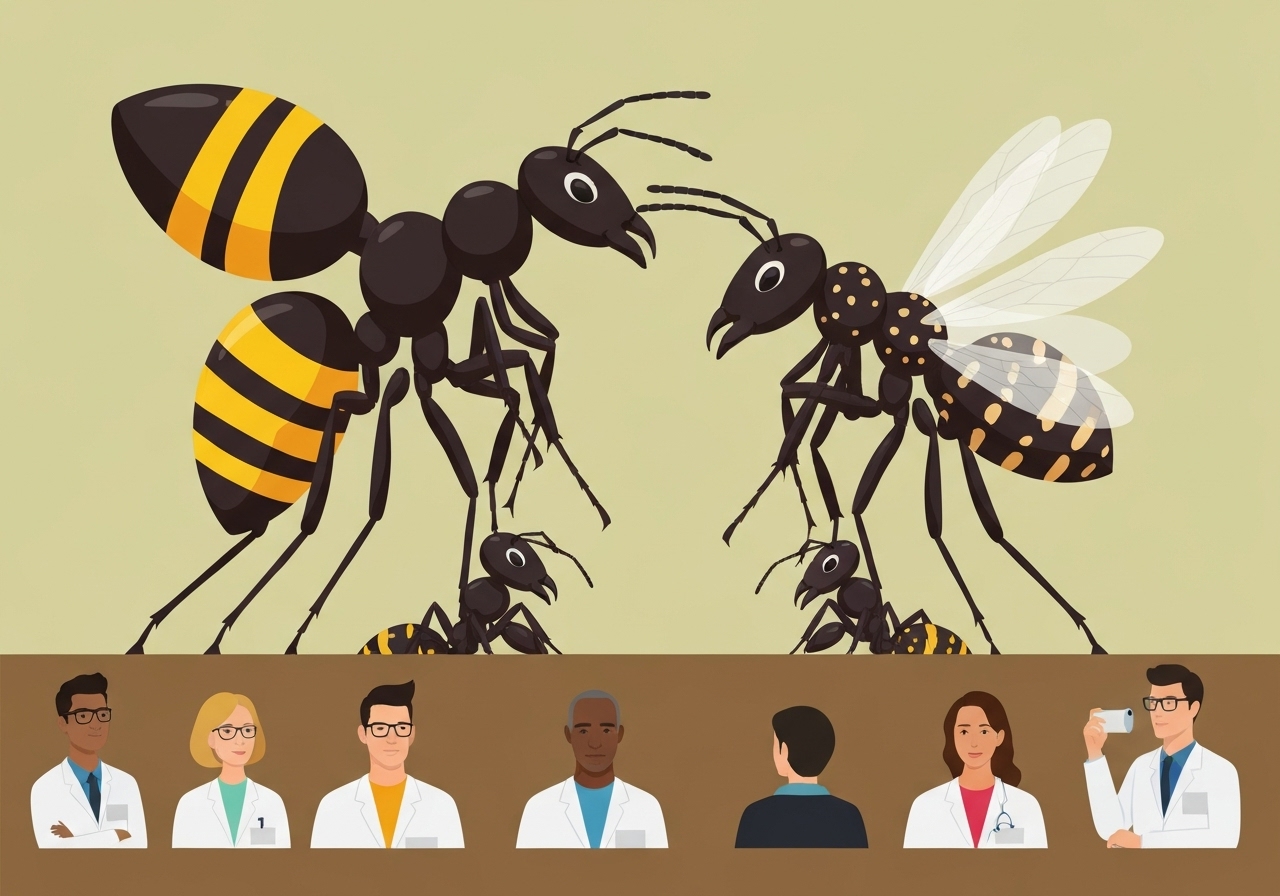
Lead: A study published in Nature on 6 September 2025 reports that some Iberian harvester ant queens on Sicily (Messor ibericus) produce two genetically distinct types of offspring—hairy M. ibericus and hairless M. structor males—creating colonies where a single queen mothers members of both species and hybrid workers.
Key takeaways
- Iberian harvester queens (Messor ibericus) on Sicily produce males that are genetically Messor structor, a species whose nearest wild populations are >1,000 km away.
- The same queen can also produce M. ibericus offspring and hybrid workers by mating with males present inside the colony.
- M. structor males produced in the colony are clonal, share the queen’s mitochondrial DNA, and match M. structor genomes despite morphological differences.
- Researchers describe the system as a form of “sexual domestication,” where one species effectively controls the reproduction of another.
- The two lineages diverged >5 million years ago, yet now form a functional two-species superorganism.
Verified facts
The study, reported in Nature (Juvé et al., 2025), examined colonies of Messor ibericus on Sicily and combined morphological assessment with genetic sequencing. Analyses show that some queens produce males whose nuclear genomes match Messor structor while all individuals in the colony share the queen’s mitochondrial DNA.
Reproductive behavior observed and inferred from genetic patterns indicates multiple reproductive routes: queens can reproduce clonally to make daughter queens, fertilize eggs with M. ibericus sperm to produce new queens, or use sperm from M. structor males—produced inside the colony—to produce workers. Workers are hybrids of the two genomes.
A comparative summary:
| Trait | M. ibericus (queen line) | M. structor (male clones) |
|---|---|---|
| Morphology | Hairy | Hairless |
| Genomic identity | M. ibericus nuclear DNA | M. structor nuclear DNA |
| Mitochondria | Shared (queen’s mtDNA) | Shared (queen’s mtDNA) |
| Geographic nearest wild population | Local (Sicily) | >1,000 km away |
Genetic dating places the split between the two species at over 5 million years ago. Despite deep divergence, the colony-level arrangement makes M. structor males functionally dependent on M. ibericus queens in these Sicilian populations.
Context & impact
Researchers frame this arrangement as blurring traditional species boundaries and altering concepts of individuality in social insects: a single colony behaves as a two-species superorganism where reproduction is partitioned by role (queens vs workers vs clonal males).
The mechanism removes the need for queens to locate unrelated mates from the wild: by producing clonal M. structor males internally, queens retain access to a distinct nuclear genome for worker production without relying on external populations.
Implications include a new model for how genomes and social roles can be combined across lineages, with potential lessons for understanding reproductive parasitism, genome co-option, and the evolution of social organization.
Official statements
“It’s an absolutely fantastic, bizarre story of a system that allows things to happen that seem almost unimaginable,”
Jacobus Boomsma, evolutionary biologist (quoted in Nature coverage)
“These M. structor males appear to have become an integral part of M. ibericus populations rather than simple hybrids,”
Jessica Purcell, News & Views (Nature)
Unconfirmed
- Historical origin: the precise sequence of events by which M. ibericus first acquired M. structor genomes (for example, an ancestral hybridization event or repeated captures) remains inferred rather than directly observed.
- Geographic dynamics: whether M. structor historically had closer populations to Sicily or was introduced remains unresolved.
Bottom line
The Nature study documents a rare and striking reproductive system in which single ant queens produce offspring that belong to two deeply diverged species, producing hybrid workers while retaining clonal male lineages of a second species. This arrangement challenges conventional species boundaries and offers a novel example of how social insects can restructure reproduction to combine genomes and roles within a single colony.